Wholesale pricing on LED mesh screens is decided by four variables that have nothing to do with pitch: the supply form you buy (bare module, kit or finished panel), the module length your warehouse and container can take, the RGB configuration locked into the unit, and how much of the order is custom.
Two distributors can request the same 400 m² of P25 and receive quotes 30% apart, because one asked for bulk modules and the other asked for assembled panels with drivers. This guide sets out what each variable does to your landed cost, where the real minimum order sits, and which six numbers you need to send before any supplier can quote you honestly. Two further variables are not in the product at all: the certificate the destination market will accept, and the night-time luminance its ordinances allow.
Before you read
This page covers supply terms for distributors, integrators and contractors buying in volume. If you are specifying a single facade and need to know whether a mesh screen suits the building at all, start with how to choose an outdoor LED mesh screen instead. Electrical and optical figures come from the published MEKALEO MDL-Grid table, revision November 2026. Where a figure is a worked example or an assumption, it is labelled as one.
1. The three LED mesh screen supply forms, and who carries the risk in each
One factory will quote three different products against the same drawing, and the spread between them is not margin. It is assembly labour, electrical matching, burn-in and pre-delivery test, moved from their floor to yours. On a 400 m² P25 order that spread is wide enough to make the cheaper quote the more expensive project.
So the first question to any supplier is not price. It is which of the three forms below the price refers to, answered on the quotation document rather than in the covering email.
Form A — bare module
You receive the LED cell as it leaves the line: frame extrusion, PCB, LED packages, driver ICs, connectors. No power supply, no receiving card, no mounting brackets, no cable loom. This is the cheapest per square metre and the only form that makes sense if you already run an assembly operation with a soldering bench, a burn-in rack and a QC process.
What you take on: sourcing and matching drivers to the load, wiring the DC distribution, waterproofing every field joint, testing every panel before it leaves your facility, and owning the warranty claim when a customer’s installation fails because a connector was not potted correctly.
Form B — kit
Modules plus the matched power supplies, receiving cards, data cables and mounting hardware, packed by facade section rather than by component type. You assemble; the factory has done the electrical matching and the bill of materials.
This is the form most integrators should be buying. It removes the two failure modes that cost the most to fix — undersized power supply and incompatible receiving card — while keeping the labour that you can actually do profitably in your own workshop.
Form C — finished panel
Assembled, wired, powered, burned in and tested, delivered as a panel you hang on a bracket. The factory carries assembly labour and the pre-delivery test. You pay for it, and you pay for the volume that the crate occupies.
Form C is correct when the installation site has no workshop, when the schedule leaves no assembly window, or when your own labour cost per square metre is higher than the factory’s.
| What you specify | Bare module | Kit | Finished panel |
|---|---|---|---|
| Unit price | Lowest | Mid | Highest |
| Freight per m² | Lowest | Mid | Highest — crates are bulky |
| Your assembly labour | Highest | Mid | Lowest |
| Factory pre-test | No | Partial | Full burn-in |
| Who owns a field failure | You | Shared | Factory |
| Typical buyer | Screen assembler | Integrator | Contractor, no workshop |
Three questions that settle which form you should buy
Do you have burn-in capacity? Electronic assemblies fail on an infant-mortality curve: the units that would have failed in their first days of running fail in their first days of running, wherever that happens. On a facade that failure is a callout at height with a crane or a rope access team. In your workshop it is a swap off a shelf. If you cannot run modules under load before dispatch, buy Form C and let the cost sit in the unit price.
Can you test to a stated numeric standard? Ask any factory, including this one, for acceptance criteria in numbers: maximum dead pixels per module, luminance uniformity as a percentage across the module, burn-in duration at rated load, and colour tolerance between adjacent modules expressed in ΔE. A supplier who cannot put numbers on those four has a habit rather than a process, and Form A or Form B moves that process, plus the warranty exposure behind it, onto your floor.
Is your assembly labour cheaper per square metre than the factory’s? Compare your fully loaded hourly rate, with bench space, test equipment and rework included, against the gap between Form A and Form B pricing. If the gap is smaller than your loaded assembly cost, Form A adds risk without adding margin.
2. Module length sets your freight cost more than pitch does
Module length is a harder constraint than pitch, and it is the one buyers check last. Pitch changes how the screen looks. Module length decides whether the crate fits your warehouse door, your goods lift and the container, and none of those three can be changed after the order is placed.
The constraint is hard: the internal length of a 40HQ container is 12.03 m. Anything longer than that ships as open-top, flat-rack or break-bulk, and the freight rate stops being a container rate.
Published module sizes
| Pitch | Max module size | Pixels per module | Fits 40HQ with margin |
|---|---|---|---|
| P15.625 | 0.5 m × 6.25 m | 64 × 64 | Yes — 5.8 m spare |
| P20 | 0.4 m × 8.0 m | 50 × 50 | Yes — 4.0 m spare |
| P25 | 0.5 m × 10.0 m | 40 × 40 | Yes — 2.0 m spare |
| P50 | Custom, 20 × 20 px | 400 per m² | Custom — confirm length in writing |
| P62.5 | Custom, 16 × 16 px | 256 per m² | Custom — confirm length in writing |
| P83.3 | Custom, 12 × 12 px | 144 per m² | Custom — confirm length in writing |
How the module length changes the container count
A 40HQ measures 12.03 m × 2.35 m × 2.69 m internally: about 76 m³ and a 26.5 t payload. On this product the payload almost never binds — 400 m² of P25 weighs 3.3 t — so what you are buying is volume, and the number that governs the freight is cubic metres per square metre of screen.
Work it through for a 400 m² facade at P25, where the published module is 0.5 m × 10.0 m:
Each module stands on edge in a cradle: 10.0 m long, 0.5 m high, and around 0.12 m thick once foam and frame are counted. That is 0.6 m³ per module and 48 m³ for the order — roughly two thirds of a 40HQ. The crate frame adds 80–150 mm at each end of every bay, so a 10.0 m module leaves about 1.8 m of container length unusable.
Run the same 400 m² at P20, module 0.4 m × 8.0 m, 125 modules. Each is 0.38 m³, so 48 m³ again: the same freight volume, in 125 pieces instead of 80, with 3.8 m of dead length per bay instead of 1.8 m. A shorter module does not buy you freight. It buys you handling — more crates to open, more modules to lift, more joints at height.
The freight question to ask
Ask for cubic metres per square metre of screen, not the container count. At 0.12 m³ per m², a 1,000 m² order is about 120 m³ — two 40HQs. A supplier quoting one container for that area is either packing more tightly than the description says or shipping a thinner module. Container counts hide how much of each box is air, and on this cargo air is most of what you pay for: 3.3 t of product against a 26.5 t payload.
Do not cut a module on site
A 10 m P25 module is a sealed unit. Cutting it to fit a 6 m warehouse opens the extrusion, breaks the factory moisture seal and turns a factory joint into a field joint — which is exactly the joint that fails two winters later. If your storage length is under 10 m, order the P20 at 8.0 m or specify a shorter custom module at the time of order. Never resolve it with a saw.
3. The RGB configuration trap in every wholesale quote
Open any two wholesale quotations for “P50 mesh screen” and the square-metre power figure may differ by a factor of more than two. Neither supplier is lying. The pitch does not fix the power — the LED package does.
In the published specification, P50 is listed at 120 W/m² to 288 W/m². P62.5 runs 76.8 to 184.3 W/m², and P83.3 runs 43.2 to 103.7 W/m². The range exists because the same grid extrusion can be populated with one RGB package or two.
| Pitch | LED package | Power range | Voltage | Brightness |
|---|---|---|---|---|
| P15.625 | SMD3535 (8RGB) | 614.4 W/m² | DC 24V | 3,000–5,000 nits |
| P20 | SMD3535 (6RGB) | 375 W/m² | DC 24V | 4,400 cd/m² |
| P25 | SMD3535 (4RGB) | 240.0 W/m² | DC 24V | 2,800–3,500 nits |
| P50 | SM3535 (1RGB / 2RGB) | 120–288 W/m² | DC 12V | 1,420 cd/m² (2RGB) |
| P62.5 | SM3535 (1RGB / 2RGB) | 76.8–184.3 W/m² | DC 12V | 896 cd/m² (2RGB) |
| P83.3 | SM3535 (1RGB / 2RGB) | 43.2–103.7 W/m² | DC 12V | 504 cd/m² (2RGB) |
Power is the variable that propagates furthest. It sets the transformer kVA a distributor must hold, the cable cross-section the installer pulls, the number of injection points per facade section, and the metered operating cost the end client sees in year two. A 400 m² P50 order at 120 W/m² draws 48 kW. The same order at 288 W/m² draws 115 kW, and 115 kW does not sit on the transformer that was sized for 48.
Working backwards from the brightness the client needs
When the distributor cannot specify the configuration, the client’s brightness target decides it — provided the target is stated in the unit the specification uses. Nits and candela per square metre are the same quantity, so a brief written in nits and a table written in cd/m² are directly comparable. A brief written in lumens is not, because lumens describe total output rather than output per unit of area, and a 10,000 lumen fixture tells you nothing about what a square metre of facade will look like at noon.
In the published table the figures are per configuration, not per pitch: P50 at the two-RGB configuration is 1,420 cd/m², P62.5 at the same configuration is 896 cd/m², and P83.3 is 504 cd/m². Quoting the P15.625 peak of 7,200 cd against a P83.3 brief is the most common way two suppliers end up describing the same word — “bright” — with numbers 14× apart.
| Viewing condition | What drives the configuration | Practical consequence |
|---|---|---|
| Daylight, street distance | High ambient requires 2RGB | Upper end of the power range, larger transformers |
| Daylight, distant viewpoint | 1RGB often sufficient at low pixel density | Lower power, smaller injected current |
| Night only, decorative | Dimming headroom matters more than peak | 1RGB, but confirm the dimming curve |
| Night only, media content | Colour accuracy at low output | 2RGB for grayscale stability |
Ask for the brightness figure at the configuration quoted, not the peak figure for the pitch. A peak number taken at the highest configuration the pitch allows does not describe the product you are buying.
Quote a P50 at 120 W/m², take delivery of the two-RGB version at 288 W/m², and the facade draws 2.4× the budgeted load. The transformer, the cable and the metering were sized for the smaller figure, and none of the three is a cheap replacement. Put the RGB configuration on the purchase order as its own line, with the W/m² that goes with it.
Refresh rate, grayscale and IP: the part of the configuration quotes leave out
Two quotes can both read “P25, 1,600 dots/m², 240 W/m²” and still describe different products. The published table separates the two families on three further attributes that almost never appear in a wholesale quotation.
| Attribute | P15.625 to P25 | P50 to P83.3 | What it changes for your customer |
|---|---|---|---|
| Refresh rate | 3,840 Hz | 4K / 3,840 Hz | Below about 1,920 Hz a camera sees banding on the facade. Broadcast, event and photo-facing projects need the figure in writing. |
| Grayscale | 16-bit | 256-level | Low-output rendering. A night-time facade spends most of its life well below peak, so this is the number the client actually looks at. |
| Ingress protection | IP66 to IEC 60529 | IP66 to IEC 60529 | In IP66 the second digit is powerful water jets, not immersion. All six pitches carry it, so it is a baseline to verify in writing rather than a differentiator to sell. |
| Housing fire class | UL94-V0 | UL94-V0 | A tender that asks for a fire class is asking about the extrusion and the PCB substrate, not about the LED package. |
Two consequences. A quote that names only pitch and pixel density has not described a comparable product, because refresh rate and grayscale depth are exactly where a cheaper bill of materials hides. And the IP rating belongs to the module, not to the assembly: the connector, the gland and the potting are what fail in service, and none of them are inside the module’s IP66 test. Ask what the field joint is rated to once it is made on site.
Rule for wholesale buyers. Never accept a quote that gives pitch without giving W/m² and the RGB configuration. If a supplier writes “P50, 400 dots/m²” and nothing else, you do not yet have a specification — you have a shape.
Night-time brightness limits are a market parameter, not a product one
The same screen can be compliant on one elevation and non-compliant four hundred metres away, because night-time luminance is capped by local ordinance rather than by the specification. This is the one configuration variable a wholesale buyer cannot read from a datasheet, and the one that most often turns a delivered order into a retrofit.
| Where the rule appears | Typical form of the limit | What it forces on the order |
|---|---|---|
| Taiwan, LED sign boards | 25 m² and above: 250 cd/m² maximum between 19:00 and 06:00. Under 25 m² or non-LED boards: 300 cd/m² | A scheduled night scene, not a manual dim |
| US municipal lighting ordinances | Automatic reduction to 100–150 nits from 30 minutes after sunset to 30 minutes before sunrise; 200 nits where ambient light is already high | Photocell or astronomic time clock wired into the controller |
| Residential-facing elevations | Operation prohibited from around 23:00 until dawn where the face is visible from housing | Curfew scheduling in the control system, and a client who will maintain it |
| Zoning-based caps | Rural zones near 20 nits, suburban near 40, high-ambient commercial 160 and above | Two configurations for one product line if you sell into mixed districts |
| Content change rate | Often one message change per 60 seconds or slower | Player settings, written into the handover |
Two technical consequences follow, and both land on the supplier rather than the buyer.
The first is dimming depth. The published P15.625 configuration peaks at 7,200 cd/m². Driving that to 100 nits is a 72:1 reduction. At that depth the viewer is no longer seeing brightness, they are seeing grayscale resolution, and the two families differ: P15.625 to P25 is published at 16-bit, while P50 to P83.3 is published at 256-level. A 256-step ramp spread across the full output range leaves very few distinct steps inside the bottom 1.4% of it, which is where a night-capped facade lives. If the destination market caps night luminance, the grayscale figure matters more than the peak figure — the reverse of how quotations are usually compared.
The second is control architecture. Manual dimming does not satisfy these ordinances, because the requirement is that the reduction happens automatically and can be evidenced. A permit application commonly asks for the maximum luminance of the face and the method that brings it down by a stated hour. A screen delivered with a brightness slider and no schedule is, in those jurisdictions, an unpermitted installation that happens to work.
Ask before you quote, not after
Ask the buyer which zoning district the elevation sits in and whether the face is visible from housing. A distributor who quotes one configuration into a residential-view district is quoting a product that will have to be dimmed to a level its grayscale cannot render cleanly.
4. The density cliff at P50, and why it changes the whole system
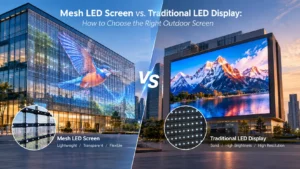
Between P25 and P50 the product changes category. It is not a coarser version of the same screen. Weight falls by a factor of 5.3, optical transparency jumps from 24.0% to 80–85%, and the operating voltage drops from DC 24V to DC 12V.
That step has direct consequences for what a distributor should hold in stock:
- P15.625 to P25 are the same family — SMD3535, DC 24V, 8.2 to 10.2 kg/m², transparency 24–39%. They share driver families and mounting brackets. One bracket SKU can serve all three.
- P50 and coarser are a separate family — SM3535, DC 12V, 0.78 to 1.54 kg/m², transparency 80% and above. Different power supplies, different brackets, different injection distances. Holding both families means holding two service kits.
If you stock only one, stock the P15.625–P25 family. It covers the majority of medium and large facades where the viewing distance is under 120 m. Reach for P50+ when the building has a strict structural allowance, when the client cannot lose daylight, or when the facade is being retrofitted onto an existing curtain wall that was never designed for additional dead load.
The three situations that force you onto P50 or coarser
Structural allowance under 5 kg/m². There is no negotiation here. If the engineer’s written allowance excludes the 8.2 kg/m² of P25, the screen is a P50 or the project is an independent frame — and the frame brings its own weight back into the same calculation.
Daylight transparency is a stated requirement. P25 at 24.0% transparency blocks roughly three quarters of the light. On an office facade where occupants sit behind the glass, that is usually unacceptable. P50 at 80–85% is a different proposition entirely, because at that transparency the screen reads as a veil rather than a wall.
The client is keeping the existing glazing and adding the screen. This is the retrofit case. A screen added to a finished facade has to work with what is there, and 24% transparency on a building that was designed to be fully glazed will be rejected at the visual mock-up stage.
Do not sell transparency as a premium feature
Transparency in this product family tracks pixel density almost mechanically — 4,096 dots per square metre cannot be more than 39.2% transparent, and 144 dots per square metre will exceed 88%. If a customer asks for high transparency, they are asking for a coarser pitch and a lower resolution. Confirm which of the two they actually need before quoting, because the price difference between them is large and the decision is not reversible after fabrication.
5. What actually sets the minimum order
Distributors usually assume MOQ is a function of area. It is not. Area only sets the price band. The binding constraint is SMT changeover plus burn-in rack capacity, and both are counted in boards, not square metres.
Three practical consequences follow:
- One configuration, more area, beats several configurations at the same area. If your order splits across four pitches and two RGB variants, each split pays its own changeover.
- Standard module lengths avoid a tooling step. 6.25 m, 8.0 m and 10.0 m are published sizes. A custom 7.4 m module is a new extrusion set-up.
- Spares should be ordered inside the same run. Modules bought six months later come from a different SMT batch, and batch-to-batch colour drift on a facade is visible at dusk.
Batch consistency is a wholesale problem, not a manufacturing one
LED binning changes between production runs. Two modules made three months apart, both within the published specification, can differ visibly when driven at 20% brightness across a single facade. The specification permits it; the client will not accept it.
The practical rules for a distributor holding stock:
- Keep a batch record by order, and record which batch went to which project. When a replacement is needed in year three, you need to know which batch to match.
- Do not mix batches within a single facade section, even if the modules are otherwise identical.
- When you must mix, mix them at a section boundary where the human eye already expects a break, never in the middle of a continuous surface.
- Order the spares for a project at the same time as the project, and label the crate with the project name rather than the part number.
6. When 7–15 days is real, and when it is not
Lead time claims in this category are usually quoted as a single number. That number is only meaningful against a specific configuration. Below is how the clock actually divides.
Questions worth asking before you commit the date to your own customer:
- Does the 7–15 days start from purchase order or from drawing approval? The gap is usually 2–4 days.
- Is the quantity in the quote one production run? A 500 m² order split across two runs takes two windows.
- Who files the export documents, and does the window include them?
What pushes a standard order past 15 days
The published window describes a normal production run at a normal time of year. Four conditions extend it, and all four are predictable if you ask before ordering:
| Condition | Effect on the window | How to avoid it |
|---|---|---|
| Order placed during pre-holiday peaks | Production slot queues behind existing bookings | Book the slot, not just the order |
| Custom RAL on the extrusion | Coating queue adds a step outside the window | Use published colours, or accept the delay |
| Third-party driver specified | Lead time now depends on another supplier | Accept the factory’s matched driver, or stock your own |
| Quantity split across two runs | Two windows, sequenced | Merge into one run, or order the second run early |
Ask which of the four applies to your order, and ask about the production schedule rather than about the delivery promise. A supplier who can name the week their line is booked through is giving you a checkable fact. A supplier who repeats the catalogue window has told you nothing about your order.
7. Packaging, condensation and the spares ratio
Two things ruin a mesh screen in transit that no specification table mentions: condensation inside the crate, and a packing method that loads the module face against a hard surface.
Condensation
A sealed crate crossing a climate band carries warm humid air into a cold hold. The water condenses on the coldest surface, which is the aluminium extrusion and the exposed PCB edge. Desiccant has to be calculated, not guessed: ask for the dosage in grams per cubic metre of crate volume, and the voyage length the figure was calculated for. A number that was set for a two-week coastal run does not hold for a 45-day routing with two transhipments.
Where the calculation cannot be produced, three physical measures do the same job more slowly: a foil-lined crate, individual module bags, and VCI film on any bare aluminium or connector pin. Condensation damage is not visible at delivery. It appears as corrosion on the connector pins, and it appears in the second rainy season.
Packing method
Modules travel on edge in a foam-cradled frame, never stacked face-down. A 10.0 m module face-loaded on a flat pallet shows pressure marks on the PCB after a sea voyage, and those become permanent bright or dark columns once energised. Two accessories decide whether you can prove it later: a shock indicator on the crate, and tilt indicators on the cradle ends. Without them, transit damage is your word against the carrier’s, and the carrier’s paperwork is always more complete than yours.
Sea freight, air freight, and when air is actually rational
Air freight is rational for spares and samples and irrational for project orders. On this cargo the air rate runs roughly four to six times the sea rate per kilogram. Thirty square metres of P25 weighs about 250 kg, so the premium is a few hundred dollars set against a service call that would otherwise stay open for a month. Decide it in the contract, not in the incident: who authorises air freight on a warranty claim, and at whose cost.
| Scenario | Mode | Reasoning |
|---|---|---|
| Full project order | Sea, 40HQ | Volume and weight make air uneconomic by an order of magnitude |
| Spares with the main order | Sea, same container | No incremental freight at all |
| Emergency spares, project live | Air | Cost of the open service call exceeds the freight |
| Sample for approval | Air, small | Time to approval is the critical path |
| Replacement under warranty | Agree in the contract | Who pays and which mode must be written down |
Insurance and Incoterms
Marine cargo insurance should be arranged by whichever party carries the risk, and that is defined by the Incoterm rather than by habit. Confirm whether your quote is FOB, CIF or DAP before comparing two prices: a CIF price includes insurance and freight to the destination port, and a DAP price includes onward delivery but not duty. Two quotes that look 15% apart are frequently the same price at different Incoterms.
What landed cost actually contains
A wholesale price is an FOB number, and a distributor’s margin is decided by everything that happens to it between the factory gate and the site. The lines below are the ones quoted separately, which is exactly why they are the ones left out when two prices are compared side by side.
| Line | Typical share of FOB value | What moves it |
|---|---|---|
| Ocean freight and marine insurance, port to port | 8–15% in total | Volume far more than weight, which is why section 2 matters |
| Destination port charges and clearance | 1–3% | Agent fees, inspection regime, documentation errors |
| Import duty | Set by tariff classification, not by value | The HS heading the goods are entered under |
| Inland haulage and unloading | Varies with distance and lifting method | A 10 m module needs a longer trailer and a lifting plan |
| Air freight, if used at all | 30–40% of FOB value | Rational for spares and samples only, as above |
Classification is the line to settle first, because it sets the duty rate and cannot be renegotiated once the goods are at the port. Display assemblies are entered under different headings depending on what the goods actually are, and the headings in common use sit in the 8528 and 8531 ranges for display apparatus and 9405 for luminaires. Which one applies follows from the form you buy, which is one more reason section 1 is not an academic distinction: a bare module and a finished panel can cross the same border as different goods, at different rates.
Get the classification in writing before the first shipment
Ask your customs broker for the heading and the duty rate against the form you are actually importing, and send that description to the factory so the commercial invoice matches it. A mismatch between invoice and entry is resolved at the importer’s cost, and it is resolved after the goods have arrived.
Spares ratio
Carry 3–5% of area as spare modules in the first order. This is not a warranty provision — it is what lets you answer your own customer without waiting on an international shipment. Colour batch matters: spares from a later production run will not match the installed screen at low brightness. Order them inside the same run.
8. Wholesale commercial terms to agree before the first order
These are the terms that determine whether wholesale supply is a business or a series of one-off purchases. Each is worth settling in writing before price is discussed, because price is negotiable and territory usually is not.
| Term | What to specify | Why it matters to you |
|---|---|---|
| Territory | Country, region, or named accounts only | Prevents a second distributor undercutting your pipeline |
| Branding | Neutral, your label, or factory label | Determines whether you can build your own brand equity |
| Price validity | Fixed period, and the index that triggers review | LED and driver pricing moves; an open-ended price is not a commitment |
| Warranty path | Who receives the claim, who ships the replacement | A 5-year warranty is only worth the response time behind it |
| Documentation | CE, RoHS, test reports, IES files | You cannot tender without them, and they are hard to obtain retroactively |
| Spares commitment | Years of availability after last shipment | Determines whether you can service the facade in year 4 |
Not in the catalogue
Territory protection and private-label rights are negotiated per account and depend on market and volume, so neither can be read off a price list. Ask for both in the quotation document, with the exclusivity period and the annual volume they are tied to. An email thread is not enforceable the first time a second distributor appears in your territory.
Payment terms, and what they tell you
On a first order the money splits between a deposit against production and a balance against documents. What varies is the ratio, and what triggers the balance — and that trigger is where the risk sits.
- Balance against a copy of the bill of lading. Common on repeat orders and weak on a first one, because the money leaves before anyone opens the crate. Use it once you have a shipping history with the supplier, not before.
- Balance against a pre-shipment inspection report. A third-party inspection — SGS, Bureau Veritas or TÜV — costs a few hundred dollars and is the only structure that puts an independent party between your payment and the crate. Write the scope into it: quantity, module count, dead-pixel check against the stated criteria, packaging condition and packing list against the order.
- Irrevocable L/C at sight. Protects both sides above the order value where a total loss would matter to you. It costs bank fees and carries document-discrepancy risk, so it is not worth arranging on a 200 m² sample order.
- T/T deposit to an unverified entity. This is credit risk rather than a commercial term. Confirm the legal entity, that the beneficiary account name matches it, and the factory address before any transfer — the account name on the proforma invoice is the single cheapest fraud check available.
For repeat orders, the structure that works for both sides is usually a deposit that covers material and a balance on a fixed number of days after arrival. That gives the supplier working capital and gives you a window to check the goods before the money is gone.
Market access: what the certificate has to say
“CE and RoHS” on a quotation is a summary, not an approval. What decides whether your customer can energise the screen is the standard the document actually names, and the two largest markets name different ones.
| Market | What the installer has to show | What you need from the factory |
|---|---|---|
| United States, assembly | An electric sign under NEC Article 600: the assembly listed to UL 48, or an equivalent listing from a recognised testing laboratory | A file number covering the assembly, not only the driver |
| United States, components | LED modules under UL 879, retrofit kits under UL 879A | Component listings that name the module you are buying |
| United States, low-voltage side | Class 2 wiring under NEC Article 725 is only permitted where the driver output is listed to UL 1310, below 100 VA per circuit | A driver listing that carries UL 1310 alongside UL 8750 |
| European Union, directives | LVD 2014/35/EU, EMC 2014/30/EU, RoHS 2011/65/EU, with a signed declaration of conformity | The declaration plus the reports behind it, with laboratory names |
| European Union, EMC standards | EN 55032 for emission, Class A for outdoor assemblies; EN 55035 for immunity | Reports at the class you are selling into |
| European Union, photobiological | EN 62471 blue-light hazard group, increasingly asked for on high-brightness outdoor faces | The group number, not an assurance that it is safe |
| United Kingdom | UKCA marking, in parallel with CE | Separate documentation where the CE file is not accepted |
Three distinctions are worth holding onto, because each one is where a shipment fails.
UL 8750 covers LED equipment as a component. It does not make an assembly an electric sign. Inspectors working to NEC Article 600 look for UL 48, and a driver listed to UL 8750 alone can pass a component review and still fail the sign installation. Discovering that after delivery means rewiring at your cost, not the factory’s.
Harmonic limits are quoted more loosely than they apply. EN 61000-3-2 sets limits for equipment drawing up to 16 A per phase, and a facade of any commercial size exceeds that at the service. The assessment therefore belongs at the driver and circuit level, and a report on one power supply is not a report on the installation. If a supplier offers “EN 61000-3-2 compliant” without saying what was tested, the statement has no scope.
And the declaration of conformity is the document that carries legal weight, not the test report. Ask for the declaration with the standards listed by number, the signatory and the date. A report from a laboratory nobody can reach is a PDF; a declaration is an assertion the manufacturer is accountable for.
Rule for wholesale buyers. Put the destination market on the enquiry, not on the purchase order. The United States stack and the European stack are different documents against different standards, and a factory that quotes one stack to both markets has not understood the question.
9. The enquiry that gets a useful answer
Most wholesale enquiries arrive as “please send your best price for LED mesh screen”. The reply is necessarily a range, and a range cannot be budgeted against. Six numbers change that.
- Pitch required, or the closest important viewing distance if pitch is still open
- Total area in m², and whether it is one facade or several separated sections
- Supply form wanted — bare module, kit or finished panel
- Module length limit — the longest item your warehouse or site lift can take
- RGB configuration, or the brightness target that decides it
- Destination port, and the date you need it on site rather than the date you need it shipped
With those six, a supplier can return a document that states pitch, module dimensions, weight per square metre, power draw at the specified RGB configuration, refresh rate and grayscale depth, IP rating and housing fire class, container plan in cubic metres, packing method, lead time measured from drawing approval, and a price band against a named Incoterm. A reply that gives a number without those cannot be compared with another quote, and comparison is the only thing a wholesale price is for.
FAQ
What is the minimum order for wholesale LED mesh screens?
There is no single figure, because the binding constraint is SMT changeover rather than area. In practice an order that stays inside one pitch and one RGB configuration, at a published module length, prices well from a few hundred square metres. An order that splits across several variants needs more total area to reach the same per-square-metre cost.
Can I get my own brand on the modules?
Private label is a commercial agreement, not a catalogue option, and it is normally tied to an annual volume commitment. The practical questions are whether the label goes on the extrusion, the crate or the driver, and whether the factory’s certification documents can still be used in your tender.
Why is a P50 quote sometimes more expensive per square metre than P25?
Because pitch does not determine the LED package. A P50 grid can be populated with a single RGB package or two, and the specified power range runs from 120 to 288 W/m². A two-package version uses more LEDs per square metre than the density figure alone suggests, so the material cost rises even though the grid is coarser.
What module length should I standardise on?
Standardise on the longest module your storage and lifting equipment can handle, subject to the 12.03 m internal length of a 40HQ container. If your warehouse takes 8 m, specify the P20 at 8.0 m rather than cutting a 10 m P25 module — cutting breaks the factory seal and creates a field joint.
How many spare modules should I hold?
Three to five percent of ordered area, bought inside the same production run. Spares from a later run will not match on colour at low brightness, which is exactly when a facade is most visible.
Is the 7–15 day lead time inclusive of customization?
No. It describes a standard configuration. A custom RAL colour, a non-standard module length or a specified third-party driver each insert an approval or set-up step outside that window, typically adding several days.
What IP rating should I expect?
The published MDL-Grid range is IP66 with a UL94-V0 fire rating across all six pitches. Treat any claim above IP66 on an open mesh structure as something to verify with a test report, because the open grid geometry makes true submersion protection difficult to certify.
Does refresh rate matter on a mesh screen?
Once a camera is pointed at the facade, yes. The published range is 3,840 Hz with 16-bit grayscale on P15.625 to P25, and 3,840 Hz with 256-level grayscale on P50 to P83.3. Below roughly 1,920 Hz, video and broadcast capture picks up banding that nobody sees standing in front of the building. If the facade will be filmed, put the refresh figure and the grayscale depth on the purchase order: both can be reduced without changing pitch, pixel density or power draw, which is why neither appears in a short quotation.
Pitch or viewing distance, area, supply form, module length limit, RGB configuration and destination port. MEKALEO returns module count, container plan, power at the specified configuration, lead time from drawing approval and a price band.
Scope, provenance and limits
Electrical and optical figures are taken from the published MEKALEO MDL-Grid specification table, revision November 2026, covering six pitches from P15.625 to P83.3. Container dimensions are nominal ISO 40HQ internal dimensions; container volumes are worked from module dimensions and the crate allowances stated in section 2, so they move with your packer’s method. Freight ratios, cost splits and lead-time effects are ranges from our own quotation rounds, not published tariffs. Landed-cost percentages are ranges observed across our own shipments and should be replaced with your broker’s figures. Night-time luminance limits are examples of how local ordinances are written, not a statement of the law in your jurisdiction, and the certification summary is a map of which documents to ask for rather than a substitute for the standard itself. Territory, private-label and payment terms are negotiated per account and are not catalogue items, and nothing here is a price list.
Last reviewed November 2026.
Project enquiry
Send your drawings. Get a specification you can defend.
Elevation DWG, facade area, closest viewing distance and site country — we reply within 48 hours with a fixture matrix, power and DMX topology, and a quotation. No price-only quotes.
5,000+ projects delivered · 40+ countries · ISO 9001 · CE / UL / RoHS