Key Takeaways
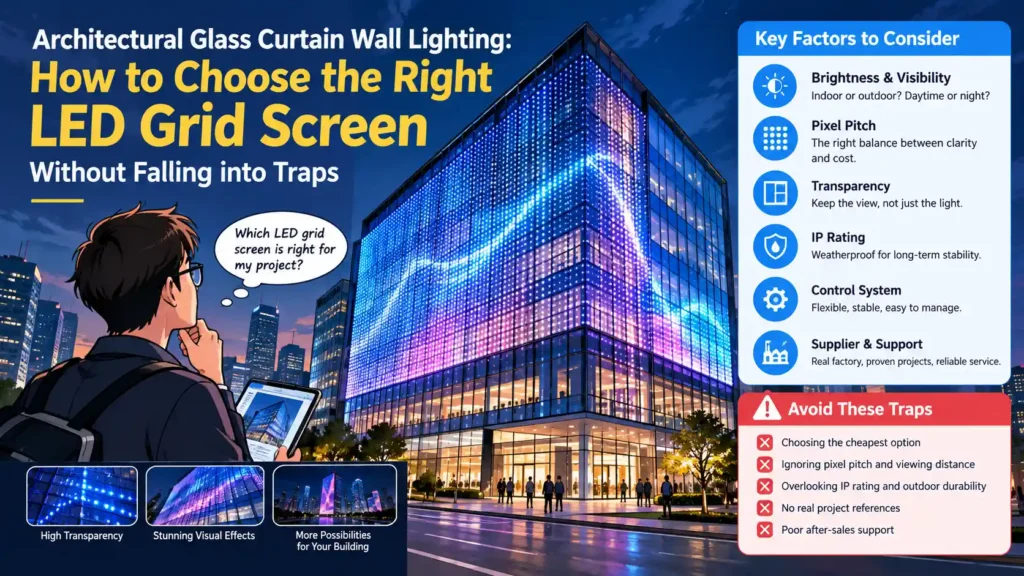
In modern commercial complexes, high-end retail centers, and landmark building media facade retrofits, the key to a successful architectural glass curtain wall lighting project lies in scientifically selecting the right LED grid screen (transparent LED display / architectural media facade) based on primary viewing distance, building natural lighting requirements, and secondary steel structure load-bearing capacity. Blindly pursuing low initial prices or excessive resolution can lead to pixel graininess that damages commercial advertising value, causes runaway secondary steel structure reinforcement costs, or even fails fire and planning approvals.
Viewing Distance & Clarity Matching: For mid-to-close range facades with a primary viewing distance of 25m to 40m, P25 (pixel density of approx. 1,600 dots/m²) is recommended to deliver ultra-fine visuals and eliminate graininess. For projects with a viewing distance exceeding 40m, higher-transparency P40 models should be chosen.
Steel Structure Cost Control: Selecting an LED grid screen built with a lightweight aluminum profile architecture significantly reduces dead load at the source, preventing bulky and expensive secondary steel structure reinforcement costs from eroding project profits.
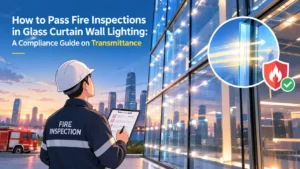
Lighting Compliance Red Lines: If the building glass curtain wall has strict mandatory requirements for natural light transmittance (e.g., greater than 60%), a P40 model with 60% to 65% physical transparency must be selected to smoothly pass fire safety and local municipal planning approvals.
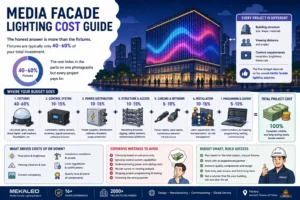
Procurement & TCO Control: Evaluating project success goes beyond initial equipment purchase prices; it requires a comprehensive assessment of supply chain stability, dynamic power consumption, high-altitude maintenance complexity, and commercial advertising rental ROI.
1. Mathematical Modeling of Viewing Distance: Balancing P25 vs. P40 Visual Performance and Commercial Value
During the initial project selection stage, general contractors and system integrators often hesitate between mainstream grid screen models like P25 and P40. The industry-standard formula for calculating grain-free viewing distance is:
Viewing Distance (m) = Pixel Pitch (mm) × 1
Taking the P25 LED grid screen as an example, its critical threshold is 25 meters. When the primary viewing distance falls between 25m and 40m, choosing a P40 screen may expose physical grid lines at close range. If the project is located on a prime commercial pedestrian street or a mid-to-close range facade, visual clarity directly determines the impact of luxury or high-end commercial advertisements. Choosing MEKALEO’s P25 high-definition fine-pitch grid screen (with a pixel density of 1,600 dots/m²) perfectly secures high-end commercial monetization capabilities.
2. Building Body Load: How to Prevent “Secondary Steel Structures” from Causing Project Budgets to Explode
Architectural glass curtain wall lighting is far more than just “hanging a screen up”; it directly impacts the structural safety and regulatory compliance of the building itself.
High-rise building glass curtain walls endure massive wind loads year-round. If an LED screen is excessively heavy or features poor wind-resistance design, it can cause devastating overloads to the building’s original curtain wall mullions. Many contractors focus only on the unit price of the screen during contract signing while ignoring that heavy screens require massive and expensive secondary steel structure reinforcements, ultimately eating away profit margins through steel and labor costs. By adopting MEKALEO’s lightweight aluminum profile LED grid screens, dead loads are drastically reduced while maintaining high wind-load resistance, directly cutting massive structural reinforcement and high-altitude installation labor costs for contractors.
3. Physical Transparency Hard Constraints: Preventing Fire and Planning Approvals from Being Indefinitely Delayed
Many engineering teams focus solely on nighttime lighting effects during early planning stages while neglecting daytime natural lighting rights and local planning regulations.
The P40 grid screen maintains a physical transparency of 60% to 65%, whereas the P25 grid screen features a higher pixel density, denser PCB routing, and more lamp beads, resulting in a transparency of 45% to 50%. If the target building’s glass curtain wall has strict natural lighting rate requirements (e.g., demanding over 60%), blindly choosing P25 will trigger compliance failures during reviews. For projects with strict lighting metrics, opting for the high-transparency P40 ensures smooth clearance through fire safety, local planning, and architectural approvals, avoiding months of project delay costs caused by mandatory remediation.
4. The Procurement Perspective: Balancing Supply Chain Security, Lead Times, and Commercial Terms
For corporate procurement managers and project purchasing agents, selecting an LED grid screen supplier involves far more than comparing the initial unit price per square meter. A truly cost-effective procurement decision must evaluate the following three commercial dimensions:
Supply Chain Stability & Source Manufacturing: Partnering with direct source manufacturers like MEKALEO eliminates intermediary markups and ensures stable raw material supply chains, avoiding project delays caused by component shortages or OEM transit friction.
Customization Flexibility & MOQ Control: B2B procurement often requires customized cabinet sizes and specialized mounting brackets to fit irregular architectural curtain walls. Direct manufacturers offer flexible Minimum Order Quantities (MOQ) and rapid custom engineering support without inflating project budgets.
After-Sales Warranty & Risk Mitigation: Reliable suppliers provide transparent warranty terms, spare-part backups (such as backup receiving cards and pixels), and comprehensive technical documentation, mitigating the heavy financial and operational risks associated with post-installation failures in high-altitude outdoor environments.
5. Calculating Total Cost of Ownership (TCO): Maximizing Project Profitability
For B2B general contractors, system integrators, and procurement directors, project success is measured not by how cheaply equipment is bought initially, but by its TCO (Total Cost of Ownership):
Power Consumption & Dynamic Energy Efficiency Ratio: Although the dynamic average power consumption of P25 is slightly higher than that of P40, its higher pixel capacity per unit area delivers a greater information-carrying capacity for commercial videos, offering better long-term investment value.
Manufacturer & Supply Chain Empowerment: Partnering with a direct source manufacturer like MEKALEO grants you comprehensive support ranging from custom cabinet sizes and high-refresh-rate driving configurations to energy-saving mixed-light solutions. All factory-shipped products come with authentic physical optical parameters and testing reports, empowering engineering teams to win bids through hard data.
Project Fast-Track Channel:
If you are currently participating in or executing a glass curtain wall LED grid screen project, feel free to contact MEKALEO’s engineering and sales team. Based on your project CAD drawings, viewing distance parameters, and building lighting red lines, we will provide you with free custom selection solutions, professional CAD layout designs, and competitive factory-direct quotations to safeguard your project profit margins.
Frequently Asked Questions (FAQ)
Q1: How should I choose between P25 and P40 LED grid screens for actual projects?
Choose P25 when: The primary viewing distance is between 25m and 40m, the project is located in a prime commercial district, and there is an exceptionally high demand for commercial advertising clarity and visual presentation.
Choose P40 when: The viewing distance exceeds 40m, or the glass curtain wall is subject to strict local planning restrictions on natural light transmittance where high transparency is mandatory.
Q2: Why is the transparency of P25 lower than that of P40?
Because P25 features a tighter pixel pitch (25mm), integrating more lamp beads, driver ICs, and denser PCB routing per unit area. This increases the physical blocking surface area, naturally making its transparency slightly lower than the larger-pitch P40.
Q3: How can we reduce secondary steel structure costs during the bidding phase?
By selecting LED grid screens built with a lightweight aluminum profile architecture, which minimizes screen dead load at the source. This substantially cuts down the steel volume and construction complexity required for secondary steel reinforcement, effectively controlling overall budgets.
Data Sources & Industry Standards
To ensure absolute engineering credibility and compliance, the technical parameters, optical formulas, and structural load evaluations referenced in this article are derived from and verified against the following recognized industry benchmarks:
Architectural Optics & Transparency Standards: ISO 9050 (Glass in building — Determination of light transmittance, solar direct transmittance, total solar energy transmittance, ultraviolet transmittance and related glazing factors) and CIE (International Commission on Illumination) guidelines for urban media facades. Detailed standards can be referenced at ISO 9050 Standard Overview and CIE Urban Lighting Masterplanning Guide.
Structural Engineering & Wind Load Parameters: Structural Design Standards for High-Rise Building Curtain Walls (incorporating dead load calculations and wind-pressure resistance thresholds for aluminum profile frame architectures).
Product Optical & Electrical Performance Metrics: Strictly referenced against MEKALEO product factory physical optical testing reports, high-refresh-rate driving configuration parameters, and dynamic power consumption benchmark data.
Updated Date: September 24, 2026 | Technical Standard: Physical Optics & Electrical Metric Verification