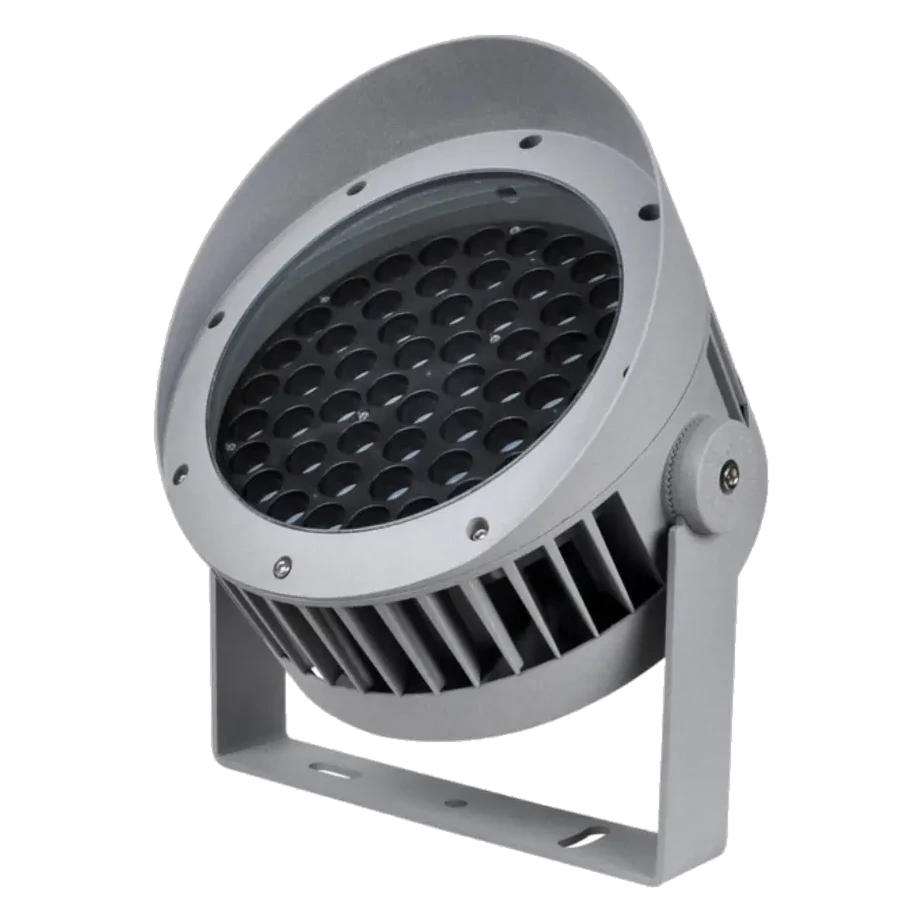
01
M175-RGB-18W
⌀ 175 mm head · 270 mm overall
The close-in body. Media screen walls on mid-rise blocks, portal frames and canopy edges where the fixture line sits within about 10 m of the surface.
Power18 W
InputDC24 V
Beam30° / 60°
Size175×160×270
MEKALEO builds three die-cast aluminium bodies — 18 W, 36 W and 48 W on DC24 V — with 30° or 60° optics, 2000–6000 K white and RGB on DMX512. Made for linked facade media screens across multiple buildings, high-rise crowns and bridge structures — architectural lighting specified by facade consultants and lighting designers.
All three models share the same optics and the same 30° / 60° choice. What changes with set-back distance is the head size and the wattage you need to hold illuminance on the surface.
Coverage is the illuminated width on the surface: 2 × set-back × tan(½ beam). Indicative only — final wattage, optic and aiming are confirmed by a lighting simulation on your elevation. Send drawings for a free layout →
Count, spacing and load are pure geometry at 25% overlap — not a lighting calculation. Whether that spacing actually holds the illuminance you need depends on the output of the body, so the layout goes through a DIALux run before it goes on your drawing. Send the elevation for the simulated version →
The model number is the head diameter in millimetres. It is the same luminaire in three sizes — same die-cast aluminium body, same tempered glass front, same 3030 LED array and DC24 V engine — you choose the size by the throw you actually have.
The close-in body. Media screen walls on mid-rise blocks, portal frames and canopy edges where the fixture line sits within about 10 m of the surface.
The middle of the range and the usual starting point. Multi-building media walls, hotel and retail podiums, bridge piers at moderate throw.
The largest head in the range. High-rise crowns, long bridge spans and tower faces where the throw runs past 20 m and the surface still has to read evenly.
These three are our own fixtures — our die-cast moulds, our optic, our driver layout, populated on our own SMT line. Nothing here is a bought-in public housing with a label on it. That is why the numbers below are fixed drawings rather than a “typical range”: the model number is the head diameter we cut, the wattage is the board we populate, and a different beam, colour or body is a change in our own tooling — not a conversation with a third-party supplier.
Dimensions in millimetres, measured on our own datasheet drawing — W × D × H including the U-bracket. Size, beam angle and colour temperature are specified at order; the parameters on this page describe this fixture only, not a general market category.
Every project starts with a section drawing and a distance — that is the lighting design decision. The fixture follows from those two things, not the other way round.
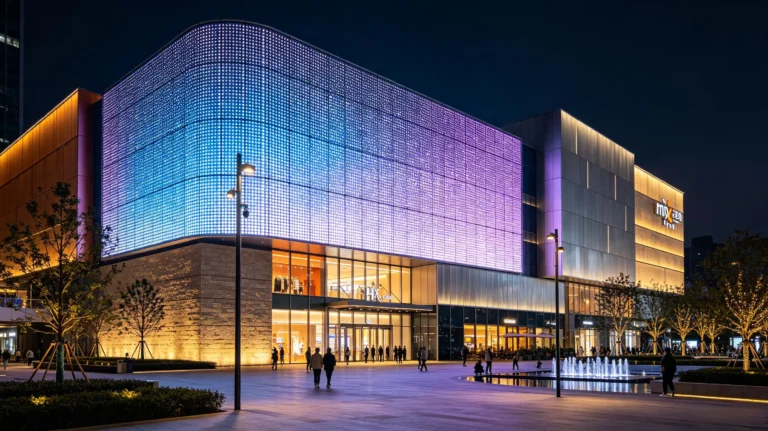
Grade-level uplight and a 60° wall wash across stone, curtain wall and metal panel.
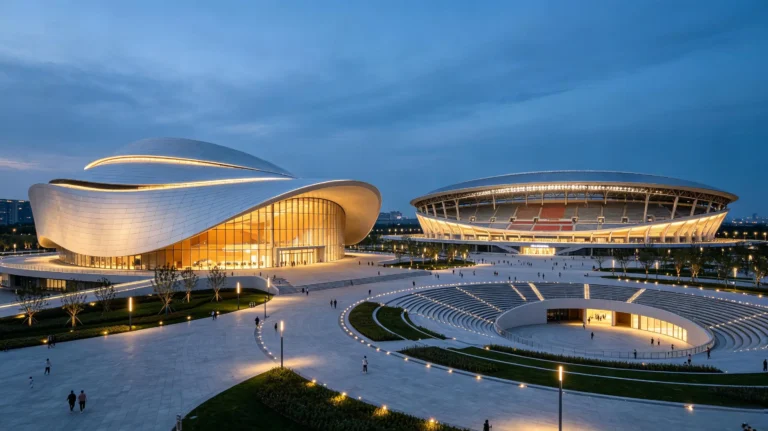
60° wash over paving, steps and entrance canopies at 8–15 m set-back.

30° optics set back from deck level and pylon bases, aimed along the structure, with the U-bracket carrying the tilt.
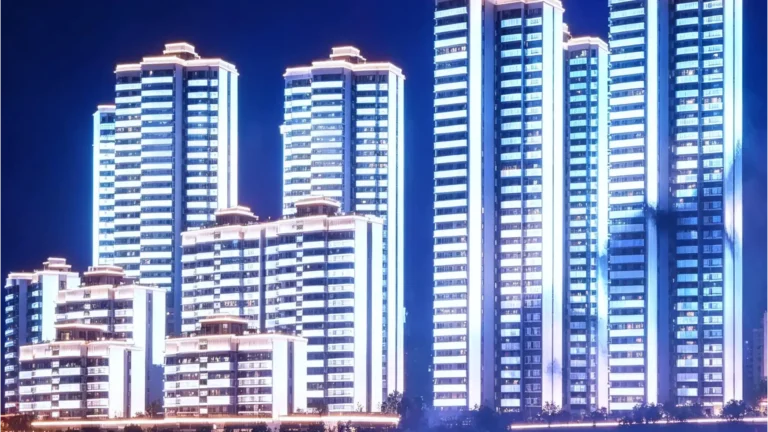
Vertical accent runs and crown lighting, addressed in DMX groups up the elevation.
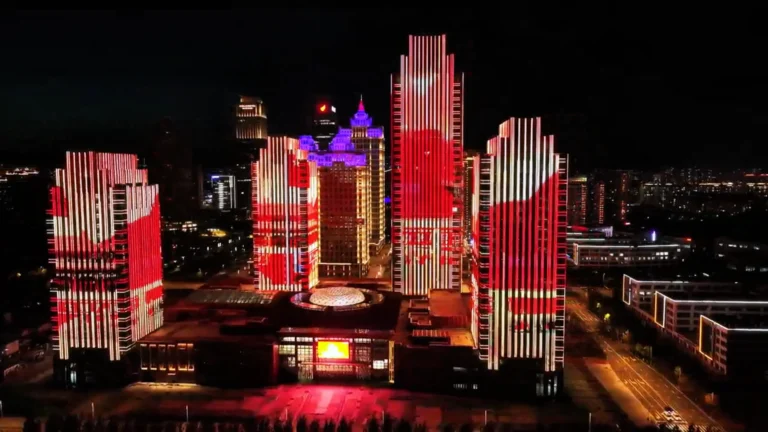
Facade wash plus warm landscape layers for arrival courts and terraces.
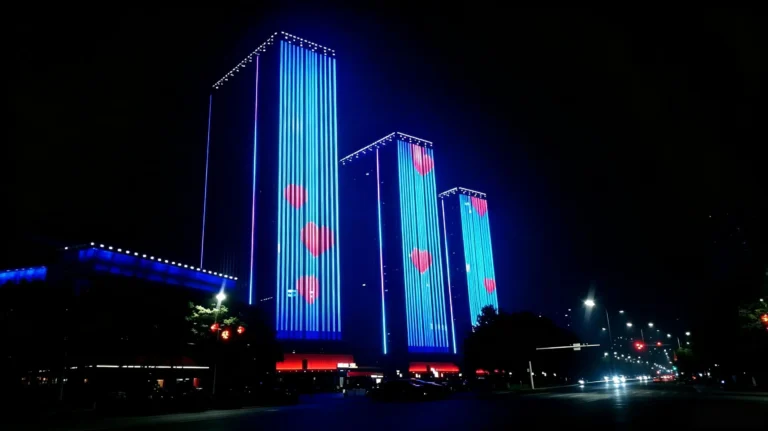
Floodlight base layer under a mesh screen — one control desk, one scene.
Die-cast aluminium profiles with a radial fin stack behind the LED board. There is no separate heat-sink plate bolted on — the board sits on the body, so the thermal path is the housing itself.
The front is tempered glass in a machined groove. Glass does not yellow or craze under UV the way a PC lens does, which is what the 4.5 UV-resistance grade on the label refers to.
The 3030 LED plane is recessed behind the bezel with an individual reflector on each package. At shallow viewing angles you see the rim, not the source — glare control built into the casting rather than bolted on. It is also what keeps spill light off the neighbouring windows — the first thing a light-pollution assessment asks about.
Cold-resistant, UV-resistant and flame-retardant wiring and housings, rated UL94 V0. That combination is what makes the fixture viable for long-term outdoor use rather than a season of temporary installation.
| Element | Specification |
|---|---|
| Housing | Die-cast aluminium profiles |
| Front cover | Tempered glass |
| Wiring & housing | Cold-resistant / UV-resistant / flame-retardant |
| Flame rating | UL94 V0 |
| UV resistance | Grade 4.5 |
| Ingress protection | IP66 |
| Driver | DMX512 constant-current on board; 24 V PSU supplied separately |
| Input | DC24 V |
| Approvals | CE |
| Design rights | Private mould, patented appearance, own IP |
Two things decide whether a floodlight survives five years on a facade: how the board was assembled, and whether anyone actually measured the light. Both happen in-house at MEKALEO.

LED packages go onto the board on our own line, not a subcontractor. Reel-to-board keeps the bin code traceable to the batch.
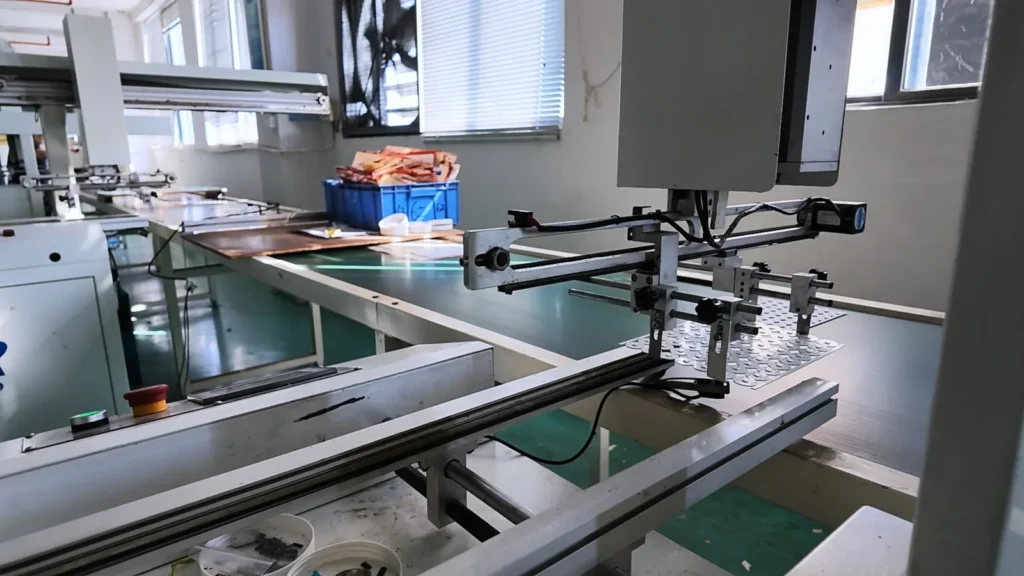
Placement head running a light-engine board. Paste, placement and reflow stay in one continuous flow instead of moving between shops.
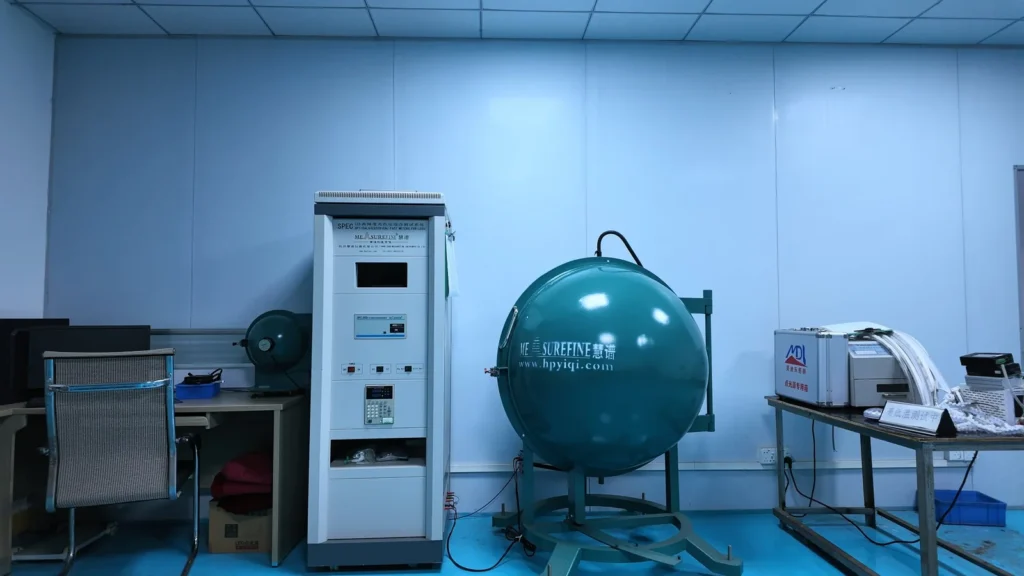
Integrating sphere with a high-precision spectroradiometer. Flux in lumens, CCT, CRI and efficacy in lm/W are measured on the sample — not copied from a supplier datasheet.
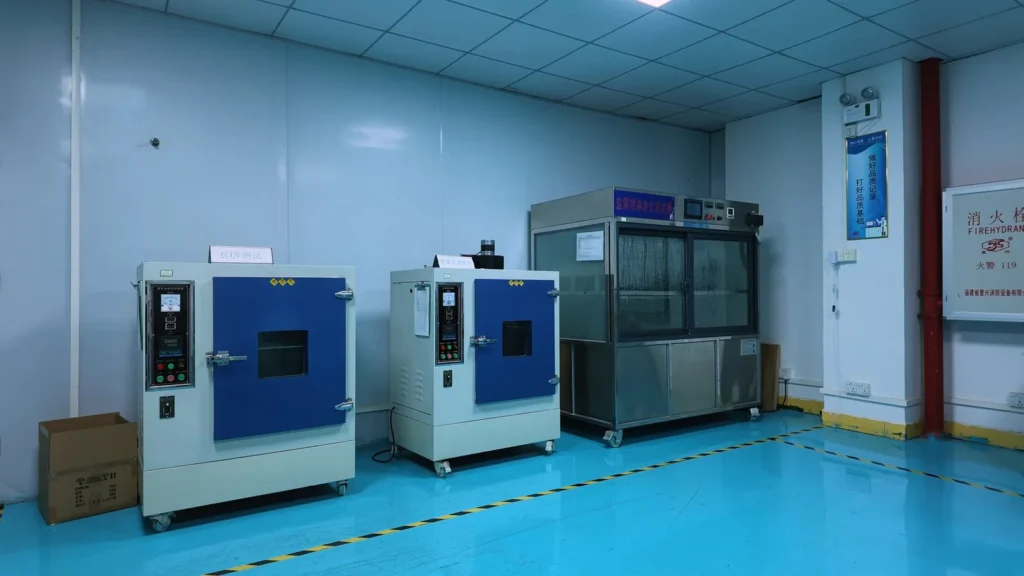
UV exposure, thermal cycling and salt-spray cabinets. Housings and gaskets run through the same bay as the electronics before a batch ships.
A factory with its own engineering desk and render studio. The three things a bid actually needs — a layout, a night render and a sample — come from the same MEKALEO team, in the same building.
A lighting engineer reads your elevation the way the consultant will: set-back distance, aiming angle, glare into the neighbouring windows. Tenders are decided here.
Our own render team puts the actual fixture and the actual optic onto your elevation — not a stock photo of somebody else’s building with a disclaimer underneath.
The line is ours, so a sample is a scheduling question rather than a favour. It is built on the same line and carries the same batch code as the production run.
Elevation, set-back, control protocol.
Fixture schedule plus DIALux check.
Photomontage for the bid pack.
Unit price, Incoterm, lead time.
Built and measured before the PO.
Slot booked to your programme.
Most enquiries get a layout and a first render back within two working days — because the line, the engineering desk and the render studio sit under one roof, and a beam angle that changes on Tuesday does not restart the job.
| Parameter | M175-RGB-18W | M215-RGB-36W | M260-RGB-48W |
|---|---|---|---|
| Power | 18 W | 36 W | 48 W |
| Input voltage | DC24 V | DC24 V | DC24 V |
| Current draw (nominal, W ÷ 24 V) | 0.75 A | 1.5 A | 2.0 A |
| Light source | 3030 LED | 3030 LED | 3030 LED |
| Colour temperature | 2000 / 2700 / 3000 / 6000 K | 2000 / 2700 / 3000 / 6000 K | 2000 / 2700 / 3000 / 6000 K |
| Beam angle | 30° / 60° | 30° / 60° | 30° / 60° |
| Head diameter | 175 mm | 215 mm | 260 mm |
| Overall size (mm) | 175 × 160 × 270 | 215 × 170 × 310 | 260 × 195 × 360 |
| Housing | Die-cast aluminium | Die-cast aluminium | Die-cast aluminium |
| Front cover | Tempered glass | Tempered glass | Tempered glass |
| Control | DMX512 | DMX512 | DMX512 |
| Ingress protection | IP66 | IP66 | IP66 |
| Approvals | CE | CE | CE |
← Swipe the table to compare all three models →
All three bodies share one optics platform, one driver platform and one sealing system — the difference is head size and wattage. What you are buying is uniformity on the wall: the same optic at the same spacing gives the same even wash whether you hang M175 or M260.
Every figure on this page is a MEKALEO product parameter — drawn or measured for this fixture, not a catalogue average carried over from another supplier. Where a number depends on the batch or the optic you order, we say so instead of printing a single impressive one: ask for the integrating-sphere report for the exact bin you are buying.
Four lines, one elevation. What picks the product is how far the light has to travel, and whether the line you are drawing is a surface, an edge or a picture.
| What decides it | LED flood lightthis page | LED wall washer | LED linear | LED mesh screen |
|---|---|---|---|---|
| Throw distance | 5–35 m | 0.3–3 m | On the line itself | On the facade itself |
| Mounted where | Ground, podium roof, outrigger | Soffit, cornice, recess | Mullion or transom | Over the curtain wall |
| Beam shape | Round, 30° / 60° | Asymmetric wash | Linear bar | Pixel grid |
| What it reads as | A surface lit from a distance | A graded wash down a wall | A drawn line | A moving image |
| Typical site | Crown, bridge, tower face, plaza | Curtain wall, cornice | Profile, floor band, outline | Media wall, landmark screen |
| Watch out for | Spill past the parapet | Hotspot at the top of the wash | Source visible at eye level | Weight and wind load |
← Swipe the table to compare all four →
Most elevations use two of these at once: a mesh screen for the picture, flood lights for the tower above it, linear for the outline that ties the two together. If you are not sure which one your drawing is asking for, send the section — the set-back distance alone usually settles it. Ask the engineering desk →
Two digits, two separate tests. The first is dust. The second is water — and it only tells you which water condition the fixture survived, not how well it will survive your site.
The first digit is dust, and the M-series sits at 6 — dust-tight, which is the top of that scale. The options all sit in the second digit, and each one below is a defined laboratory condition under IEC 60529 — not a score. A higher digit is not a stronger seal for every site; it is a different condition, and every step costs something in heat, weight or serviceability.
A head on a crown or a bridge never sits under water. Sealing it to immersion level means a heavier gasket and a fully closed body — which traps heat around the LEDs and makes the fixture slower to open for service.
So the rating we publish is the one that matches the condition the fixture actually lives in: driven rain and a wash-down, not immersion.
The part that actually fails on a facade is rarely the seal. It is the cable entry — a gland that was never torqued, or a gasket pinched between factory and site. That is why the torque figure travels with the drawing, and why the installer sheet matters as much as the rating.
IK is a weighted striker dropped on the glass, under IEC 62262 — a vandal or a scaffold pole, not water. An IP rating says nothing about impact and the two are always quoted separately. Our M-series datasheet carries IP66; if your specification calls for an IK class, put it in the RFQ and we will confirm what can be certified for that project.
Ratings are where a specification gets won or lost, so we publish the test condition rather than the highest digit. If your RFQ asks for IP67 or an IK class we cannot certify, we will say so at quotation instead of at delivery. Send the specification sheet →
M175 / M215 / M260 is the head diameter in millimetres — the number you can measure on site with a tape. RGB is the engine, 18W / 36W / 48W is the total power. So M215-RGB-36W is a 215 mm head, colour engine, 36 W.
This matters when you are replacing fixtures on an existing facade: the head size decides whether the old bracket and cut-out still work.
Ours, end to end. The die-cast mould is our own tooling — the model number is the diameter we cut, not a catalogue size. The optic, the board and the light engine are ours, assembled on our own SMT line, and every production batch is measured on our own integrating sphere before it ships. The appearance is patented and registered to us.
That is also why a spec question gets a drawing back instead of “we will check with the factory”. The parameters on this page are the parameters of this fixture: where a figure depends on the batch or the optic you order — flux, CRI, efficacy — we say so and send the report for the bin you are buying, rather than printing one number and letting the delivery decide.
Beam angle is a distance decision, not a taste decision — a narrow beam for a tower crown, a wide beam for a plaza. The illuminated width on the surface is about 2 × set-back × tan(½ beam). At 10 m: the 30° optic covers roughly 5.4 m, the 60° optic roughly 11.5 m.
Pick the narrowest angle that still covers your target at the distance you actually have. Wider angles put more light past the parapet and into neighbouring windows — and on a media wall they wash out the contrast of the screen itself.
The model code carries RGB, and the datasheet lists four white points on the Kelvin scale — 2000 K, 2700 K, 3000 K and 6000 K — as options. Tell us which white you need for the everyday architectural scene and which colour behaviour you need for events, and we confirm the exact engine on the proforma invoice before production.
Worth knowing: colour mode runs lower in efficacy than pure white, so specify the white output you need first and size the colour scene from there — not the other way round.
DC24 V means the conversion happens in a remote power supply, not inside the fixture. The head stays cooler, the electronics sit in a dry cabinet, and the fixture itself is safe to service in a wet location.
The trade-off is voltage drop. At 24 V the current is high for the wattage — 0.75 A for the M175, 1.5 A for the M215 and 2.0 A for the M260 — so keep DC runs short and size the cable against drop, not against ampacity. On a long facade, feed each group of fixtures from a local PSU rather than daisy-chaining 24 V across the whole elevation.
IP66 means dust-tight and protected against powerful water jets. It is a test on the assembled, sealed fixture — including the cable entry, which is part of the seal rather than an accessory.
A fixture that passes IP66 on the bench will still fail on a facade if the cable gland is not torqued or the gasket is pinched during installation. Send us the installer and we will send the torque figures with the drawing.
Yes, and on tall buildings it is often the right answer: M215 at the podium, M260 up the tower where the throw is longer, M175 on detail and canopy edges. All three share the same optics platform and the same DMX addressing, so they run as one scene.
What stays fixed is the optic: the 30° or 60° version is chosen at order. Get the distances right on the drawing before the PO, not after the first night mock-up. A mixed elevation is also the case where commissioning earns its keep — every head has its own angle, and the aiming sheet has to travel with the drawing.
An elevation with dimensions, the set-back distance from the fixture line to the surface, the target illuminance in lux or the look you are after, and the control protocol. With those four we return a fixture schedule, a spec sheet, a lighting simulation and a per-unit price — enough to drop straight into your BOQ.
Send them to our engineering desk and you will have a layout back within two working days.
Read it off the selector above: set the set-back, set the wall width, and it returns the head count and the spacing. The rule behind it is that centres run at about 75% of the coverage width, so the wall stays even between heads instead of scalloping.
For a 60 m wall at a 10 m set-back on the 60° optic that works out at nine heads at roughly 7 m centres. At the same width on the 30° optic you would need more than twice as many — which is the moment a wider optic stops being a compromise and becomes the cheaper answer.
A wall washer is built to sit close — usually a soffit, a cornice or a recess within a metre of the wall — and throw a graded wash down it. A flood light is built to sit metres away and land a pool of light on a surface. If you can mount within a metre of the curtain wall, the washer gives less spill and no visible hotspot at the top.
If the only mounting point is the ground or a podium roof 10 m out, no washer will reach it — that is a flood light job. The comparison table above lines the four lines up on throw distance, which is the one row that usually settles it.
IP65 is a 6.3 mm jet. IP66 is a 12.5 mm jet at eight times the flow. IP67 is thirty minutes at one metre of depth. A facade above ground meets driven rain and, on some sites, a periodic wash-down — that is the IP66 condition, and it is what the M-series carries.
IP67 buys nothing on a crown, and it costs you heat: a body sealed for immersion is a body that holds its heat. Where IP67 and above genuinely matter is buried, submerged or permanently wet locations — not a wall forty metres up. The ratings section above has the full breakdown.
Aim at night with the facade’s own ambient lighting off, and work from the bottom of the elevation upwards — a head set from the top down will be re-aimed as soon as you see what the row below it is doing. Set the bracket angle against the drawing rather than by eye, and write the angle for each head onto a sheet as you go.
On a mixed elevation that aiming sheet is the only thing that lets the next crew reproduce the scene after a service visit. A one-night mock-up on the first bay is almost always cheaper than re-aiming sixty heads from a cradle.
No. At 24 V the current is high for the wattage — 2.0 A for the M260 — so voltage drop arrives quickly. Over a long run the last heads see less than 24 V and run dim while the first ones are correct, and no amount of DMX addressing fixes that.
Feed each group from a local power supply rather than daisy-chaining across the elevation: one PSU per floor band, or per eight to ten heads, sized against voltage drop and not against ampacity. Keep the PSU itself in a dry cabinet, not on the facade.
Yes — photometric files in IES and LDT, dimension drawings in PDF and DWG, and the datasheet, issued with the quotation for the exact model and optic you are specifying. That way the file in your model matches the fixture that will ship, rather than a catalogue average.
If you are building the DIALux or Relux model before the specification is fixed, send the set-back distance and the surface type and we will issue the file for the closest optic so the model can start now and be refined later.
On most media facades it has to. The mesh screen carries the image on the flat of the wall; the flood lights pick up the crown, the parapet return and the structure above it, which the screen does not cover. Both run on DMX512, so they are addressed as one scene — but they remain two products with two power systems.
Keep the flood light heads out of the screen’s viewing cone. A 30° head aimed across a media wall will wash the contrast out of the picture at exactly the angle people stand and look from, and that is the one mistake you cannot correct in commissioning.
Our engineering desk returns a schedule, a DIALux render and a price — no account and no MOQ to start the conversation.
Drawings and quotations by email. Site questions and anything urgent, by WhatsApp.
Drawings, schedules and written quotations. Attach the elevation, the set-back distance and the control protocol.
Write to the desk → WhatsApp +86 189 2811 4374Site questions, install details, DMX addressing, order status. Send a photo of the bracket and we will answer on the spot.
Open WhatsApp →