Written by the [MEKALEO] Engineering Team — a media facade lighting manufacturer with 16+ years designing, producing, and commissioning systems across 2000+ projects . Factory: Ancient Towns of China.
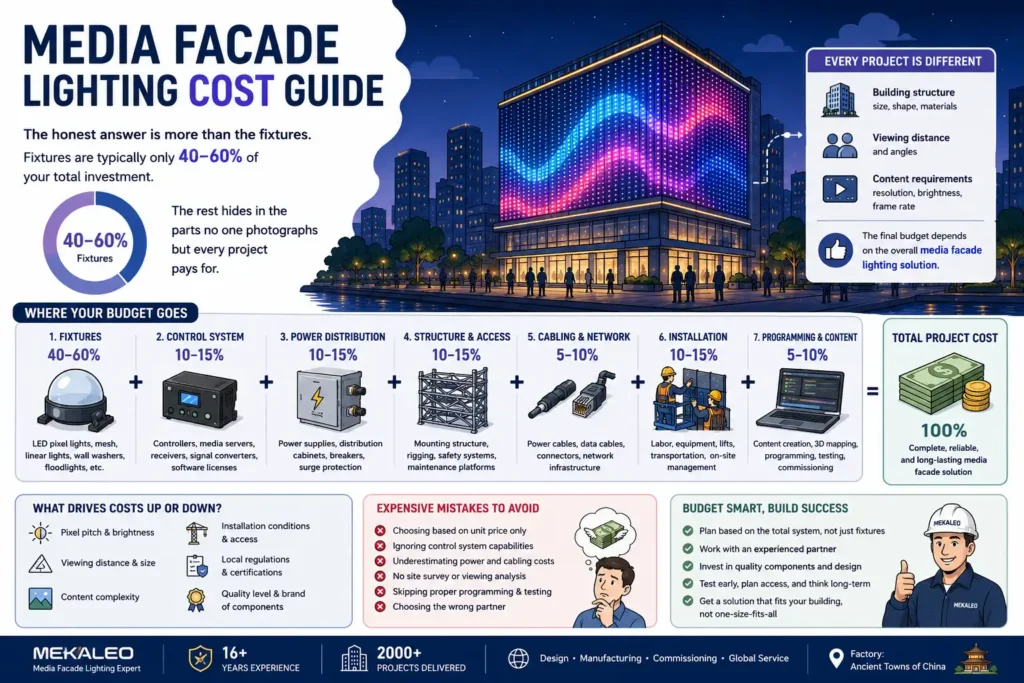
How much does a media facade cost?” is the first question every client asks us — and the honest answer starts with an uncomfortable fact: the fixtures you see in the catalog are typically only 40–60% of what you’ll actually spend. The rest hides in control hardware, power distribution, cabling, installation access, and programming — the parts no one photographs but every project pays for.
Because every building, viewing distance, and content requirement is different, the final budget depends heavily on the overall media facade lighting solution selected for the project.
This guide breaks down every cost layer with realistic ranges, explains what drives prices up or down, and shares the budgeting lessons we’ve learned from 300+ delivered projects — including the expensive mistakes clients make when they compare quotes on unit price alone.
The Full Cost Structure: Where the Money Actually Goes
A complete media facade budget splits into six layers. Here’s the typical distribution we see across our delivered projects:
| Cost Layer | Typical Share of Total | What’s In It |
|---|---|---|
| Fixtures | 40–60% | Pixel lights, mesh, linear, washers, floods |
| Control system | 8–15% | Controllers, nodes, network switches, software licensing |
| Power distribution | 8–12% | Power supplies, distribution boards, protection |
| Cabling & connectors | 5–10% | Data + power cable, waterproof connectors, conduit |
| Installation | 15–25% | Labor, access equipment (lifts/scaffolding/rope access), mounting structure |
| Design & programming | 5–10% | Lighting design, pixel mapping, content creation, commissioning |
The lesson we repeat to every client: a quote that only lists fixtures isn’t a project budget — it’s half of one. When comparing suppliers, demand line-item quotations covering all six layers, or you’re comparing incomparable numbers.
Fixture Costs: Typical Ex-Factory Ranges
These are realistic ex-factory ranges for quality outdoor-rated (IP65–IP67) products. Prices vary with LED brand, driver brand, housing material, and order volume:
| Fixture Type | Typical Ex-Factory Range | Priced Per |
|---|---|---|
| LED pixel lights | $2–$10 | per node/point |
| LED mesh screen | $150–$600 | per m² |
| LED linear (addressable) | $15–$80 | per meter |
| Wall washer | $15–$80 | per meter |
| Floodlight (RGB/RGBW) | $40–$400 | per unit |
What Moves These Numbers
- LED chip brand (Lumileds, Cree, Osram vs. generic): 15–30% price difference, but directly tied to lumen maintenance and color stability.
- Driver brand (Mean Well, Signify class vs. generic): the single most consequential quality choice — in our warranty records, power-side failures outnumber LED failures by a wide margin.
- IP rating: IP67 costs more than IP65 in sealing, connectors, and testing. Pay for it where fixtures are exposed; don’t pay for IP68 under a protective eave.
- Order volume: facade projects order in thousands of units; per-unit pricing at volume typically runs 20–40% below sample pricing. Quote at your real quantity.
⚠️ We deliberately show broad ranges because every media facade lighting installation is unique. Any supplier who provides a fixed number before reviewing elevations, viewing distances, maintenance access, and site conditions is either estimating blindly or expecting variations later. A reliable quotation starts with understanding the architecture and the complete media facade lighting solution required for the project.
The Cost Drivers: What Makes One Project 5× Another
1. Pixel Pitch — The Biggest Lever of All
Resolution is paid for per pixel, and pixel count grows with the square of density. Halving the pitch quadruples the pixels.
Field lesson: on a shopping-mall project, we specified 15mm pitch for the lower three floors (pedestrian viewing) and 40mm above — cutting pixel count roughly 60% versus a uniform-pitch design, with zero visible quality loss from any real viewpoint. Matching pitch to actual viewing distance is the single most effective cost decision in a media facade. Clients who copy indoor-screen resolution onto a building routinely overpay by half.
2. Coverage Strategy — Media Everywhere vs. Media Where It Matters
Full-envelope pixel coverage is the most expensive possible design. On an office-tower project, the client’s budget covered either sparse full-coverage pixels or dense addressable linear on the floor lines — we recommended linear-first. The chase animations photographed so well the client never funded the pixel phase. Addressable linear delivers most of the perceived media effect at roughly a quarter of pixel-grid cost.
3. Building Height and Access
Installation cost scales brutally with height and access difficulty. The same fixture that costs $10–20 to install at podium level with a scissor lift can cost $60–150 to install on a tower crown requiring rope access or a mast climber. Access method is often the difference between two otherwise identical quotes — ask every bidder to state theirs.
4. Control Complexity
A static color-changing scheme needs a modest DMX controller. Full video content needs Art-Net networks, managed switches, media server hardware, and software licensing sized to pixel count — plus the engineering time to plan universes and node placement. Control typically runs 8–15% of budget, but skipping its planning is how projects fail: our hardest early failure was a facade where every fixture worked and the system couldn’t hold sync. The fix cost weeks. Data architecture is cheap to design and expensive to retrofit.
5. Structure and Facade Condition
New builds can integrate mounting into the curtain wall. Retrofits pay for brackets, anchoring surveys, and sometimes structural reinforcement — mesh screens especially, where wind load drives the attachment engineering. On our first large mesh job, wind calculations forced a late redesign of every attachment point. Now we price structure early, because it’s never zero.
The Hidden Costs Nobody Quotes
From our delivered-project records, the items most often missing from budgets:
- Waterproof connectors and terminations — linear runs have joints every few meters; cheap connectors are how water gets in and warranties get invoked.
- Spare stock — we advise clients to buy 2–5% spare fixtures with the main order. Matching bins years later is difficult; a small spare inventory keeps the facade uniform for its whole life.
- Content creation — a video-capable facade with no content budget is a very expensive blank screen. Plan $5,000–$30,000 for initial content plus periodic refreshes.
- Electricity and operation — modest compared to legacy lighting (LED systems draw 50–70% less than the metal-halide era, per U.S. DOE research), but a real line item: a mid-size linear facade runs roughly 3–8 kW at full output. Scheduling (full shows at peak hours, dimmed overnight) cuts this substantially.
- Warranty logistics — who pays freight on replacements? Is labor covered, or only modules? On a hard-access facade, uncovered labor can dwarf the part cost.
Total Cost of Ownership: The Metric That Actually Matters
Field lesson that cost a client real money: a competing bid on a hotel project was about $18,000 cheaper on fixtures. The client took it. In year three, driver failures across the array — on a facade requiring scaffolding access — cost more than twice that saving in replacement labor alone. We were brought in for the retrofit.
The correct comparison between quotes is cost over 10 years, not cost at purchase:
TCO = Purchase + Installation + (Energy × 10 yrs) + (Expected failures × access cost) − What the warranty actually covers
The variables that dominate that formula are driver quality, sealing quality, and warranty terms — none of which appear in a unit price.
How to Reduce Cost Without Reducing Quality
What we genuinely recommend (and what we’ve talked clients into, sometimes against our own invoice size):
- Match pixel pitch to viewing distance — the biggest saving available, often 40–60% of pixel count.
- Linear-first design — addressable linear on architectural lines before any pixel grid.
- Concentrate media on the visible faces — the elevation nobody sees from the street doesn’t need pixels.
- Spend on drivers and power, save on marketing specs — brand-name power components over headline lumen numbers.
- Mock up one bay first — a single-bay pilot (typically $3,000–$8,000) has saved our clients from six-figure mistakes in pitch choice and color more than once.
- Phase the project — build the control backbone and wash layer now, add pixel density later. A well-planned system is expandable; a badly planned one is disposable.
What we don’t recommend: cutting the wash layer (imagery floats on a dead building), generic drivers (year-three failures), or skipping the mock-up (the most expensive $5,000 ever saved).
📊 Quick Reference: Budget Ranges by Project Type
Indicative all-in ranges (fixtures through commissioning), for planning purposes only — real quotes require drawings:
| Project Type | Typical Scope | Indicative All-In Range |
|---|---|---|
| Color-changing facade (small–mid building) | Linear + washers + DMX control | $30,000–$150,000 |
| Architectural outline (mid-rise) | Linear + floods + control | $80,000–$300,000 |
| Animated facade (mid-rise) | Pixels + washers + Art-Net | $150,000–$600,000 |
| Full media facade (tower) | Pixels/mesh + full stack + Madrix | $500,000–$3,000,000+ |
⚠️ We deliberately show wide ranges: any supplier who gives you a tight price before seeing your elevations, viewing distances, and access conditions is guessing — or planning change orders.
❓ FAQ
Q: How much does media facade lighting cost per square meter? It varies too widely for one honest number — pixel pitch alone can swing cost by 4× for the same area. As orientation: sparse-pitch animated coverage starts around $100–$200/m² all-in, while dense video-capable coverage can exceed $1,000/m². Send drawings for a real figure.
Q: Why do quotes from different suppliers differ so much? Usually they’re quoting different things: fixtures-only vs. full system, generic vs. brand-name drivers, and different (or unstated) installation access methods. Demand six-layer line-item quotes to compare fairly.
Q: What’s the cheapest way to get a media effect? Addressable linear lights on the building’s architectural lines — most of the perceived effect at roughly a quarter of pixel-grid cost. It’s our most common recommendation to budget-constrained clients.
Q: How much should I budget for the control system? Typically 8–15% of total — but treat its planning as non-negotiable regardless of budget. Sync failures from unplanned data topology are the most common expensive failure we encounter.
Q: What does a media facade cost to run? A mid-size linear facade draws roughly 3–8 kW at full output — comparable to a few air conditioners — and scheduling cuts it further. Energy is rarely the budget problem; access-dependent maintenance is.
Q: Is it worth paying more for brand-name drivers and power supplies? In our warranty records, power-side failures far outnumber LED failures, and on hard-access facades the labor to replace them dwarfs the component saving. Yes — it’s the best money in the budget.
📚 References
- U.S. Department of Energy, Solid-State Lighting Program — LED efficacy, lifetime, and energy-savings research 🔗 https://www.energy.gov/eere/ssl/solid-state-lighting
- IEC 60529 — Degrees of protection provided by enclosures (IP Code) 🔗 https://webstore.iec.ch/publication/2452
- ANSI E1.11 (DMX512-A) — ESTA Technical Standards Program 🔗 https://tsp.esta.org/tsp/documents/published_docs.php
- ANSI C78.377 — Chromaticity (SDCM/MacAdam ellipse) specification 🔗 https://webstore.ansi.org/
- IES LM-79 / LM-80 — Photometric and lumen maintenance test standards 🔗 https://store.ies.org/