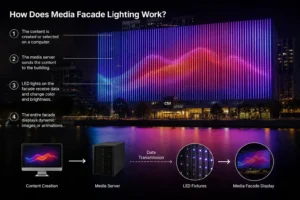
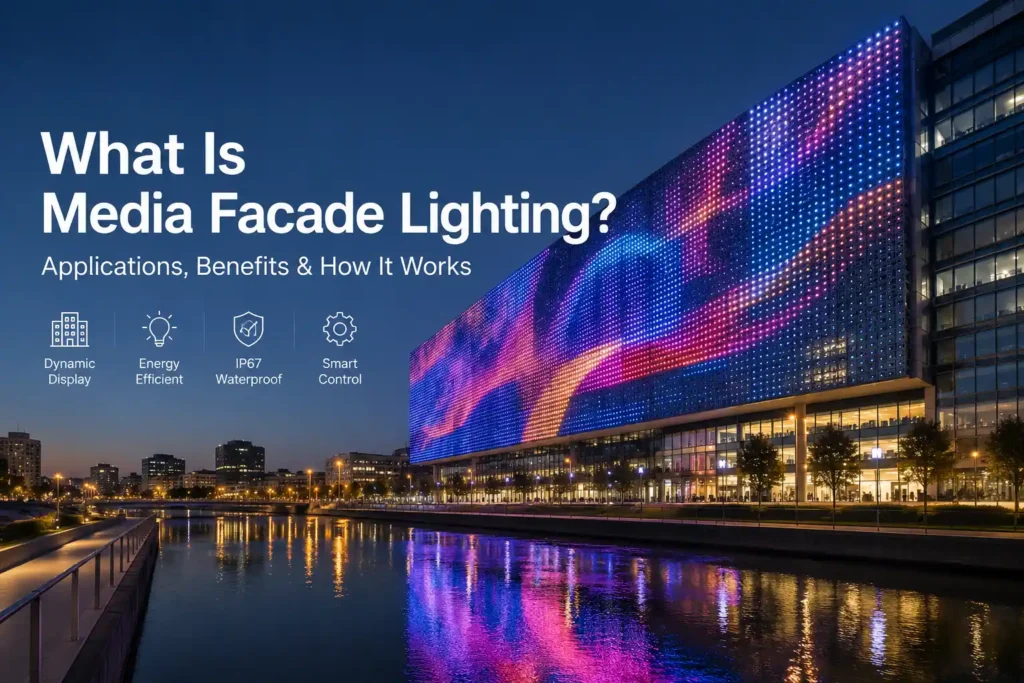
A media facade is a building surface that has LED technology embedded directly into its architecture, allowing the entire exterior to display dynamic visual content — animations, colors, patterns, and real-time digital media. Unlike a billboard attached to a wall, a media facade is the wall: the display function is integrated into the building envelope itself.
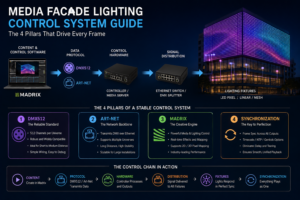
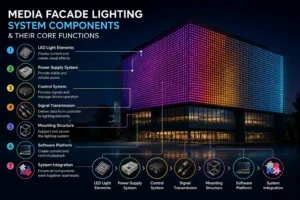
For companies exploring complete systems, understanding how a media facade works in practice is just as important as understanding the definition itself. Our Media Facade Lighting Solutions page provides a broader overview of system architecture, control methods, and project applications.
This article explains the concept, the main system types, where the technology fits (and where it doesn’t), with real-world landmark examples.
Media Facade Meaning: Architecture as a Communication Platform
The term combines two ideas:
- “Facade” — the exterior face of a building
- “Media” — the ability to carry changing digital content
A media facade turns architecture into a large-scale visual communication platform. In modern projects it is planned during the architectural design phase, not added afterward, because it involves structural, electrical, and content infrastructure working as one system.
Media Facade vs. Facade Lighting: The Key Distinction
| Aspect | Media Facade | Traditional Facade Lighting |
|---|---|---|
| Function | Dynamic digital communication | Static architectural illumination |
| Content | Video, animation, real-time visuals | Fixed colors and effects |
| Control | Software-based, programmable | Manual or preset |
| Design stage | Integrated into building envelope | Added as a lighting layer |
| Purpose | Branding, identity, communication | Aesthetic enhancement |
Traditional facade lighting highlights what a building looks like; a media facade changes what a building says.
The 4 Main Types of Media Facades
1. LED Pixel Facades — Individual addressable light points mounted across the structure. The most flexible and widely used configuration, ideal for towers viewed from a distance.
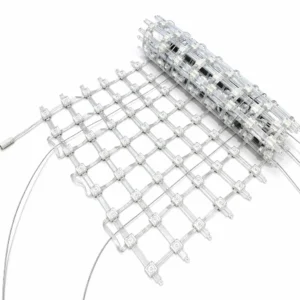
2. LED Mesh Facades — A flexible LED grid installed over glass curtain walls, delivering higher resolution while keeping 40–70% transparency for interior daylight and views.
3. LED Linear Facades — Light bars following architectural lines such as floor edges, mullions, and building contours, emphasizing the geometry itself.
4. Glass-Integrated LED Facades — LEDs laminated inside the glazing, invisible by day. The premium option, specified at the design stage of new construction.
Each type differs in resolution, transparency, structural load, and maintenance access — most large projects combine two or more. (For fixture-level specifications, see the full range of media facade lighting systems.)
Where Media Facades Are Used — and Where They Shouldn’t Be
Strong fit: commercial skyscrapers, shopping malls, stadiums, airports, bridges, entertainment districts — anywhere with high nighttime visibility and a communication purpose. In smart-city planning, media facades are increasingly treated as urban digital infrastructure.
Poor fit — worth knowing before investing:
- Low-visibility sites: if few people see the building at night, ROI collapses
- Residential buildings: brightness regulations and neighbor complaints make them impractical
- Tight budgets: the technology requires proper engineering; cutting corners produces failed installations
3 Design Mistakes That Ruin Media Facade Projects
Most performance problems come from early design decisions, not hardware:
- Wrong pixel pitch for the viewing distance — too fine wastes budget; too coarse makes content unreadable
- Poor structural coordination — lighting designed separately from the facade engineering creates installation and maintenance nightmares
- Ignoring ambient brightness — a facade competing with streetlights and neighboring signage needs output planning, not just fixture selection
These are exactly the issues an experienced system provider resolves during the design phase — before any hardware ships.
Iconic Media Facade Examples Worldwide
(Industry benchmarks for reference)
- Burj Khalifa, Dubai — a fully integrated LED facade running synchronized building-wide shows for global events
- Times Square, New York — multiple LED-clad buildings forming a continuous urban media environment
- Shibuya district, Tokyo — hybrid media architecture blending displays and architectural lighting into one urban visual system
FAQ
Is a media facade the same as a giant LED screen? No. An LED screen is a sealed display panel attached to a structure; a media facade integrates light points into the architecture itself, usually with transparency and much wider pixel spacing.
Can a media facade look normal during the day? Yes — mesh, linear, and glass-integrated systems are designed to be visually minimal or invisible in daylight.
Do media facades cause light pollution? Well-designed systems comply with standards like CIE 150:2017 through brightness caps, curfew dimming, and content scheduling.
How long has media facade technology existed? Early large-scale projects appeared in the early 2000s; LED efficiency and control technology made the format mainstream in the 2010s.
From Concept to Project
Understanding what a media facade is marks the starting point. Turning a building into one requires pixel-pitch planning, structural coordination, control architecture, and lifecycle-cost evaluation — deliverables a qualified manufacturer prepares from your building drawings.
Explore complete media facade lighting solutions — send your building photos and receive a design proposal within 24 hours.
References
- Signify — architectural lighting systems: https://www.signify.com
- International Association of Lighting Designers (IALD): https://www.iald.org
- CIE — International Commission on Illumination: https://cie.co.at