Executive Summary
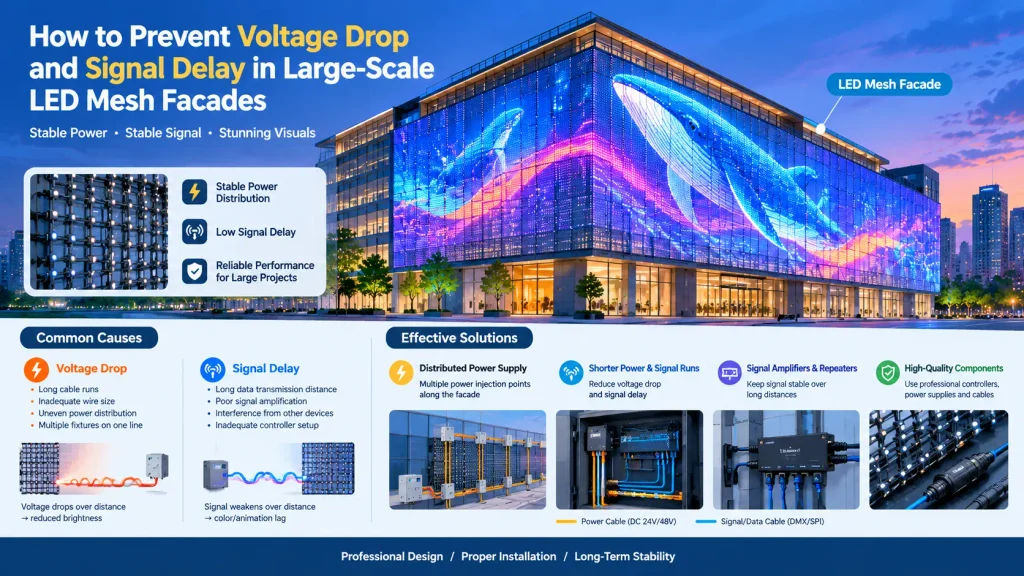
Core Answer: In large-scale architectural LED mesh facade projects, preventing voltage drop and signal delay requires moving away from traditional low-voltage long-run wiring and multi-level daisy-chaining. Instead, engineering teams must deploy AC high-voltage master transmission combined with distributed IP67 power boxes for electrical stability, and fiber-optic backbones with hardware-level Genlock synchronization to eliminate signal latency and frame tearing across high-rise media facades.
Voltage Drop Prevention: Deliver AC 220V/380V to local zones and convert to DC locally, keeping low-voltage lines under 3–5 meters to ensure terminal voltage loss stays below 5%.
Signal Integrity Assurance: Utilize armored single-mode fiber-optic links and industrial gigabit switches to limit control routing to a maximum of 2 cascade layers.
Hardware Synchronization: Implement Genlock timing across multi-controller video processors to force sub-microsecond frame refreshes across thousands of square meters.
Environmental Hardening: Operate outdoor power supplies below 75% load capacity and equip all network ports with professional surge protective devices (SPDs).
1. Introduction: The Dual Engineering Bottlenecks of Large-Scale LED Mesh Facades
Architectural media facades and transparent LED mesh screens transform high-rise buildings into dynamic digital canvases. However, scaling these installations beyond hundreds of square meters introduces severe physical challenges. Traditional low-voltage power distribution and standard copper cabling fail under long-distance transmission, resulting in color shifting, flickering, signal loss, and screen tearing.
This technical guide outlines enterprise-grade engineering methodologies designed to eliminate power loss and signal latency in mission-critical LED facade projects.
2. Power Distribution & Voltage Drop Mitigation in High-Rise Facades
How to Stop Low-Voltage DC Line Loss and Terminal Voltage Drop
Low-voltage DC systems (DC 5V, 12V, or 24V) are standard for powering LED mesh strips. However, transmitting low voltage over long distances causes severe ohmic resistance and voltage degradation.
The Problem: When terminal voltage drops below 4.2V in a 5V system, red and green diodes experience unequal forward voltage shifts, leading to severe white-balance distortion (yellowish/reddish discoloration), visible screen flickering, and receiver card reboot loops. High full-white currents also cause dangerous thermal buildup in undersized cables.
The Engineering Solution:
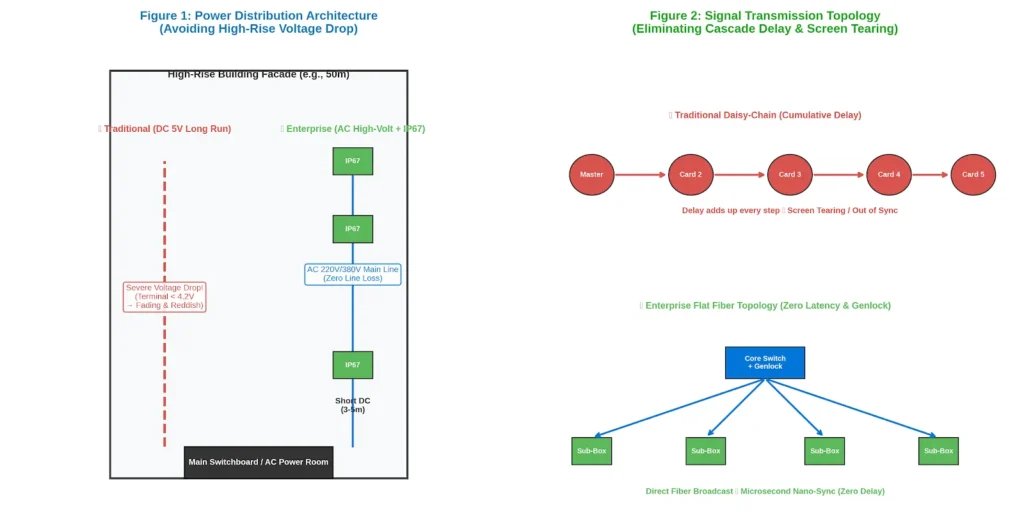
High-Voltage Master Transmission: Run AC 220V/380V high-voltage lines from the main electrical cabinet to distributed sub-control zones. High voltage drastically reduces current load and copper cable gauge requirements over vertical spans.
Distributed IP67 Power Conversion: Install industrial-grade, waterproof power supply boxes directly adjacent to LED display clusters. This restricts low-voltage DC cable runs to 3 to 5 meters maximum.
Strict Engineering Thresholds: Ensure the terminal voltage drop never exceeds 5% of the rated voltage (maintaining $\ge 4.75\text{V}$ for 5V systems under full load). Avoid unsupervised parallel power outputs to prevent internal circulating currents.
3. Signal Transmission & Latency Elimination in Long-Distance Topologies
How to Eliminate Signal Delay, EMI Interference, and Frame Tearing
Outdoor electromagnetic interference (EMI) from architectural lighting transformers and power corridors wreaks havoc on standard networking hardware.
The Problem: Standard UTP copper cables (Cat5e/Cat6) degrade rapidly in outdoor environments, shrinking reliable transmission distance from 100 meters to 60–70 meters. Furthermore, deep daisy-chaining (cascading multiple receiving cards sequentially) creates cumulative microsecond delays, resulting in visible “waterfall tearing” across large vertical video displays.
The Engineering Solution:
Fiber-Optic Backbones: Replace copper direct links with Industrial Media Converters and Armored Single-Mode Fiber Optic Cables, extending transmission range to kilometers with total immunity to EMI.
Flat Topology Architecture: Restrict signal routing layers to a maximum of 2 cascade layers using core gigabit or 10-gigabit industrial switches to eliminate cumulative propagation delays.
Genlock Hardware Synchronization: Deploy Genlock (hardware-locked synchronization) across multi-controller video processors to lock all receiving cards to a unified clock cycle, ensuring seamless, tear-free playback across massive multi-screen facades.
Surge and Grounding Protection: Protect all data ports with professional Network Signal Surge Protective Devices (SPDs) and bond all sub-control chassis and structural steel to the building’s lightning protection grid.
4. Engineering Comparison: Traditional vs. Enterprise-Grade Architecture
| Evaluation Metric | Traditional / Conventional Design | Enterprise-Grade Best Practice | Impact on Large-Scale Facades |
| Power Transmission | Long-run low-voltage DC lines (5V/12V from ground floor) | AC 220V/380V master lines + distributed IP67 sub-boxes | Eliminates severe voltage drop ($\Delta U > 5\%$) and color shifting. |
| Signal Medium | Long UTP Cat5e/Cat6 copper direct cabling | Industrial media converters + Armored Single-Mode Fiber | Prevents EMI degradation, extending distance from 70m to kilometers. |
| Network Topology | Multi-level deep daisy-chaining (Cascade $> 4$ layers) | Flat topology via core industrial switches (Max 2 layers) | Eliminates waterfall delays, cascade lag, and screen tearing. |
| Frame Synchronization | Independent or software-only loose sync | Hardware-level Genlock synchronization processors | Ensures sub-microsecond refresh alignment across multi-screen walls. |
| Power Supply Operating Load | Full load ($100\%$ capacity) or tight margins | Derated below $75\%$ capacity (e.g., max 225W on 300W PSU) | Accommodates extreme outdoor ambient temperature shifts and thermal stress. |
5. Frequently Asked Questions (FAQ)
Q1: Why does my LED mesh screen change color or turn yellow/red at the top of the building?
A: This is caused by excessive voltage drop over long DC cable runs. As voltage drops below 4.2V on 5V systems, LED diode forward voltages shift disproportionately. The solution is to switch to AC high-voltage master transmission and place IP67 power supplies within 3 to 5 meters of the top-section LED strips.
Q2: What is the maximum safe distance for control signals in outdoor LED mesh installations?
A: Standard copper Ethernet cables are limited to 60–70 meters in high-EMI outdoor environments. For long distances between control rooms and facade sub-controllers, single-mode fiber-optic cables paired with industrial media converters should be used to extend range up to several kilometers without signal loss.
Q3: How can I prevent screen tearing and frame delays on multi-screen high-rise facades?
A: Screen tearing is caused by excessive daisy-chaining and clock drift across multiple controllers. Eliminate this by deploying a flat network topology (max 2 switch layers) and implementing hardware-level Genlock synchronization to synchronize frame refresh cycles across all receiving cards.
Q4: What is the recommended power supply derating ratio for outdoor LED mesh projects?
A: Outdoor switching power supplies should operate at under 75% capacity (e.g., maximum 225W load on a 300W rated power supply). This accounts for extreme ambient temperature fluctuations and restricted thermal dissipation inside waterproof enclosures.
References & Data Sources
IEEE Standards Association: IEEE 802.3 Ethernet Standards & Long-Distance Fiber Optic Transmission Guidelines https://standards.ieee.org/standard/802_3-2018.html
National Electrical Manufacturers Association (NEMA): Enclosure Ratings & Outdoor Power Supply Thermal Derating Guidelines (NEMA 250 / IP67) https://www.nema.org/
Building Industry Consulting Service International (BICSI): Telecommunications Distribution Methods Manual (TDMM) – Structured Cabling and Grounding for High-Rise Structures https://www.bicsi.org/
Lighting Systems Engineering Handbook: Architectural Media Facade Power Distribution and Genlock Synchronization Protocols https://www.ies.org/
This engineering guide is continuously reviewed and updated to reflect current architectural lighting standards and 2026 industry best practices.
Conclusion
From commercial complexes and cultural tourism landmarks to large-scale LED Mesh Screen and Media Facade projects, MEKALEO remains dedicated to empowering global contractors and partners with reliable, transparent, and wind-conscious industrial-grade lighting and display solutions.
With 20 years of project expertise, we provide LED Mesh Screens, LED Point Lights, and Media Facade solutions designed for large-scale architectural applications. We look forward to joining hands with you to build the world’s next iconic lighting and media facade landmark.