Read Time: ~8 mins
About MEKALEO (Brand & Engineering Strength)
As a leading LED pixel light manufacturer and facade lighting solution supplier with over 20 years of focus in the industry, MEKALEO (located in Guzhen, Zhongshan — China’s Lighting Capital) is dedicated to delivering high-performance IP67 waterproof LED pixel lights, DMX512 / SPI LED pixel nodes, and custom architectural LED mesh solutions for global 3D media facade lighting projects. Supported by our experienced engineering and design teams, MEKALEO has deeply contributed to numerous large-scale architectural lighting developments worldwide.
Executive Overview
In architectural lighting, we often ask a fundamental question: How can luminaires evolve from being an “architectural accessory” into “the architecture itself”?
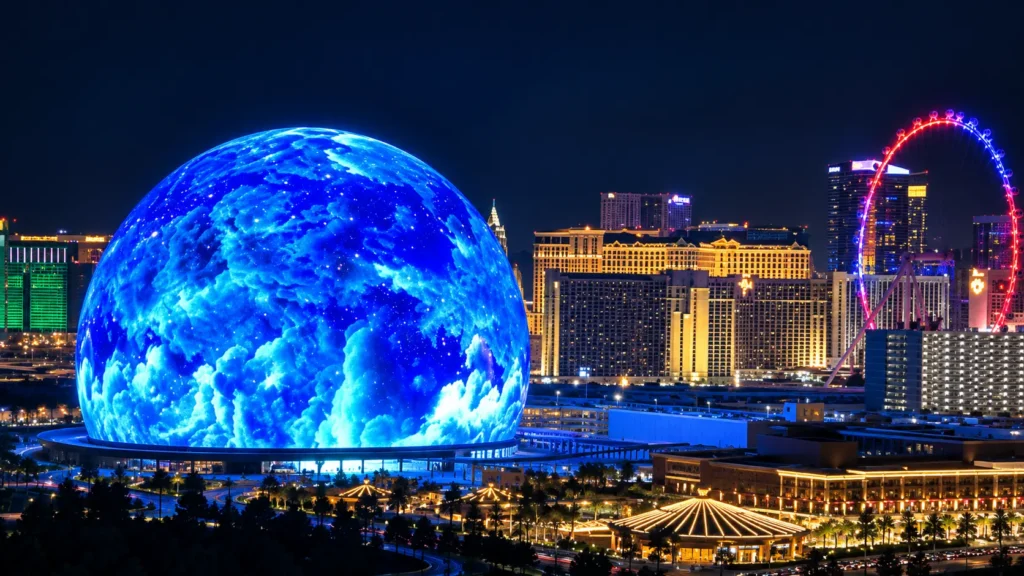
The completion of the Las Vegas Sphere (MSG Sphere) in 2023 offered a masterclass answer. Standing 112 meters tall and 157 meters wide, its 54,000 m² exterior—known as the Exosphere—represents the current pinnacle of digital media architecture and architectural pixel lighting.
Looking past the headline-grabbing $2.3 billion price tag and social media buzz, the Sphere is a textbook engineering accomplishment. From a pure lighting and optical design perspective, its facade successfully integrates 1.2 million high-density, programmable LED pixel lights into a 30% open-air aluminum mesh. In doing so, it overcame three major industry challenges in large-scale curved LED display facade projects: daylight visibility, wind load/heat dissipation, and wide-angle glare control.
How Does the Exosphere’s LED Pixel Light System Work?
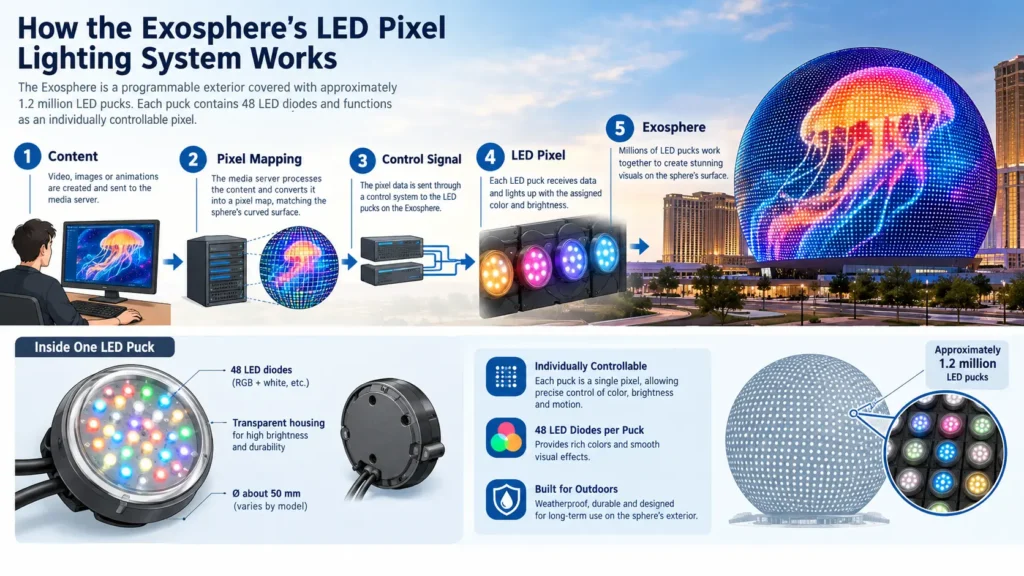
Transforming 1.2 million individual LED pixel light nodes into a smooth, seamless 16K ultra-HD dynamic canvas requires a highly synchronized four-step process:
3D Spatial Mapping
Engineers created a 1:1 digital twin of the Sphere, mapping the precise 3D spatial coordinates $(X, Y, Z)$ of every single pixel light node into a master coordinate database. Because standard 2D video cannot wrap naturally around a sphere, media servers map and distort the video layout via UV unwrapping—ensuring graphics render on the curved surface without stretching or warping.
High-Concurrency Video Slicing & Distributed Rendering
Processing 16K content at 60 frames per second generates massive data volumes. The media server cluster slices the master video into dozens of sub-regions. Multiple server nodes render these sub-regions simultaneously, using millisecond-level frame synchronization to eliminate visual tearing.
High-Bandwidth Network Data Distribution
Standard DMX512 networks lack the bandwidth for millions of channels. Instead, this DMX LED pixel light system uses a hybrid Art-Net and sACN IP-based network over 10Gbps fiber connections. Data streams from the main control room to distributed sub-controllers around the structure, which decode the data into high-speed local serial commands.
Driver IC Control & Optical Diffusion
Each LED pixel light node houses a custom driver IC using high-frequency Pulse Width Modulation (PWM) to regulate current. The IC adjusts the output of all 48 LEDs inside the node to blend colors before light passes through the polycarbonate diffuser dome.
Structural & Optical Integration: Large Pixel Pitch & Architectural Mesh
1 Node Design and Optical Layout
Hardware Specs: The Exosphere features roughly 1.2 million custom RGBW LED pixel light nodes. Each IP67 waterproof LED pixel node encapsulates 48 high-brightness LEDs capable of displaying 256 million colors.
Large Pixel Pitch & Visual Continuity: Designed with a pixel pitch of 200mm (20cm), the array creates a seamless 3D curved LED display facade. Up close, individual pixel nodes are clearly visible as a grid. However, from distances beyond 100 meters (e.g., from the Strip or surrounding hotel towers), the human eye can no longer resolve the 20cm gaps, allowing the individual pixels to merge into a continuous LED dot lighting display.
2 Daytime “Invisibility” & Thermal Management
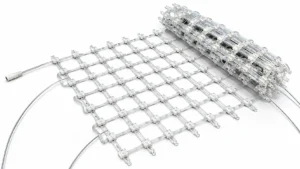
Structural Transparency: Mounting the exterior LED pixel lights onto an open aluminum lattice creates a 30% open-area ratio. This architectural LED mesh design significantly reduces wind load from desert gusts while allowing natural airflow to cool the display.
Eliminating the “Black Box” Effect: The black bases and anti-glare lenses blend directly into the metallic mesh structure. Under daytime sunlight, the pixel lighting hardware hides within the building skin, avoiding the unsightly “giant black wall” look typical of unlit traditional LED screens.
3. Three Key Takeaways for the Lighting Industry
1 Wide-Angle Optical Diffusion (“Light Without Lamps”)
Applying point light sources across curved surfaces usually creates viewing angle distortion and unwanted glare. The Sphere solves this using custom polycarbonate (PC) hemispherical diffusion domes that offer high UV resistance and an IP67 rating. The optical geometry spreads light ultra-widely, maintaining consistent color saturation and brightness whether viewed head-on, from the side, or looking upward from the ground.
2 Extreme Daylight Visibility
Direct sunlight in the Nevada desert can easily top 100,000 Lux. Standard architectural lighting gets completely washed out. By packing 48 high-power LEDs into each LED pixel light, the Exosphere achieves peak brightness levels reaching thousands of Nits. This enables high-contrast imagery—from a giant eyeball at high noon to a detailed Mars surface at dusk—even under direct sunlight.
3 Advanced Curvature Correction & Signal Handling
Managing millions of control channels in an advanced programmable LED pixel light architecture without latency demands exceptional system design. Combining a high-bandwidth Ethernet network with a server cluster capable of real-time 16K/60fps video slicing ensures the dynamic visuals run smoothly without warping or lagging.
Design Reflection: Remaining Challenges & Considerations
1. Light Pollution & Dark Sky Compliance
Las Vegas is a high-brightness city where a massive luminescent sphere fits in naturally. However, transferring a mega-scale LED pixel light system to cities with strict dark-sky regulations presents challenges with light trespass and sky glow. Future projects in sensitive urban areas will need refined multi-tier dimming schedules and physical shielding angled to block spill light into the night sky.
2. Environmental Aging & Long-Term Maintenance
Exposing 1.2 million outdoor LED pixel light nodes to extreme desert temperatures, intense UV radiation, and sandstorms inevitably leads to polycarbonate yellowing, seal degradation, and LED color shift over time. Replacing individual nodes at extreme heights is exceptionally costly. A key technical priority for future LED media facade projects will be automated color and brightness compensation algorithms that monitor lumen depreciation via sensors and adjust driving currents automatically.
Frequently Asked Questions (FAQ)
Q1: How many LED pixel lights are used on the Las Vegas Sphere?
A: The Exosphere uses approximately 1.2 million custom LED pixel lights (pixel nodes). Each node houses 48 high-output RGBW/RGB LEDs capable of displaying up to 256 million colors.
Q2: Why does it look like a dot matrix up close, but an HD video screen from afar?
A: This is due to the 20 cm (200mm) large pixel pitch and the limits of human visual acuity. At viewing distances over 100 meters, the eye cannot resolve 20 cm gaps between pixel light nodes. The light blends together across the spherical surface into a continuous high-definition image.
Q3: How does the Sphere handle intense sunlight and strong desert winds?
A: For sunlight, each LED pixel light packs high-power LEDs that output thousands of Nits to cut through 100,000+ Lux glare. For wind and heat, the display uses an architectural LED mesh with a 30%+ open area that lets wind pass through safely while enabling passive convection cooling.
Q4: What should engineering contractors look for in an LED pixel light manufacturer for mega-facades?
A: Key requirements include choosing an experienced outdoor architectural lighting factory that provides IP67/IP68 waterproof LED pixel nodes, stable DMX512 / Art-Net control system integration, custom mounting brackets for structural transparency, and professional 3D spatial mapping support.
Data Sources & References
Technical metrics, dimensions, and system specifications cited in this analysis are sourced from the following engineering reports and official releases:
Sphere Entertainment Co. Official Releases
Exosphere hardware specs and system capability overviews
SACO Technologies Technical Whitepapers
Exosphere 1.2M Custom LED Pixel Light Architecture & Optical Design
7thSense Case Studies
16K x 16K 60fps Media Processing & Playback for the Exosphere
Populous Architectural Engineering Reports
Spherical Architecture, Structural Wind Loads, and Exosphere Integration