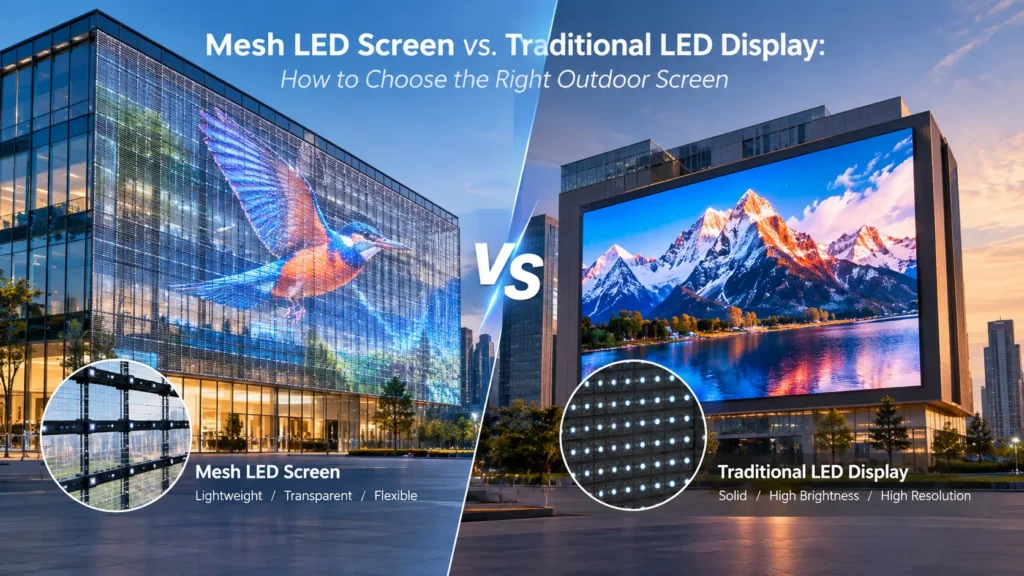
If you are choosing an outdoor LED screen, here is the short answer: Traditional LED displays are best for small, close-up screens at street level. However, for large installations on tall buildings, high-rise facades, or glass curtain walls, Outdoor Mesh LED Screens are almost always the smarter, more cost-effective choice.
Mesh LED screens save up to 45% on total project costs because they are extremely lightweight, let wind blow right through them, and don’t require heavy steel supports or expensive air conditioning.
Quick Key Takeaways
70% Lighter: Mesh screens weigh only 10–15 kg per square meter, making them safe for glass walls and older buildings.
Wind-Safe: With 40% to 80% transparency, wind passes straight through the screen—ideal for high-rise or coastal areas.
Saves Energy: Mesh screens cool down naturally through open airflow, cutting power bills by 30% to 50% without needing active air conditioning.
Preserves Daylight: People inside the building can still enjoy daylight and views through the windows during the day.
1. The Hidden Cost Iceberg: Why the Screen Price Is Only 40% of Your Budget
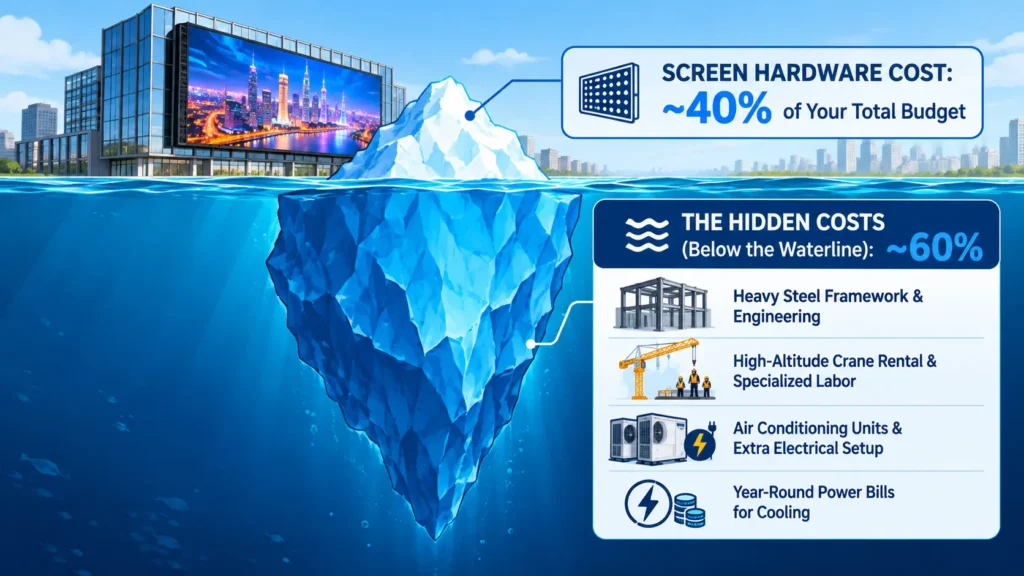
When shopping for an outdoor LED wall, it’s easy to focus only on the price per square meter of the screen itself. But in real-world projects, the screen hardware makes up only about 40% of your initial budget.
The other 60% hides “below the surface” in heavy steel support structures, high-altitude cranes, specialized installation crews, and ongoing electricity costs.
Total Cost Comparison at a Glance
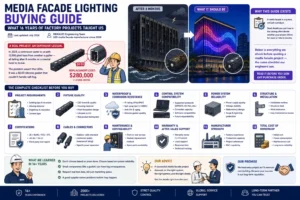
(Based on MEKALEO’s 16+ years of manufacturing expertise and insights from 20+ major outdoor LED mesh facade projects in China)
| Feature | Mesh LED Screen | Traditional Solid LED Screen | What This Means for Your Project |
| Weight | 10 – 15 kg/m² | 35 – 50 kg/m² | 70% Lighter: No need to heavily reinforce your building. |
| Steel Framing | Minimal / Hanging Mount | Heavy-gauge steel cage | 30%–50% Savings: Uses far less structural steel. |
| Cooling | Natural airflow | Air conditioning required | Zero AC Costs: Saves money on equipment and power bills. |
| Wind Resistance | High (Open gaps let wind pass) | Low (Acts like a solid sail) | Safer High-Altitude Use: Drastically reduces wind drag. |
| Power Use | ~250–400 W/m² (Avg) | ~450–800 W/m² (Avg) | Lower Utility Bills: Uses up to 40% less electricity. |
2. Aesthetics & Safety: Invisible Media vs. The “Black Box” Effect
Traditional solid LED cabinets look like massive, dark boxes when turned off. They block natural sunlight and can make modern glass buildings look cluttered.
Mesh LED screens solve this by acting like an “invisible screen”:
Natural Daylight Inside Your Building
Mesh screens consist of thin LED strips with open space between them. With 50% to 80% transparency, employees and visitors inside the building can still enjoy sunlight and see outside clearly.
Built for High Winds and Extreme Weather
On high floors or in coastal regions, strong winds create massive pressure against solid walls. Because a mesh screen is hollowed out, wind blows right through it—reducing wind drag by up to 60% and keeping the building structure safe.
3. Quick Decision Guide: Which One Fits Your Project?
Not sure which screen fits your needs? Use this simple rule of thumb:
Choose an Outdoor Mesh LED Screen if:
Your screen area is larger than 100 m² or installed above the 5th floor.
You are mounting the screen over a glass curtain wall, window facade, or modern building.
Your location gets strong winds or is near the ocean.
Viewers will stand 20 to 30 meters away or farther.
Choose a Traditional Solid LED Screen if:
The screen is placed at street level or near eye level along a road.
Viewers stand close to the screen (under 10 meters away), requiring fine, razor-sharp detail.
You are building a small to mid-sized billboard (under 30–50 m²) on a solid concrete wall.
Frequently Asked Questions
Q1: Are Mesh LED screens fully waterproof for heavy rain and storm weather?
Yes. Quality outdoor mesh screens come with an IP67 or IP68 waterproof rating. The electronics and wiring are completely sealed inside weather-proof aluminum or silicone housing, allowing them to handle torrential rain, high humidity, and extreme temperatures from -40°C to +60°C.
Q2: Do the open gaps in a mesh screen lower the picture quality during the day?
Not when viewed from the correct distance. Outdoor mesh screens use ultra-bright LEDs (delivering 6,500 to 10,000 nits of brightness). From 20 meters away or more, the human eye naturally blends the light strips together into a crisp, bright image—even under direct, sunny skies.
Q3: How do technicians repair a mesh screen on a 100-meter skyscraper?
Repairing a mesh screen is simple and fast. Instead of taking down large, heavy panels, technicians can swap out individual LED strips from either the front or back in under three minutes without turning off the rest of the display.
References & Industry Standards
Structural & Wind Load Safety: ASCE/SEI Standards for Building Envelopes – Guidelines on dynamic pressure and structural safety for building facades.
Ingress Protection & Waterproofing: IEC IP Code Ratings – International standards for outdoor electronics protection (IP67/IP68).
Lighting Performance: Illuminating Engineering Society (IES) – Architectural lighting brightness, efficiency, and glare control standards.
Architectural Integration: Media Architecture Institute – Frameworks for integrating digital media displays into urban building design.