Last updated: July 2026 |MEKALEO] Engineering Team — LED media facade manufacturer since 2009
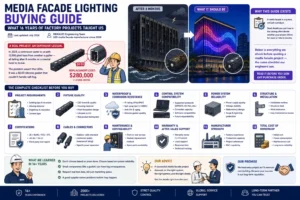
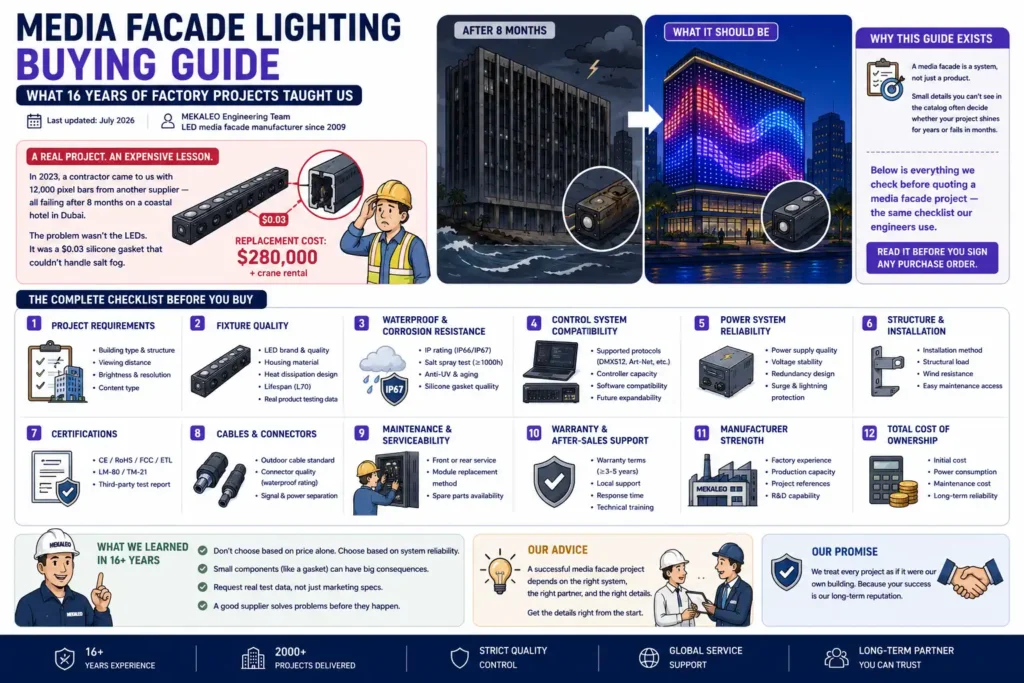
One lesson we’ve learned from 16 years of media facade projects is that failures are rarely caused by the LEDs themselves. More often, they come from overlooked details such as sealing materials, connector quality, drainage design, or thermal management — especially in coastal and high-humidity environments.
When these details are ignored, the cost of replacement can quickly exceed the original product investment once labor, access equipment, and project disruption are included.
That’s why every project quotation at MEKALEO goes through the same engineering checklist outlined in this guide. Review it before signing any purchase order — it could save months of delays and significant maintenance costs later.
1. What Is Media Facade Lighting?
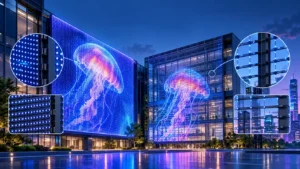
A media facade turns a building’s exterior into a low-resolution display using individually controllable LED fixtures. Unlike an LED billboard (fine pixel pitch, video-grade), a media facade prioritizes architectural integration, transparency, and viewing distance — typically watched from 50–500 meters away.
Four mainstream product types:
| Type | Typical Pixel Pitch | Best For | Transparency |
|---|---|---|---|
| Linear pixel bars | 50–200 mm | Building outlines, curtain wall mullions | High |
| LED pixel dots | 100–500 mm | Large-area low-res animation | Very high |
| Mesh/grid screens | 25–100 mm | Video content on glass facades | 60–90% |
| Flexible pixel strips | 60–160 mm | Curved surfaces, retrofit projects | High |
Rule of thumb for pixel pitch: minimum viewing distance (m) ≈ pixel pitch (mm) ÷ 1. A 100 mm pitch looks coherent from ~100 m. Buying a finer pitch than your viewing distance requires is the most common way buyers overspend — we’ve seen budgets inflate 40% for resolution no one can perceive from the street.
2. The 7 Specifications That Actually Matter
2.1 IP Rating — and What Datasheets Don’t Tell You
IP65 is the minimum for facades; IP66/IP67 for coastal or high-rainfall regions (per IEC 60529). But the rating alone is not enough. Ask these three questions:
- Is it structural waterproofing or glue-potted? Potted fixtures (fully encapsulated in PU or silicone) survive 8–10 years outdoors; gasket-only designs often fail at year 3–5 when seals harden.
- Cable entry design? 70% of water ingress failures we’ve repaired happened at the cable gland, not the housing.
- Salt spray test report? For projects within 5 km of the coast, demand a 500-hour neutral salt spray test (ISO 9227). Standard aluminum housings without marine-grade anodizing corrode visibly within 18 months in the Gulf region — we learned this on our first Qatar project in 2012.
2.2 Brightness and Auto-Dimming
- Urban facade: 1,200–2,500 nits daytime-visible; 4,000+ nits for direct-sunlight-facing surfaces
- Night output must dim to 300 nits or below — many cities now enforce this (e.g., Shanghai’s landscape lighting regulations; dark-sky guidelines referencing CIE 150:2017)
- Confirm the control system supports scheduled or photocell-based dimming. Fixed-brightness fixtures get projects shut down by municipal complaints. It happened to one of our clients in Hangzhou in 2019 — retrofit cost more than the original dimming module would have.
2.3 Control Protocol: DMX512 vs. SPI vs. Art-Net/DVI
| Protocol | Pixel Count per Universe/Line | Cable Distance | Use Case |
|---|---|---|---|
| DMX512 (ANSI E1.11) | 170 RGB pixels | 300 m (with proper RS-485 wiring) | Reliable, industry standard, mid-size projects |
| SPI (TTL) | Flexible | <10 m without amplification | Cheap, short runs, risky on tall buildings |
| Art-Net/sACN over Ethernet | Thousands | 100 m per segment, extendable via fiber | Large facades, video playback |
Field lesson: on a 180 m tower we delivered in 2021, the client’s previous SPI-based system showed random flicker above floor 30 — signal degradation over long risers. We rebuilt it with DMX512 + fiber backbone between floor distribution boxes. If your building exceeds 100 m, budget for fiber signal distribution from day one.
2.4 LED Package and Lifetime
- Demand branded LED chips with LM-80 test data; expect L70 ≥ 50,000 hours
- Color consistency: ≤ 5 SDCM binning, or adjacent fixtures will visibly mismatch — a defect you cannot fix after installation
- Check the driver IC (e.g., constant-current types like UCS512 / SM17512-class). PWM refresh ≥ 1.2 kHz if the facade will be filmed or photographed (avoids camera flicker)
2.5 Mechanical: Wind Load and IK Rating
Facade fixtures are structural elements. Verify:
- Bracket wind-load calculation matching local code (e.g., ASCE 7, EN 1991-1-4, GB 50009)
- IK08 minimum impact rating (IEC 62262) for fixtures within 3 m of ground level
- Stainless steel 304 fasteners standard; 316 for coastal projects — mixing aluminum housing with carbon-steel screws causes galvanic corrosion (another failure we’ve physically repaired for other brands’ installs)
2.6 Power System
- Calculate at 80% of PSU rated capacity, never 100%
- Outdoor-rated power supplies (IP67, e.g., Mean Well HLG series or equivalent with matching certifications)
- Voltage drop: on 24 V systems, keep single runs under 10 m or upsize cable gauge — we spec by calculation (≤3% drop), not by habit
2.7 Certifications to Demand
- CE (EN 60598-1 / EN 55015) for EU, UL 1598 / cUL for North America, RoHS everywhere
- Photobiological safety: IEC/EN 62471 (Risk Group 0 or 1)
- Ask for the actual test reports with report numbers — not just a logo on the datasheet. We’ve audited competitor “certifications” that were for a different product model. Verify the model number matches.
3. Real Project Reference: What a Delivered Spec Looks Like
Project: 32-story commercial tower, Southeast Asia (2024) Scope: 8,600 linear meters of DMX pixel bars, 100 mm pitch
- Fixture: 1000 mm aluminum-extrusion bar, IP66 potted, IK08, 12 W/m
- Control: Art-Net master → 42 floor-level DMX distribution boxes via single-mode fiber
- Power: 380 outdoor PSUs at 72% average load
- Commissioning: 9 days on site, including pixel mapping against the media server (Madrix)
- Post-delivery data: 14 fixture failures in first 24 months out of 8,600 (0.16%) — all replaced under our 5-year warranty within 3 weeks
What went wrong (and what we changed): initial pixel mapping was done from CAD drawings; on-site fixture orientation differed on 3 facade sections because the curtain wall contractor mirrored the mounting rails. Now we require photographic verification of every zone before mapping — a half-day step that saves a week of rework. Put this in your contract with any supplier.
4. Five Buying Mistakes We See Every Year
- Choosing pixel pitch by budget, not viewing distance — either overspending or ending up with unreadable content
- Ignoring the control system until after fixture purchase — controller and fixture IC must be confirmed compatible before the PO
- No spare stock clause — order 3–5% extra fixtures. Matching LED bins two years later is nearly impossible
- Comparing quotes without comparing potting, housing alloy, and PSU brand — a 20% cheaper fixture usually hides exactly there
- Skipping DIALux/pre-visualization — a rendered content simulation costs a supplier a few days and prevents six-figure disappointments. Any serious manufacturer will provide one free for real projects
5. Supplier Evaluation Checklist (Copy This)
- Own factory with SMT lines, or trading company? (Ask for a live video factory tour)
- LM-80, salt spray, IP test reports with matching model numbers
- Minimum 5-year warranty in writing, with defined response time
- Reference projects older than 3 years you can independently verify
- Free control system compatibility test before mass production
- Aging test: 48–72 h full-power burn-in before shipment, with records
- Sample approval process: sealed golden sample retained by both parties
FAQ
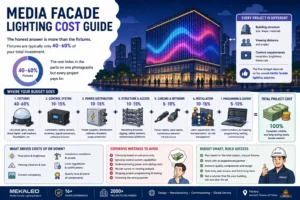
How much does media facade lighting cost? Typical turnkey range: $80–350 per m² depending on pixel pitch, fixture type, and control complexity. Linear outline lighting sits at the low end; video-capable mesh at the high end. Fixtures are usually 55–65% of total cost; control, power, and installation make up the rest.
How long does production and delivery take? Standard: 20–35 days production for 5,000+ meter orders, plus shipping. Add 7–10 days if custom pitch or housing color (RAL powder coating) is required.
Can media facade fixtures be installed on an existing building? Yes — pixel dots and flexible strips are designed for retrofit. The critical constraint is usually cable routing and adding weatherproof distribution boxes, not the fixtures themselves. Send us facade drawings or photos and we’ll assess feasibility at no cost.
About [MEKALEO]
We are an LED media facade manufacturer based in [guzhen China], operating our own 12,000 m² factory since 2009. 600+ facade projects delivered across 40+ countries. ISO 9001 certified; products carry CE, UL, and RoHS certification with verifiable report numbers.
📩 Get a free lighting simulation and BOM for your project: send facade drawings to [[email protected]] or reach us at [+8618928114374]. Response within 24 hours on business days. 📍 [6th Floor, No. 398, Haizhou East Bank North Road, Guzhen Town, Zhongshan City] — factory visits and live video audits welcome.