Outdoor LED facade lighting is the discipline of using weather-rated LED fixtures to illuminate a building’s exterior as a designed visual system — not merely to make it visible after dark, but to shape how it is perceived, remembered, and photographed.
A well-lit facade does three jobs at once: it reinforces brand identity, it defines architectural form through contrast and shadow, and it manages how a building integrates into its nighttime surroundings. Getting all three right is an engineering problem as much as an aesthetic one. This guide unpacks both — and if you’re ready to move from theory to a specified system, explore our outdoor LED facade lighting solutions.
What Is Outdoor LED Facade Lighting?
Outdoor LED facade lighting is the discipline of using weather-rated LED fixtures to illuminate a building’s exterior as a designed visual system — not merely to make it visible after dark, but to shape how it is perceived, remembered, and photographed.
A well-lit facade does three jobs at once: it reinforces brand identity, it defines architectural form through contrast and shadow, and it manages how a building sits within its nighttime surroundings. Getting all three right is an engineering problem as much as an aesthetic one. This guide walks through six essentials — what facade lighting is, where it came from, what it’s made of, how it works, where it’s used, and where it’s going — and if you’re ready to move from theory to a specified system, explore our outdoor LED facade lighting solutions.
1. Definition: What Facade Lighting Actually Means
Illumination as Communication, Not Just Visibility
The core idea separating facade lighting from ordinary exterior lighting is intent. A security floodlight exists to let you see. A facade lighting scheme exists to make you feel something — grandeur, warmth, modernity, brand recognition — while you see. Light becomes a design material, worked like stone or glass.
Facade Lighting vs. Floodlighting
The two are often confused. Floodlighting pours even, high-output light across a surface for maximum visibility. Facade lighting uses contrast, direction, color, and shadow to sculpt perception. Floodlighting is sometimes a tool within a facade scheme, but it is not a synonym — a fully flooded building often looks flat and lifeless, precisely because it lacks the shadow that gives form its depth.
The Three Layers of a Facade Scheme
Professional designers typically compose in layers: a base wash establishing overall brightness, accent lighting picking out columns, cornices, or entrances, and dynamic or decorative layers — color, animation, media content — used sparingly for events. The art lies in restraint; the most admired facades rarely use every capability at once.
2. History: From Gas Flame to Addressable Pixel
The Pre-Electric Era
Monumental exterior illumination is older than electricity. Nineteenth-century civic buildings and expositions were outlined with gas jets and, later, carbon-arc lamps — dramatic but hot, dangerous, and impossible to control with precision.
The Incandescent and Discharge Decades
The twentieth century brought incandescent floodlighting, then high-intensity discharge (HID) sources — metal halide, high-pressure sodium, mercury vapor. These made large-scale facade illumination practical and were the standard from roughly the 1960s through the 2000s. Their weaknesses were fixed: limited color, high heat, slow warm-up, short life, and heavy energy draw. Color changes meant physically swapping gel filters.
The LED Turning Point
Practical high-brightness LEDs arrived in the 1990s and 2000s. The breakthrough was the efficient blue LED (whose inventors received the 2014 Nobel Prize in Physics), which made white and full-color LED light possible. Suddenly a single fixture could produce any color on command, switch instantly, last tens of thousands of hours, and consume a fraction of the power. By the 2010s LEDs had displaced HID for virtually all new facade projects.
The Digital and Media-Facade Era
The most recent shift is not about light output but control. Individually addressable pixels, DMX and network protocols, and cloud scheduling turned static illumination into a programmable medium. Buildings became low-resolution displays — the “media facade” — capable of animation, live content, and synchronized city-scale shows.
3. Components: What a Facade Lighting System Is Made Of
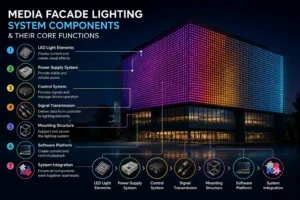
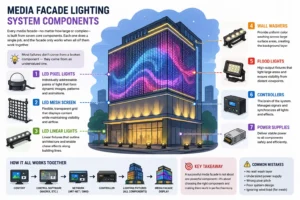
A facade installation is a system, not a bag of fixtures. Five component groups determine how it performs and how long it lasts.
The LED Source and Optics
At the heart is the LED package itself, rated for efficacy (lumens per watt, typically 100–160 lm/W outdoors) and color consistency. Around it, lenses and reflectors shape output into a defined beam — 10° to spotlight a column, 120° to wash a broad wall. Beam angle, not raw wattage, decides whether light lands where intended or spills wastefully into the sky.
The Driver: The System’s Brain
Every fixture needs a driver to convert AC mains into the constant current LEDs require, and to handle dimming and color channels. Because heat and electrical stress concentrate here, the driver — not the LED — is usually the first component to fail. Brand-name drivers with long warranties are the single biggest lever on system longevity.
The Housing and Thermal Path
LEDs don’t burn out abruptly; they slowly dim as junction temperature rises. Die-cast aluminum housings double as heat sinks to pull that heat away. As a rule of thumb rooted in the Arrhenius reliability model, every 10°C reduction in junction temperature roughly doubles useful life — which is why thermal design quietly determines lifespan.
Seals, Gaskets, and Connectors
Outdoors, water is the enemy. Silicone gaskets, IP-rated connectors, and anti-condensation breather valves keep moisture out over years of UV exposure and thermal cycling. Cheap seals harden and crack; failed seals, not failed chips, end many fixtures’ lives prematurely.
Control Infrastructure
Finally, the controllers, cabling, power supplies, and data network that let fixtures be addressed and synchronized. On large facades this “invisible” layer is as critical as the lights — underestimating it is one of the most common causes of a project that looks right on paper but can’t be reliably run.
See the full range of facade fixture types we manufacture to match each surface to the right optic.
4. How It Works: From Electricity to Designed Light
The Physics in Brief
An LED produces light through electroluminescence — electrons crossing a semiconductor junction release energy as photons. Unlike incandescent sources that waste most energy as heat, LEDs convert a large share of electricity directly to light, which is why they run cool and efficient.
Binning: Why Color Consistency Is Hard
No two LED chips come off the line identical. Manufacturers sort them by color and brightness into bins; tight binning (measured in MacAdam ellipse steps, ideally SDCM ≤3) keeps hundreds of fixtures visually matched across a facade. Loose binning is the hidden reason two “identical” fixtures glow subtly different shades on the same wall — and the difference only worsens as they age.
Environmental Protection Ratings
Because facade fixtures live outdoors, their survival is graded by standardized codes. IP ratings (IEC 60529) describe protection against dust and water — IP65 is the practical outdoor minimum, IP67 mandatory at ground level. IK ratings (IEC 62262) grade impact resistance where fixtures sit within human reach. These aren’t marketing labels; they’re the difference between a fixture that lasts a decade and one that fails in a monsoon.
Verified Performance
Trustworthy performance claims rest on standardized testing: LM-79 measures a fixture’s actual photometric output, and LM-80 tracks how its lumen output holds up over thousands of hours. A supplier who can produce genuine LM-80 data is one whose lifespan claims you can actually trust.
Turning Fixtures Into a System
Individually, fixtures just emit light. Networked through control protocols, they become a coordinated instrument — dimming on schedule, shifting color for seasons and events, or animating in unison. This layer is what elevates a lit building from merely bright to genuinely designed.
5. Applications: Where Facade Lighting Earns Its Keep
Commercial and Hospitality Landmarks
Hotels, casinos, shopping malls, and flagship retail use facade lighting as a 24-hour brand billboard. A distinctive nighttime signature drives recognition and social-media exposure far cheaper than equivalent advertising. Here dynamic color and seasonal themes justify their cost.
Corporate and Institutional Buildings
Headquarters, banks, and civic buildings favor restrained, static white schemes that signal permanence and trust. The goal is dignity, not spectacle — often a single well-chosen color temperature grazing the building’s best architectural features.
Cultural and Heritage Architecture
Museums, theaters, cathedrals, and historic monuments use lighting to reveal craftsmanship — the texture of carved stone, the rhythm of a colonnade. Wall grazing (mounting fixtures close and aiming steeply) exaggerates surface detail that flat floodlighting would erase. Heritage projects demand particular sensitivity: light should honor the architecture, not overwhelm it.
Bridges, Towers, and Infrastructure
Bridges and telecom towers become civic landmarks through lighting, often tied into city identity and celebration schedules. These projects push the hardest engineering: long cable runs, extreme weather exposure, and difficult maintenance access that make component quality non-negotiable.
Media Facades and Urban Spectacle
At the far end sit fully pixel-mapped media facades — building envelopes turned into low-resolution displays for animation, live content, and synchronized city-wide light festivals. These deliver the greatest visual drama and carry the greatest complexity in data infrastructure, content creation, and light-pollution management.
6. Future Trends: Where the Technology Is Heading
Human-Centric and Circadian-Aware Lighting
Growing awareness of light’s effect on wildlife and human circadian rhythms is pushing design toward warmer color temperatures and lower intensities after certain hours. Expect facades that automatically shift warmer and dimmer late at night — not only to comply with tightening codes but to reduce ecological disruption.
Smart Control, IoT, and Data Feedback
Fixtures are becoming networked sensors as well as light sources. Integration with building management systems, weather feeds, and city platforms enables facades that respond to conditions in real time — dimming in fog, celebrating events automatically, and reporting their own faults before they’re visible from the street.
Responsible Lighting as Regulation, Not Option
Light pollution is shifting from aesthetic concern to legal requirement. Frameworks like the DarkSky/IES Five Principles for Responsible Outdoor Lighting (useful, targeted, low-level, controlled, warm-colored) are increasingly written directly into municipal building codes. Future projects will treat glare control and curfew scheduling as baseline compliance, not premium features.
Efficiency, Sustainability, and Circular Design
As LED efficacy plateaus, attention turns to whole-lifecycle sustainability — recyclable housings, replaceable modules instead of sealed throwaway units, and drivers designed to be serviced rather than discarded. Energy scheduling (full shows only at peak hours, deep dimming overnight) will become standard practice for both cost and carbon reasons.
Content and Experience as the Differentiator
As the hardware commoditizes, the value migrates to software and content — the choreography, storytelling, and interactivity that turn a lit surface into an experience. The next competitive frontier isn’t brighter pixels; it’s more meaningful ones.
Comparison Table: Facade Lighting Technologies Through Time
| Era / Source | Typical Period | Color Control | Efficacy | Lifespan | Key Limitation |
|---|---|---|---|---|---|
| Gas / carbon-arc | 1800s–early 1900s | None | Very low | Hours–days | Heat, danger, no control |
| Incandescent flood | Early–mid 1900s | Filters only | Low | ~1,000 hrs | Energy, short life |
| HID (metal halide, HPS) | 1960s–2000s | Filters only | Moderate | ~10,000–20,000 hrs | Slow start, heat, fixed color |
| Static white LED | 2000s–present | Limited | High (100–160 lm/W) | 50,000+ hrs | Higher upfront cost |
| RGB/RGBW LED | 2010s–present | Full, instant | High | 50,000+ hrs | Control complexity |
| Addressable pixel/media | 2010s–present | Per-pixel, dynamic | High | 50,000+ hrs | Data infrastructure, content cost |
FAQ
Q: What’s the difference between facade lighting and floodlighting? Floodlighting aims for even visibility; facade lighting aims for designed effect — using contrast, color, and shadow to shape perception. Floodlighting is a tool facade lighting sometimes uses, not a synonym.
Q: Why did LEDs replace metal halide for facades? LEDs offer instant full-color control, 50,000+ hour life, 50–70% lower energy use, and far less heat — advantages HID sources physically cannot match.
Q: What makes a facade look “designed” rather than just lit? Layering and restraint: a base wash, selective accents on architectural features, and shadow deliberately preserved to give form depth. Flooding every surface evenly usually looks flat.
Q: How long does an LED facade installation last? Quality fixtures are rated 50,000+ hours (L70). In practice, drivers and seals — not the LEDs — determine real-world lifespan, so component quality matters more than headline LED specs.
Q: What is a “media facade”? A building envelope fitted with individually addressable pixels, turning the surface into a low-resolution display capable of animation and live content.
Q: Are there rules about how bright a facade can be? Increasingly, yes. Many cities regulate uplight, glare, color temperature, and curfews, often referencing DarkSky/IES responsible-lighting principles now embedded in building codes.
References
- 1. IEC 60529 — Degrees of protection provided by enclosures (IP Code) International Electrotechnical Commission 🔗 https://webstore.iec.ch/publication/2452
- 2. IEC 62262 — Degrees of protection against external mechanical impacts (IK Code) International Electrotechnical Commission 🔗 https://webstore.iec.ch/publication/6602
- 3. The Nobel Prize in Physics 2014 — for the invention of efficient blue light-emitting diodes 🔗 https://www.nobelprize.org/prizes/physics/2014/summary/
- 4. U.S. Department of Energy, Solid-State Lighting Program — LED reliability, lifetime, and efficacy research 🔗 https://www.energy.gov/eere/ssl/solid-state-lighting
- 5. DarkSky International & IES — Five Principles for Responsible Outdoor Lighting 🔗 https://darksky.org/resources/guides-and-how-tos/lighting-principles/
- 6. IES LM-79 / LM-80 — Photometric measurement and lumen maintenance test standards Illuminating Engineering Society 🔗 https://store.ies.org/
- 7. ANSI C78.377 — Chromaticity (SDCM/MacAdam ellipse) specification for SSL products 🔗 https://webstore.ansi.org/