Building facade lighting falls into four main types: LED linear lights that outline building edges, LED wall washers and grazers that light wall surfaces, LED pixel lights that form addressable point grids, and media facades that turn a building envelope into a video canvas. Facade material, building height, viewing distance and the need for static or dynamic content decide which type fits a project. Most landmark projects combine two or more types.
Quick Selection: Which Facade Lighting Type Fits Your Project?
| If the project needs… | Choose |
|---|---|
| Crisp building outlines, mullion lines or roof edges | LED linear lights |
| Even, shadow-free light on flat cladding | LED wall washers |
| Deep texture on stone, brick or timber | LED wall grazers |
| Dynamic patterns on large or curved facades | LED pixel lights |
| Video content while keeping glass facades transparent | Media facade (transparent LED mesh or linear pixel bars) |
1. What Is Facade Lighting?
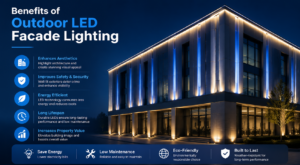
Facade lighting is the exterior lighting of a building envelope, used to make the architecture visible, legible and recognizable after dark. Modern commercial facade lighting projects serve three goals at the same time:
- Architectural identity – the building becomes a recognizable night-time landmark and supports property value and night-time footfall.
- Compliance – the design must control light pollution and glare and follow local energy codes, such as California Title 24, Part 6 outdoor lighting requirements in the US or Ecodesign rules in the EU.
- Daytime integration – fixtures, cables and brackets must stay discreet on the facade during daylight hours.
DarkSky International’s Five Principles for Responsible Outdoor Lighting are widely used as a design baseline: light should be useful, targeted, low level, controlled and warm-colored.
2. Direct-View vs. Indirect Facade Lighting
Every facade lighting scheme is built on one of two optical strategies, or a combination of both. Both draw on the same six fixture families, catalogued on our facade lighting product range.
| Strategy | How the light is seen | Typical fixtures | Key design checks |
|---|---|---|---|
| Direct-view lighting | The light source itself is visible and forms lines, dots or images | LED linear lights (outline), LED pixel lights, LED mesh screens, media facades | Glare control, diffuser quality, daytime visibility of fixtures |
| Indirect (reflected) lighting | The fixture is hidden; light is reflected by the wall material | LED wall washers, wall grazers, floodlights | Beam angle, setback distance, surface reflectance, texture depth |
3. Facade Lighting Design by Building Type
| Building type | Typical lighting language | Typical CCT | Typical fixture mix |
|---|---|---|---|
| Modern towers and commercial landmarks | Strong geometry, dynamic content | 4000K–5000K white or RGBW | Linear lights + pixel lights or media facade |
| Historic and classical buildings | Calm, warm, detail-focused | 2200K–2700K | Narrow-beam grazers, concealed spotlights |
| Resorts, hotels and eco-sensitive sites | Low-glare, indirect, soft light | 2700K–3000K | Concealed linear lights, low-level wall washers |
Historic buildings benefit from concealed fixtures and narrow-beam grazing that reveals carved stone without direct glare. Eco-sensitive sites benefit from low light levels and tight shielding to limit impact on nearby residents and wildlife.
4. The Four Main Types of Facade Lighting
4.1 LED Linear Lights: Outlining Building Edges and Structure
Definition: LED linear lights are continuous, narrow-profile luminaires used to outline building contours, frame curtain-wall mullions, trace cornices and highlight structural silhouettes. LED linear lights deliver continuous light across long vertical and horizontal runs without visible dark gaps.
| Parameter | Typical LED linear light options |
|---|---|
| Beam angle | 120° diffused (direct view); 15°×60° or 30° asymmetric (mullion grazing) |
| Power architecture | DC48V or constant-current drivers |
| Run length per power feed | Typically 12–15 m, depending on wattage and product design |
| Color options | Single CCT (2700K–6500K), tunable white, RGBW |
| Control | Single color, PWM, DMX512 |
Best applications for LED linear lights: vertical glass curtain-wall lines, cable-stayed bridge cables, rooftop parapets and canopy edges.
- Rigid aluminum LED linear lights offer better heat dissipation, integrated precision optics and higher structural durability on straight mullions and flat edges.
- Flexible silicone LED neon (IP67) bends in 2D or 3D and suits curved, freeform or parametric facades where rigid aluminum profiles cannot follow the geometry.
4.2 LED Wall Washers and Wall Grazers: Lighting Facade Surfaces
Definition: LED wall washers are linear floodlights with asymmetric or wide optics that spread light evenly over a wall surface to reveal the building’s volume. LED wall grazers are mounted very close to the wall with narrow optics to emphasize surface texture.
| Technique | Setback from wall | Typical beam angle | Visual result | Best surfaces |
|---|---|---|---|---|
| Wall washing | 0.5–1.5 m | 20°×45°, 30°×60° | Smooth, even light; hides minor surface flaws | Aluminum panels, ACP, render, smooth concrete |
| Wall grazing | < 0.3 m | 5°, 8°, 10°×30° | Strong shadows and visible texture | Natural stone, brick, timber, carved masonry |
Typical LED wall washer specifications: power from 24 W/m to 120 W/m; throw heights from about 5 m to over 30 m; optional honeycomb louvers or glare shields for visual comfort.
4.3 LED Pixel Lights: Addressable Point Grids for Dynamic Facades
Definition: LED pixel lights (also called LED point lights) are individually controllable point-source luminaires arranged in 2D or 3D grids on a facade. Each LED pixel light acts as one pixel and receives its own color data through DMX512 or SPI control.
| Parameter | Typical LED pixel light options |
|---|---|
| Pixel pitch | From about P50 mm (close viewing) to P300 mm and above (high-rise, long-distance viewing) |
| Cover options | Clear, frosted/milky, diamond-cut optics |
| Emitting angle | 110°–180° |
| Control | DMX512, SPI, RDM (model-dependent) |
Why LED pixel lights often replace rigid digital tubes on large facades:
- Lower wind load – individual points expose less surface area than continuous tubes.
- Better daytime appearance – small, spaced points interrupt the facade less.
- Easier maintenance – one failed LED pixel light can be replaced without removing a full fixture run.
4.4 Media Facades: Turning the Building Envelope into a Digital Canvas
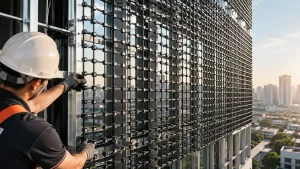
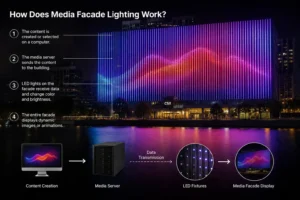
Definition: A media facade is a facade lighting system that displays video, graphics or animation across a building envelope by controlling thousands of LED pixels as one image. Media facades are integrated with the architecture rather than mounted as a separate billboard. The integration side — what it takes to make the facade itself the display — is covered in our integrated media facade solutions.
| Media facade type | Structure | Transparency / daytime impact | Typical use |
|---|---|---|---|
| Transparent LED mesh screen | LED strips or nodes on flexible stainless-steel cables or rigid frames | High; open area depends on pixel pitch (MEKALEO LED mesh models: 39.2%–88% transparency) | Glass curtain walls, large-span facades |
| Linear pixel bar system | Parallel LED pixel bars fixed on mullions | High; bars follow the curtain-wall grid | High-rise video facades visible from long distances |
| Pixel-point array media wall | Large-pitch LED pixel lights on a grid | Very high; points are widely spaced | Very large facades, low-resolution long-distance content |
| Glass-integrated LED facade | Micro LEDs laminated inside glass panels | Panel replaces the glazing itself | New-build projects designed around the display |
5. Supplementary Architectural Outdoor Lighting Fixtures
| Fixture | Typical beam | Role on the facade | Key protection requirement |
|---|---|---|---|
| Architectural spotlights / floodlights | 3°–10° (narrow) | Long-throw lighting of spires, columns, sculptures and crowns | IP66–IP67 for exposed mounting |
| In-ground recessed uplights | Narrow to medium | Lighting arches, colonnades and facade bases from the ground | IP67 and IK10 against water and foot/vehicle traffic |
| Window reveal lights | 180° or 360° blade optics | Creating glowing frames inside repeated window openings | IP65 or higher |
6. Facade Lighting Comparison and Selection Matrix
6.1 Fixture Comparison Table
| Fixture type | Main beam angle | Setback | Control protocol | Daytime concealment | Best wall height |
|---|---|---|---|---|---|
| LED linear light | 120° / 15°×60° | 0 m (surface or recessed) | Single color / PWM / DMX512 | High (housing can match facade color) | Any height (outlines) |
| LED wall washer | 20°×45° / 30°×60° | 0.5–1.5 m | DMX512 / RDM / DALI | Medium (hidden in troughs or ledges) | 5–30 m |
| LED wall grazer | 5° / 10° / 10°×30° | < 0.3 m | DMX512 / single color | Medium (close to wall profiles) | 3–15 m (textured walls) |
| LED pixel light | 110°–180° | Grid-mounted on facade | DMX512 / SPI / RDM | Medium to high (small points) | 15–150 m+ |
| Media facade / LED mesh | ~120° wide viewing | Suspended mesh or curtain-wall mounted | DMX / Art-Net / video processor | Very high (open, transparent structure) | Landmark towers and complexes |
6.2 Selection by Facade Material and Building Height
| Facade condition | Recommended facade lighting type | Mounting guidance |
|---|---|---|
| Natural stone or rough brick, below 15 m | LED wall grazers with ~10° optics | Mount within ~20 cm of the wall |
| Glass curtain wall, 15–50 m+ | LED linear lights on mullions or transparent LED mesh | Aim light away from interiors; keep the facade see-through |
| Flat ACP panels or rendered walls | LED wall washers with 30°×60° optics | Mount at ~1 m setback for smooth gradients |
| Curved or freeform facades | Flexible LED neon or LED pixel lights | Follow geometry with flexible profiles or point grids |
| Facade that must show video | Media facade (mesh, pixel bars or pixel grid) | Choose pixel pitch by viewing distance |
7. Facade Lighting Control: DMX512, RDM and Pixel Mapping
7.1 DMX512 and RDM
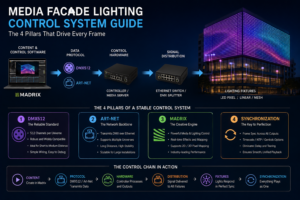
Professional dynamic facade lighting is usually controlled with DMX512-A (ANSI E1.11) and RDM – Remote Device Management (ANSI E1.20), both maintained by ESTA (ESTA standards overview, USITT Sightlines).
- DMX512 sends real-time color and intensity data to each fixture or pixel.
- RDM adds two-way communication over the same DMX line. With RDM, engineers can read fixture status, check fault reports and re-address fixtures from ground level instead of sending rope-access technicians or a gondola up the building.
7.2 Pixel Mapping and Scheduling
Media facades and LED pixel light grids use pixel-mapping software (for example MADRIX or ArKaos) to convert video into per-pixel coordinates. Facade lighting controllers with astronomical clocks can automatically dim the facade (for example by 50% after midnight) or switch to a static warm-white scene to meet local curfew and energy requirements.
7.3 Power and Data Wiring Rules for Large Facades
| Rule | Reason |
|---|---|
| Add a DMX signal repeater/isolator after every 32 unit loads, and on long cable runs (common practice on facade projects: about every 100 m) | A DMX512 line segment is rated for 32 unit loads; long runs degrade the signal |
| Terminate the end of each DMX line with a 120 Ω resistor | Prevents signal reflection that causes flicker |
| Use isolated multi-circuit power supplies with surge protection devices (SPD) | Limits fault spread and lightning/surge damage |
8. Facade Lighting Reliability: Common Problems and Solutions
8.1 Three Common Facade Lighting Defects
| Problem | Cause | Specification to prevent the problem |
|---|---|---|
| Dark spots and zebra striping between linear fixtures | Thick end caps, inconsistent LED pitch across joints | Specify seamless end caps and continuous optics with constant LED pitch across joints |
| Color shift between fixtures | Poor LED binning, yellowing potting | Specify 3-step MacAdam binning and UV-resistant optical-grade PU potting |
| High maintenance cost at height | Drivers and controllers mounted on the facade | Use remote-mounted drivers/controllers in plant rooms plus RDM diagnostics |
8.2 IP and IK Ratings for Facade Lighting
The IP code is defined in IEC 60529 and the IK impact code in IEC 62262.
| Location on building | Recommended minimum rating |
|---|---|
| High-rise facade, exposed to rain and wind | IP67 or IP68 |
| Ground level and areas people can touch | IK08–IK10 impact protection |
| In-ground uplights | IP68 + IK10 |
8.3 Materials for Outdoor Facade Lighting Durability
- Housing: 6063-T5 anodized aluminum or outdoor-grade powder coating for corrosion resistance, including coastal salt-spray environments.
- Optics: UV-stabilized optical polycarbonate (PC) or tempered glass to prevent yellowing and brittleness.
- Potting: double-layer optical-grade polyurethane (PU) potting to prevent internal condensation caused by day-night temperature swings.
8.4 Non-Destructive Installation and Thermal Expansion
- Glass curtain walls: use custom aluminum mullion clips and clamps so LED linear lights can be fixed without drilling the curtain wall or breaking its waterproofing.
- Thermal expansion: leave a 3–5 mm expansion gap in continuous LED linear light runs longer than about 10 m to stop aluminum profiles from bending in summer heat.
9. Facade Lighting Cost: Total Cost of Ownership (TCO)
Facade lighting budgets should compare total cost of ownership, not only fixture price:
Access cost (gondolas, cherry pickers, rope-access teams) is often the largest hidden cost on high-rise facades. Fixtures with IP68 protection, IK10 impact resistance and a 5-year warranty usually reduce access visits and produce a better return over a 5–10 year project life than lower-priced fixtures.
10. DIALux and AGi32 Lighting Simulation
Before procurement, a professional facade lighting project should be verified with a DIALux or AGi32 simulation using the manufacturer’s photometric files (.IES / .LDT). The simulation should use real surface reflectance values (for example about 0.3 for matte stone; glass behaves very differently and must be modeled separately) to check illuminance (lux), uniformity and glare.
11. Frequently Asked Questions
What are the main types of facade lighting?
The main types of facade lighting are LED linear lights for outlines, LED wall washers for even surface light, LED wall grazers for texture, LED pixel lights for addressable dynamic grids, and media facades for video content. Spotlights, in-ground uplights and window reveal lights are common supplementary fixtures.
What is the difference between wall washing and wall grazing?
Wall washing places LED wall washers 0.5–1.5 m from the wall with wide optics to create smooth, even light. Wall grazing places fixtures less than 0.3 m from the wall with narrow optics (5°–10°) to create shadows that emphasize stone, brick or timber texture.
When should a building use a media facade instead of static facade lighting?
A media facade is the right choice when the building must display changing content such as video, brand animation or event graphics. Static facade lighting with LED linear lights and wall washers is more suitable when the goal is architectural expression with lower cost and lower maintenance.
Which facade lighting type works best on glass curtain walls?
LED linear lights mounted on mullions and transparent LED mesh screens work best on glass curtain walls because both keep the facade see-through, avoid lighting the interior and do not require drilling through the glass.
Which IP rating is needed for high-rise facade lighting?
High-rise facade lighting exposed to rain and wind should be rated at least IP67, and IP68 is preferred for in-ground or frequently submerged locations. Fixtures within reach of people should also have IK08–IK10 impact protection.
12. Conclusion: Combine Facade Lighting Types for the Best Result
Successful facade lighting rarely depends on a single fixture type. Landmark projects typically combine LED linear lights to outline the structure, LED wall washers or grazers to give the base material and volume, and LED pixel lights or a media facade as the dynamic focal point at the crown of the building.
Planning a facade lighting project?
The MEKALEO engineering team supports OEM/ODM fixture design, DMX wiring diagrams and DIALux simulation for architectural facade projects. The six fixture families we build — linear, wall washers, flood lights, spotlights, in-ground and downlights — are specified on our outdoor architectural lighting page.
Project enquiry
Send your drawings. Get a specification you can defend.
Elevation DWG, facade area, closest viewing distance and site country — we reply within 48 hours with a fixture matrix, power and DMX topology, and a quotation. No price-only quotes.
5,000+ projects delivered · 40+ countries · ISO 9001 · CE / UL / RoHS