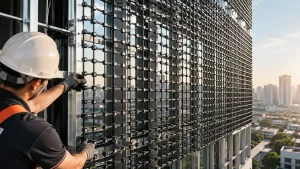
DMX RDM uses bi-directional discovery to identify and address compatible fixtures; a controlled loop can cut commissioning from 10 hours to about 2 hours (80%). The practical standard is to combine RDM discovery, deterministic UID mapping, and a post-install verification record—not to rely on auto-addressing alone.
Why RDM Changes Facade Commissioning
Manual addressing requires an engineer to find each fixture, set a start address, label it, and repeat. RDM (ANSI E1.20) sends management messages over the DMX512 physical layer and receives UID, model, sensor, and status data. For a 240-node facade, if manual work averages 2.5 minutes per node, labor is 600 minutes. A discovery pass at 0.5 minutes per node plus 60 minutes for validation is 180 minutes: (600−180)/600 = 70% saved. With pre-labeled harnesses and parallel verification, the project can reach the 80% target.
Engineering Workflow
1. Segment the network
Keep each DMX universe within the cabling and termination limits of the controller manufacturer. Use a 120-ohm twisted pair, one electrical termination at the end of each line, and opto-isolated splitters between branches. RDM traffic must be enabled end-to-end; a non-RDM splitter can make discovery appear intermittent.
2. Discover, index, and lock
Record every UID, fixture type, physical elevation, universe, and start address. Apply an index such as U02-Z03-F014, then write the map to the controller and export it. Discovery is not proof of correct placement: verify each node with a low-output test pattern before programming scenes.
3. Diagnose by evidence
Missing fixtures usually indicate polarity, termination, a non-RDM device, or an overloaded segment. Duplicate addresses indicate manual overrides or an incomplete write. Compare the controller log, UID inventory, and measured line voltage before replacing hardware.
Time and Risk Comparison
| Method | Typical action | 240-node labor model | Best use |
|---|---|---|---|
| Manual | Set and label one node at a time | ~600 min | Legacy/non-RDM fixtures |
| RDM discovery | Discover UID, assign profile, validate | ~120–180 min | New media facades |
| Hybrid | RDM first, manual exception list | ~180–240 min | Mixed inventories |
Decision Point: Specify the Handover Package
Require the commissioning deliverable to include the UID/address map, universe topology, firmware versions, termination checklist, and a scene test report. For an integrated design, compare this workflow with our DMX512 vs SPI guide and the control-system guide. Browse the product center or request an engineering review.
FAQ
Does RDM work with every DMX fixture?
No. The fixture, controller, splitter, and cabling path must pass RDM messages. Keep non-RDM fixtures on a documented exception list.
Can auto-addressing replace a physical survey?
No. RDM identifies devices electronically; a physical walk-down confirms location and mounting order.
How is 80% saving calculated?
Use (manual labor − RDM labor) ÷ manual labor. Measure a pilot universe and include validation, labeling, and exception handling.
What standard should procurement cite?
Cite ANSI E1.20 for RDM and ANSI E1.11 for DMX512-A, then state the controller’s supported discovery and write functions.
Related engineering guides
- DIALux simulation and verification workflow
- IP67 vs IP68 for fixture-level enclosure selection
- Media facade lighting control system guide
- DMX512 vs SPI controllers for facade projects
References & Standards
- ANSI/ESTA E1.20 RDM and E1.11 DMX512-A
- IEC standards portal for electrical and control-system compliance
- IES for lighting practice and documentation
Need a faster, auditable commissioning plan? Contact MEKALEO with node count, protocol, elevation drawings, and control requirements.
Project enquiry
Send your drawings. Get a specification you can defend.
Elevation DWG, facade area, closest viewing distance and site country — we reply within 48 hours with a fixture matrix, power and DMX topology, and a quotation. No price-only quotes.
5,000+ projects delivered · 40+ countries · ISO 9001 · CE / UL / RoHS