Key Takeaways
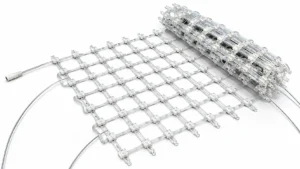
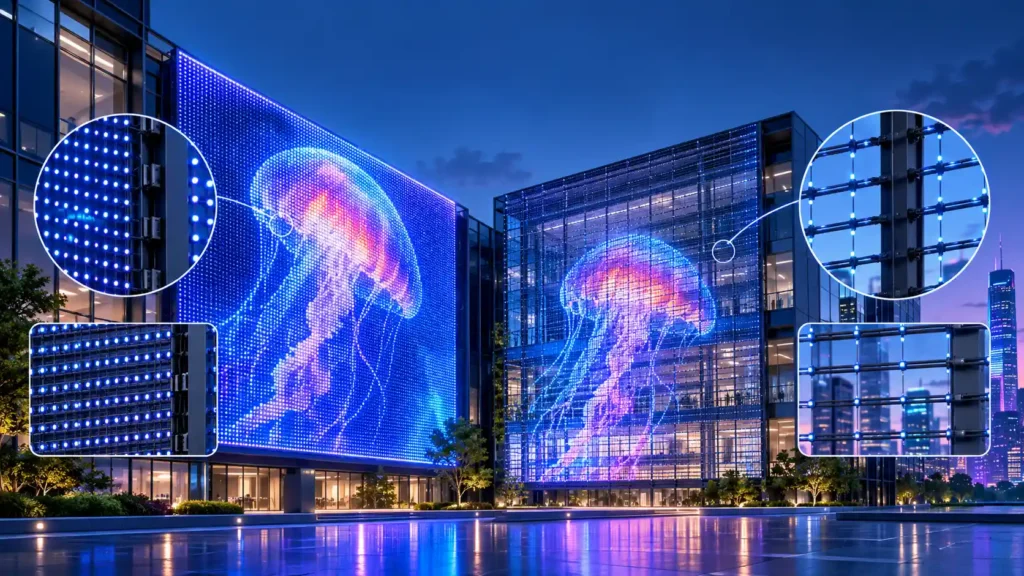
MEKALEO focuses on high-end architectural lighting and large-viewing-distance display engineering. This article provides an objective, physics-driven comparison to help B2B clients clarify the core differences between P35 and P50—two mainstream LED grid screen models among transparent LED screens and architectural media facades. The P35 LED grid screen delivers a pixel density of 816 dots per square meter (104% higher than P50) and shortens the optimal viewing distance to 35 meters, though its transparency is 52% to 55%. Meanwhile, the P50 LED grid screen maintains a higher transparency of 65% to 70%, but requires a viewing distance of 50 meters or more. In real-world project deployment, properly evaluating your LED grid screen specifications by matching viewing distance, building lighting requirements, and total cost is essential for balancing visual performance and cost-effectiveness.
Pixel Density: P35 is approximately 816 dots/m², while P50 is about 400 dots/m².
Physical Transparency: P35 ranges from 52% to 55%, while P50 ranges from 65% to 70%.
Dynamic Average Power Consumption: P35 ranges from 180W to 220W/m², while P50 ranges from 130W to 160W/m².
Optimal Viewing Distance: The threshold is 35 meters for P35 and 50 meters for P50.
1. Hardcore Calculation of Pixel Density and Resolution
Pixel Density Formula: Pixel Density = 1,000,000 / (Pitch X × Pitch Y) (dots/m²)
P35 Calculation: 1,000,000 / (35 × 35) is approximately 816.3 dots/m²
P50 Calculation: 1,000,000 / (50 × 50) = 400 dots/m²
Hardcore Conclusion: Within a 100-square-meter area, the P35 provides 41,600 more physical pixels than the P50. Thanks to standard high-brightness SMD packaging lamp beads, edge jaggedness at close range is reduced by nearly half.
2. Mathematical Modeling of Optimal Viewing Distance (Retina Distance)
Formula for Grain-Free Viewing Distance: Viewing Distance (m) = Pixel Pitch (mm) × 1
P35 Threshold: 35 × 1 = 35 meters. At distances under 35 meters, a lattice effect appears; beyond 35 meters, the pixels merge into a continuous image.
P50 Threshold: 50 × 1 = 50 meters.
Hardcore Conclusion: When the primary viewing distance falls between 35 and 50 meters, the P50 cannot eliminate physical black borders and grid lines, making the P35 a technical necessity.
3. Physical Trade-off Between Transparency and Power Consumption
Transparency Loss Ratio: The strip width and PCB layout area of the P35 are roughly 15% larger than those of the P50, dropping light transmittance from the P50’s 70% down to 52%. If a building facade requires a natural lighting rate exceeding 60%, the P35 falls short of physical compliance.
Energy Efficiency Performance: As a fine-pitch category for outdoor screens, the P35 has a higher dynamic average power consumption (around 200W/m²) compared to the P50 (around 145W/m²), representing an increase of 37.9%. However, because its pixel capacity doubles by 104%, its visual information delivery per unit of electrical energy is significantly higher.
4. From Physical Metrics to Project Implementation: How to Make Smart Selections
Having explored the underlying physical metrics like pixel density, transparency, and viewing distance, we shift our focus from laboratory comparisons to practical engineering, commercial procurement, and project profitability.
As an established brand in the industry, MEKALEO is dedicated to providing global clients with architectural media facade solutions that blend cutting-edge optical performance with high reliability. We wrote this article to clear up common industry ambiguities and marketing fuzziness, using pure physical derivations to help engineers and property owners make rational, data-backed decisions early in the project phase.
For B2B project contractors, system integrators, and commercial property developers, selection goes beyond a single metric—it requires balancing visual presentation, building compliance, structural cost, and Total Cost of Ownership (TCO) to maximize return on investment (ROI):
Matching Viewing Distance with Commercial Visual Value: For projects located on prime city commercial complexes, luxury retail centers, or bustling pedestrian walkways where the primary viewing distance ranges from 35 to 50 meters, cutting budgets to choose the P50 will introduce noticeable pixelation. This compromises high-end brand advertising campaigns and diminishes commercial advertising rental yields. Choosing MEKALEO’s P35 fine-pitch LED grid screen delivers superior visual immersion and higher advertising lease value without the exorbitant price premiums of ultra-fine-pitch indoor-grade alternatives.
Structural Load, Installation Costs, and Building Compliance: Glass curtain wall projects face strict structural wind resistance and dead-load limitations. Heavy screens require expensive secondary steel reinforcement, drastically inflating project budgets. MEKALEO’s LED grid screen series utilizes lightweight aluminum frame architecture, which drastically cuts down secondary steel structure installation costs and labor expenses. Meanwhile, for projects with strict natural lighting regulations, the high transparency of our P50 model helps streamline fire safety, local zoning, and architectural planning approvals, saving months of costly project delays.
Direct Manufacturing and Customization Support for B2B Partners: Sourcing directly from an original manufacturer provides commercial projects with massive cost advantages. As a primary source factory, MEKALEO supports flexible B2B project customization—ranging from custom cabinet dimensions and high-refresh driver IC configurations to multi-level brightness output (such as energy-saving hybrid configurations). Every batch comes with verified physical optical data and factory inspection reports, empowering contractors to win competitive bidding tenders with absolute confidence.
Accelerate Your Project with MEKALEO Factory-Direct Support: If you are currently bidding on or executing a commercial glass curtain wall LED grid screen project, don’t leave your margins to chance. Connect with the MEKALEO engineering and sales team today. Based on your project’s architectural CAD drawings, viewing distance parameters, and budget constraints, we will provide a comprehensive, complimentary package including tailored model selection reports, professional CAD layout designs, and competitive factory-direct wholesale quotations to help you secure the deal.
Data Sources and Technical References
LED Display Pixel Density and Optical Calculation Standards: CIE (International Commission on Illumination) Optical Measurement Specifications and General Industry Physical Matrix Algorithms. CIE Official Website
Architectural Glass Curtain Wall Light Transmittance and Wind Load Standards: ISO 9050 Glass in Building – Determination of Light Transmittance and Solar Direct Transmittance. ISO Store
LED Grid Screen Energy Efficiency and Dynamic Power Testing Whitepaper: MEKALEO Laboratory Optoelectronic Performance Test Reports and Accumulated Industrial Engineering Data. (Internal Engineering Documentation)
Updated Date: September 24, 2026 | Technical Standard: Physical Optics & Electrical Metric Verification