Updated: October 2026 | Estimated Reading Time: 6 minutes
Key Takeaways
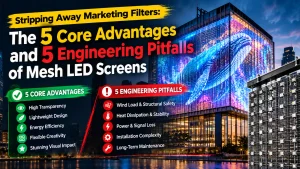
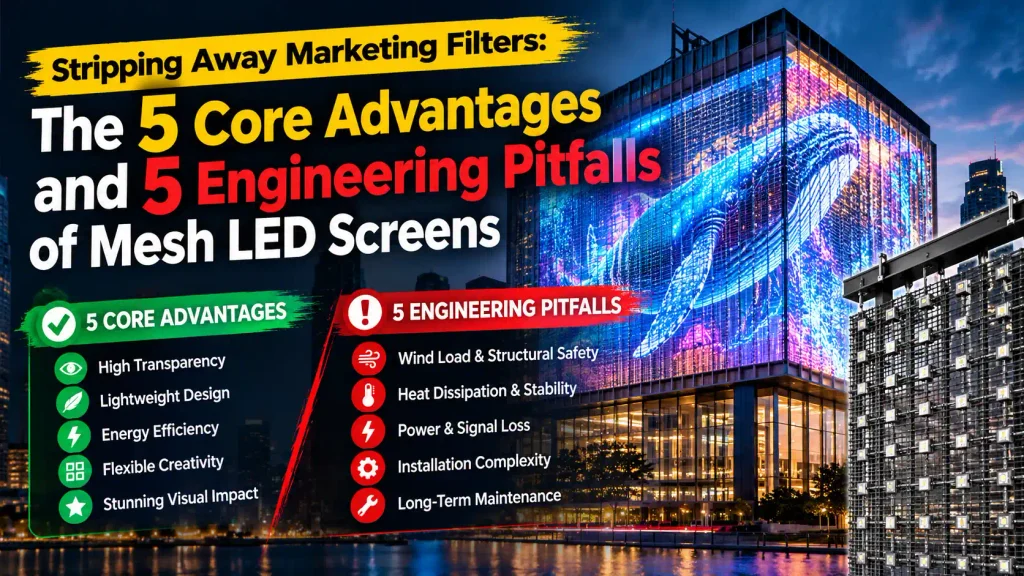
Mesh LED screens (also known as LED grid screens, strip screens, or transparent LED displays) have become a disruptive solution for urban landmark architectural lighting and large-scale performing arts stages, thanks to their high transparency of 40% to 80%+, ultra-lightweight structure, and exceptional wind-load resistance. However, when executing projects, buyers and engineering contractors must remain vigilant against inescapable physical boundaries and hidden costs: close-range pixelation caused by large pixel pitches, contrast degradation under direct outdoor sunlight, and expensive custom content adaptation costs.
Four Core Physical Advantages: High transparency without blocking light, structural load reduction, superior wind resistance, and natural convection cooling.
Five Engineering Pitfalls to Avoid: Strictly defining minimum viewing distances, evaluating outdoor orientation and light decay, preventing high-salinity coastal oxidation, reserving custom content budgets, and verifying fire safety and light pollution compliance approvals.
1. Core Parameters and Form Factor Comparison
When selecting project equipment, many procurement teams easily fall into the misconception that “higher transparency is always better.” The following structural and performance comparison table clarifies the fundamental differences between mesh LED screens and traditional cabinet-style LED screens:
| Evaluation Dimension | Mesh LED Screen (Grid/Strip Screen) | Traditional Cabinet-Style LED Screen |
| Transparency | High (40% – 80%+), air and light pass through freely | Very Low (0%), fully sealed back panel, blocks sightlines and natural light |
| Weight per Square Meter | Ultra-light (typically only $7kg – 15kg / m^2$) | Heavier (typically $30kg – 60kg+ / m^2$) |
| Wind-Load Resistance | Exceptional (grid structure, minimal wind resistance, ideal for high-rise buildings) | Weak (large windward surface area, extreme wind pressure during typhoons) |
| Cooling Method | Natural Cooling (excellent air convection, no heavy-duty air conditioning required) | Forced Air/AC Cooling (requires cooling fans or constant-temperature air conditioning) |
| Standard Pixel Pitch | Larger (mostly P25, P35, P50, etc., suitable for distant viewing) | Fine (mostly P3, P4, P6, etc., suitable for close-range viewing) |
| Total Content Cost | Higher (requires custom distorted/warped correction videos or naked-eye 3D assets) | Standard (supports direct playback of standard rectangular video content) |
2. The 5 Core Advantages of Mesh LED Screens
1. High Transparency: Balancing Architectural Facades and Visual Delivery
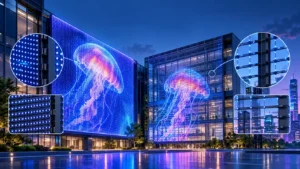
Designed with strip and grid hollow structures, transparency ranges from 40% to over 80%. When powered off during the day, screens mounted on glass curtain walls become nearly invisible, preserving the original facade aesthetics and indoor natural lighting.
2. Ultra-Lightweight Design: Significantly Reducing Building Steel Load-Bearing Stresses
Saying goodbye to sealed, heavy sheet-metal enclosures, the weight per square meter drops to just over a dozen kilograms. This provides an optimal structural weight-reduction solution for old building retrofits, glass curtain wall lighting, and large outdoor stage trusses, mitigating static and dynamic load safety risks.
3. Exceptional Wind-Load Resistance and Natural Cooling Capabilities
The unique “mesh” structure allows wind to pass through freely with minimal wind drag, making it exceptionally suited for high-rise building facades or massive outdoor high-altitude screens. Furthermore, smooth air convection eliminates the need for heavy-duty air conditioning or cooling fans, cutting long-term energy operational expenses.
4. Eco-Friendly and Low Light Pollution
Self-illuminating pixels combined with a transparent back panel reduce light reflection from completely black backgrounds. Nighttime illumination yields superior energy efficiency, and because a portion of light passes through the grid, intrusive light pollution onto surrounding environments and residents is significantly lower than traditional fully enclosed displays.
5. Modular Design and Convenient Maintenance
Utilizing strip-based plug-and-pull designs or quick-lock modules, they support front maintenance or rapid indoor troubleshooting. When a single strip fails, there is no need to dismantle the entire cabinet, substantially reducing high-altitude labor and maintenance costs.
3. Avoid the Pitfalls: The 5 Hidden Engineering Blind Spots of Mesh LED Screens
1. The Physical Paradox of Viewing Distance and Pixel Pitch: The Trade-off Between “Clarity” and Coverage
Blind Spot Analysis: To achieve high transparency, mesh screens generally feature larger pixel pitches (P25, P35, P50, etc.), making them entirely unsuitable for close-range viewing. Graininess is extremely prominent up close.
Mitigation Advice: Projects must strictly calculate the “minimum viewing distance” during early planning stages, limiting applications to landmark building facades or large outdoor stage backgrounds over 100 meters away.
2. Daytime Outdoor Brightness Decay and Contrast Challenges: “Visual Disasters” Under Direct Sunlight
Blind Spot Analysis: Mesh screens are transparent in the back without a light-absorbing rear panel. Under intense direct sunlight or backlight conditions, ambient light pierces directly through the screen toward the audience, causing severe contrast degradation and washed-out colors.
Mitigation Advice: Artificially inflating brightness to combat outdoor glare triggers skyrocketing electricity bills and accelerates LED light decay (lumen depreciation), shortening screen lifespans. Project design must evaluate building orientation (such as western sun exposure).
3. Compromises in Ingress Protection (IP Ratings) and Outdoor Durability
Blind Spot Analysis: To maximize lightness and transparency, parts of the circuit boards (PCBs), power lines, and connectors on mesh screens are designed in semi-open configurations.
Mitigation Advice: When facing typhoons, heavy rainstorms, high-salinity coastal environments, or extreme temperature fluctuations, aged rubber gaskets, PCB oxidation, and long-term wind-induced mechanical vibrations can easily cause short circuits or flickering strips. Coastal or rainy regions should avoid low-protection-tier products regardless of price.
4. Control Systems and Special Post-Production Content Adaptation Costs: The Invisible Budget Drainer
Blind Spot Analysis: The pixel layout of mesh screens is often non-standard, and aspect ratios are constrained by architectural facades, causing regular standard video content to warp or distort severely when played directly.
Mitigation Advice: Budgets must allocate funds for “custom content production fees” (such as specialized naked-eye 3D or custom geometrical correction content), otherwise powering on the screen will only yield fragmented, distorted footage.
5. Strict Regulatory and Compliance Risks: Unavoidable Preliminary Approval Hurdles
Blind Spot Analysis: Large outdoor screens in core urban zones face stringent city planning regulations, environmental light pollution codes, and fire safety restrictions (such as blocking emergency fire escape routes).
Mitigation Advice: Secure preliminary approvals from local municipal administration, urban landscape authorities, and fire departments prior to signing major deals to prevent project termination due to compliance failures.
4. Frequently Asked Questions (FAQ)
Q1: Are mesh LED screens suitable for close-range viewing?
Answer: No, they are not. Because mesh screens prioritize transparency, their pixel pitches are typically larger (e.g., P25, P35), resulting in strong graininess at close ranges. They are engineered exclusively for long-distance, large-scale visual delivery, such as landmark building exteriors or massive outdoor stage backdrops.
Q2: Why do mesh LED screens not require high-capacity air conditioning systems?
Answer: Because mesh screens utilize a hollow grid structure with smooth, unobstructed airflow, they possess exceptional natural cooling capabilities, eliminating the need for heavy-duty cooling fans or constant-temperature air conditioners in standard operating environments.
Q3: What is the most easily overlooked hidden cost when purchasing mesh LED screens?
Answer: It is the custom content production and geometric correction cost. Because mesh screen pixel arrays and aspect ratios are dictated by structural architecture, standard rectangular video assets will warp severely and require secondary production of specialized naked-eye 3D or layout-corrected video feeds.
Q4: Does direct daytime sunlight affect the display performance of mesh LED screens?
Answer: Yes, performance is impacted. Because the screen’s rear is transparent with no light-absorbing backing, strong direct sunlight passes straight through, lowering contrast and washing out colors. Comprehensive evaluation of building orientation and strategic brightness mapping are essential during the design phase.
About MEKALEO
MEKALEO is a source manufacturer specializing in outdoor media facade lighting and immersive lighting systems. With 16+ years of manufacturing experience and an 8,000 m² production facility, we provide factory-direct products and project solutions worldwide.
We serve Lighting Contractors, Facade Contractors, Engineering Companies, Lighting Distributors, System Integrators, and Advertising Companies, helping them solve common challenges such as high costs, long lead times, limited customization, inconsistent quality, and insufficient technical support.
With OEM/ODM capabilities and in-house manufacturing, MEKALEO provides product customization, technical support, quality control, and project-based solutions to help customers reduce costs, improve delivery efficiency, and minimize installation issues.
Factory-Direct Pricing · OEM/ODM Customization · Stable Supply · Project Technical Support
Planning an LED Mesh Screen or Media Facade Project?