How Does Media Facade Lighting Work? System Principles Explained
A media facade turns a building’s exterior into a programmable visual surface — but how does the system actually work behind the scenes? This guide breaks down the working principle layer by layer: how LEDs become pixels, how control signals travel across thousands of fixtures, and how video content ends up on a 100-meter-tall wall.
(If you’re looking for product specifications instead, see our [media facade lighting solutions )
1. The Core Principle: Every LED Fixture Becomes a Pixel
From Illumination to Display
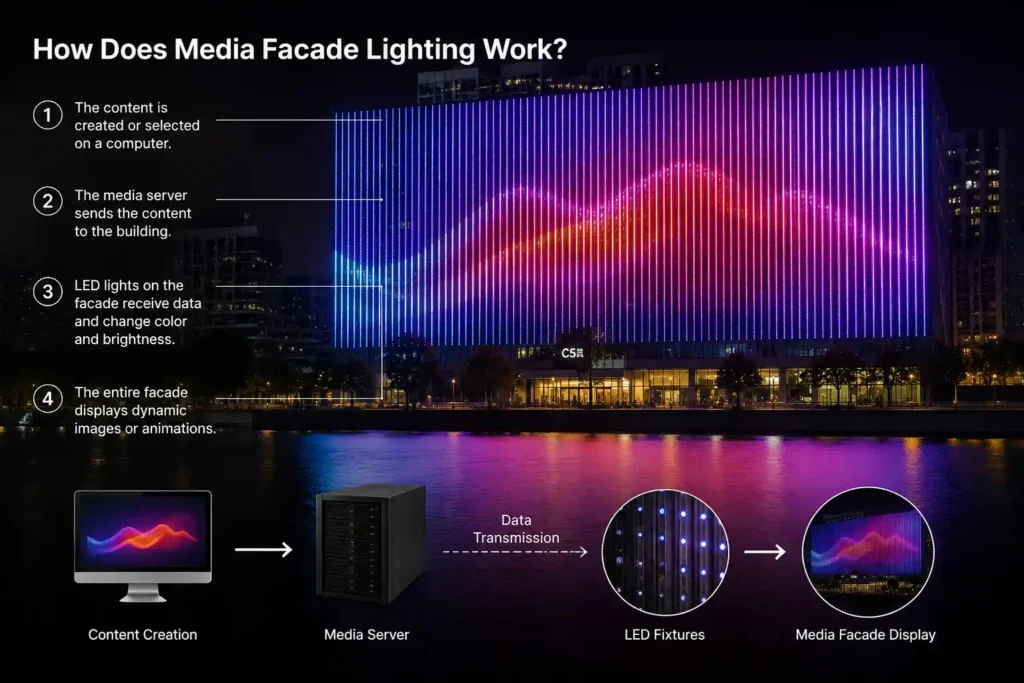
Conventional facade lighting projects light onto a surface. In a media facade system, each fixture — a [pixel light ], a bar, or a mesh node — is a light source with its own address. The control system tells every address which color to show, frame by frame, exactly like pixels on a monitor.
Why Low Resolution Still Looks Sharp
Pixel spacing on buildings typically runs 50–500 mm — far coarser than any screen. It works because of viewing distance: at 200 meters, the human eye cannot resolve individual points, so the brain merges them into smooth images. The design rule of thumb: minimum viewing distance ≈ pixel pitch × 1,000 (a 100 mm pitch reads well from ~100 m).
RGB Mixing Creates 16.7 Million Colors
Each pixel contains red, green, and blue LED chips. By varying each channel across 256 levels (8-bit), the system mixes 256³ ≈ 16.7 million colors. Higher-end systems use 16-bit processing for smoother gradients in dark scenes.
2. How the Control Signal Travels: From Video File to Building
Step 1 — Pixel Mapping
Mapping software assigns every physical fixture a coordinate on a virtual canvas. A fixture mounted on the 23rd floor, west corner, becomes “pixel (412, 87)” in the video frame.
Step 2 — Signal Distribution
The [control system →产品页6] converts video frames into lighting data and distributes it through protocols like DMX512 (up to 512 channels per line, ideal for small-to-mid projects) or Ethernet-based Art-Net/sACN (required when pixel counts reach tens of thousands).
Step 3 — Refresh and Synchronization
Data refreshes at 30–60 frames per second across the entire facade. Sub-controllers placed on each floor or zone keep thousands of fixtures frame-synchronized — a 50 ms lag between zones is visible to the naked eye as “tearing.”
3. Power and Signal Wiring: The Invisible Half of the System
Constant-Voltage Distribution
Most exterior pixel systems run on 24V or 48V DC. Power supplies are placed in weatherproof enclosures at intervals along the facade, because low-voltage DC suffers voltage drop over distance — undersized cabling causes visible color shift at the end of each run.
Signal and Power Often Share One Cable
Modern fixtures use integrated cabling (power + data in one jacket), cutting installation labor by 30–40% compared with separate runs.
Weatherproofing Standards
Outdoor fixtures require IP65–IP67 sealing, UV-stable housings, and corrosion-resistant connectors — especially for coastal or high-humidity sites. (See how our outdoor-grade fixtures are built )
4. How Content Gets Displayed: Playback, Live Input, and Interactivity
Scheduled Playback
An astronomical clock triggers the show at sunset; preset playlists loop animations, with automatic dimming after curfew hours to comply with local light-pollution rules.
Real-Time and Interactive Modes
Advanced systems accept live video input or sensor data — weather, traffic flow, music — and translate it into lighting behavior in real time.
Content Design for Low Resolution
Effective facade content uses bold shapes, high contrast, and slow motion. Fine text and detailed photos disappear at 200 mm pixel pitch; abstract gradients and silhouettes read beautifully.
5. Working Principles by System Type
Different fixture types apply the same pixel principle in different physical forms:
| System Type | How It Works | Pixel Pitch | Transparency | Typical Application |
|---|---|---|---|---|
| Pixel/Point lights | Individual addressable nodes on the structure | 200–500 mm | High | Towers, ferris wheels, long-distance viewing |
| LED mesh screen | Flexible grid hung over glass, each node = pixel | 50–150 mm | 40–70% | Curtain walls, bridges, video-grade content |
| Linear lights | Bars with multiple pixel segments follow building lines | 100–300 mm | Medium | Outlines, floors, architectural contours |
| Wall washer / floodlight | Zone-controlled color washing (not pixel-mapped) | — | — | Supplementary accent lighting |
Most real projects combine two or three types — for example, mesh on the main glass face plus linear fixtures on the crown. (Project examples )
6. From Working Principle to Working Project
Understanding the principle is step one; a successful installation depends on engineering decisions made before any fixture ships:
- Pixel density planning based on actual viewing distances around your site
- Voltage-drop calculations and wiring diagrams matched to your facade dimensions
- Controller architecture sized for your total pixel count with expansion headroom
- Mock-up testing on a small facade section before mass production
These are exactly the deliverables to expect from an experienced system provider. With 16+ years in outdoor architectural LED systems and 3,000+ global projects, our engineering team prepares facade layouts, pixel-pitch recommendations, and complete wiring solutions from a single set of building photos or drawings.
→ Send your building drawings and get a system design proposal within 24 hours
FAQ
How many pixels does a typical media facade have? Anywhere from 5,000 points on a small retail facade to over 500,000 on a supertall tower. Pixel count drives controller architecture and budget more than facade area does.
Why does my facade need sub-controllers instead of one main controller? DMX512 carries only 512 channels (≈170 RGB pixels) per line. Large facades need distributed sub-controllers to keep data refresh fast and synchronized.
What happens if one pixel fails — does the whole line go dark? No. Modern addressable fixtures use signal pass-through with breakpoint resume, so a failed unit doesn’t interrupt downstream pixels.
Can the system display video like a regular LED screen? Yes, mechanically it’s the same principle — but content must be designed for low resolution. Mesh screens (50–100 mm pitch) handle video best; point systems suit abstract animation.
How is brightness controlled to avoid light pollution? Through global dimming curves and scheduled output caps — most systems run at 30–60% output at night and comply with curfew regulations via automatic scheduling.
Sources
- Illuminating Engineering Society. The Lighting Handbook (10th Edition). IES. Available: https://www.ies.org/product/the-lighting-handbook-10th-edition/
- Note: Page parsing failed during data retrieval; the official product page remains accessible manually for industry photometric and exterior lighting guidelines.
- CIE. (2017). CIE 150:2017 Guide on the Limitation of the Effects of Obtrusive Light from Outdoor Lighting Installations (2nd Edition). CIE. DOI: 10.25039/TR.150.2017. Available: https://cie.co.at/publications/guide-limitation-effects-obtrusive-light-outdoor-lighting-installations-2nd-edition
- Content extracted from official CIE technical report covering outdoor light pollution limits for media facade design.
- ESTA Technical Standards Program. ANSI E1.11-2024 (USITT DMX512-A) Asynchronous Serial Digital Data Transmission Standard. Available: https://tsp.esta.org/tsp/documents/published_docs.php
- Note: No standalone short URL for this standard; access via ESTA’s full standard catalog page, which lists the latest 2024 revision of DMX512-A lighting control protocol.
- Media Architecture Institute. Industry Research & Global Media Facade Case Archive. Available: https://www.mediaarchitecture.org
- Note: Website server stability fluctuates; verify accessibility before publication for landmark media architecture case studies