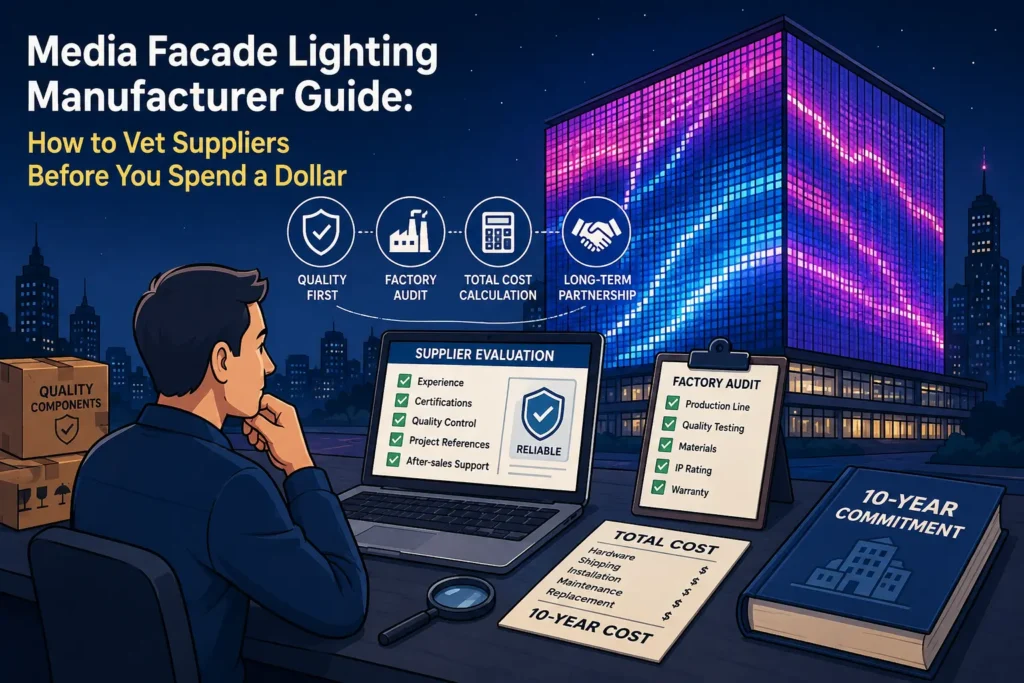
A media facade is not a lighting purchase. It is a 10-year commitment to a supplier you may never meet in person, installed 80 meters above the ground, exposed to rain, salt, UV radiation, and temperature swings — with repair costs that can exceed the original hardware price.
This guide is written for the people who carry that risk: procurement managers, lighting designers, facade contractors, and project developers. It covers how to classify suppliers, what questions to ask, how to audit a factory remotely, and how to calculate the real cost behind a cheap quotation.
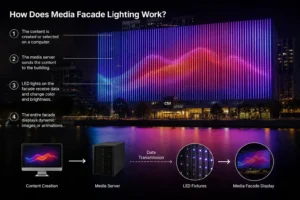
It covers how to classify suppliers, what questions to ask, how to audit a factory remotely, and how to calculate the real cost behind a cheap quotation. For buyers still evaluating system architectures and product categories, our Media Facade Lighting Solutions overview explains the major technologies used in modern building facades.
Why Media Facade Projects Fail Long Before Installation
Here is the uncomfortable truth of this industry: most media facade failures are not product failures. They are procurement failures.
When a facade goes dark two years after handover, the LED chip itself is rarely the culprit. Post-installation reviews across the industry consistently point to the same pattern:
| Root Cause of Failure | Approximate Share* |
|---|---|
| Waterproofing / sealing defects | ~35% |
| Power supply failures | ~25% |
| Control system faults | ~20% |
| Installation errors | ~15% |
| LED chip degradation | ~5% |
*Based on aggregated post-sales analysis; figures vary by climate and project type.
Notice what this table tells you. The LED — the component every datasheet celebrates — accounts for the smallest slice of failures. The top three causes (waterproofing, power, control) are all determined by who manufactured the system and how, not by which chip they soldered onto it.
This is why comparing datasheets is nearly useless. Two suppliers can quote identical specifications — same IP rating, same pixel pitch, same brightness — and deliver products with a 5x difference in field failure rates. The difference is invisible on paper. It lives in the factory: in the potting process, the connector quality, the aging tests that were or were not performed.
Vetting the manufacturer, therefore, is not one step in procurement. It is procurement.
Understanding the Four Types of Suppliers
When you search “media facade lighting manufacturer,” you will find four fundamentally different businesses using the same title. Knowing which one you are talking to changes everything about how you should negotiate.
| Trading Company | Assembly Workshop | OEM Factory | Full Manufacturer | |
|---|---|---|---|---|
| What they actually do | Resell products sourced from factories | Buy components, assemble locally | Manufacture to others’ designs | Design, engineer, manufacture, and test in-house |
| Engineering capability | None | Minimal | Limited (execute, don’t design) | Full (optics, thermal, waterproofing, control) |
| Quality control | Depends entirely on their source | Inconsistent batch to batch | Good on process, weak on design | End-to-end |
| Custom development | ✗ | ✗ | Partial | ✓ |
| Who handles a failure in year 3 | Often nobody | Often nobody | The brand that hired them | The manufacturer |
| Typical price level | Low–mid | Lowest | Mid | Mid–high |
| Risk level for facade projects | High | Very high | Medium | Low |
Three practical notes:
Trading companies are not always bad — but they must be transparent. A trader who openly tells you which factory produces the goods, and lets you audit that factory, can add value in communication and logistics. A trader who pretends to be a manufacturer is a walking liability.
Assembly workshops are the most dangerous category for facades. Indoor LED strips assembled in a small workshop may work fine. A facade fixture requires engineered waterproofing, validated thermal design, and tested connectors. Workshops copy the appearance of these features without the engineering behind them.
The word “factory” in a company name proves nothing. The verification methods in the sections below are how you find out which category you are really dealing with.
12 Questions Every Buyer Should Ask
Send these questions in writing before requesting a quotation. The quality of the answers — specific vs. vague, documented vs. verbal — tells you more than the price will.
1. Who designed the waterproof structure of this fixture? A real manufacturer can name the engineer or team, explain whether the design uses structural sealing or potting compound, and show cross-section drawings. “It’s IP67, don’t worry” is not an answer.
2. Which LED brand and bin do you use, and can you prove it? Osram, Nichia, Lumileds, Cree, or a reputable domestic brand like San’an — the answer matters less than the proof. Ask for purchase records or reel labels. Chip substitution after sample approval is one of the oldest tricks in this industry.
3. Has this product passed a salt spray test? Show the report. For any coastal or humid installation (the Gulf region, Southeast Asia, seaside developments), a neutral salt spray test (e.g., 96h+ per ISO 9227) on housings, screws, and brackets is non-negotiable.
4. Has the lens/diffuser material passed UV aging tests? PC and silicone materials yellow and become brittle under UV exposure. Ask for UV aging test data or field evidence from installations older than 3 years in sunny climates.
5. Who developed your control system — in-house or third party? If the answer is “we use a third-party controller,” ask what happens when that third party discontinues the protocol in year 4. In-house control development is a strong signal of a full manufacturer.
6. If a single pixel or fixture fails, how is it repaired on-site? Listen for: front-serviceable design, individually replaceable modules, signal bypass so one dead unit doesn’t kill the chain. If replacing one fixture requires scaffolding and disassembling ten neighbors, your maintenance budget just tripled.
7. Do you support redundant power and signal design? Large facades should not have single points of failure. Ask whether the system supports dual power feeds and backup signal paths, and whether they have actually implemented this on a real project.
8. What is your burn-in (aging) procedure before shipment? The correct answer includes a duration (typically 24–72 hours), a temperature condition, and a defect-handling process. “We test every product” without specifics usually means a 5-minute power-on check.
9. What power supply brand do you use, and at what load ratio? Mean Well or equivalent, loaded at ≤80% of rated capacity, is the standard for reliable design. Unbranded supplies running at 95% load are the #2 cause of field failures.
10. Can you provide LM-80 / TM-21 data or your own lumen maintenance testing? This tells you whether the “50,000 hours lifespan” claim is calculated from real data or copied from a competitor’s brochure.
11. What exactly does your warranty cover — parts, labor, shipping, on-site support? A “5-year warranty” that covers parts only, ex-works, with 8-week replacement lead time, is worth far less than a 3-year warranty with 2-week advance replacement and remote engineering support.
12. Can you provide three completed projects, with client contacts, that have been running for 3+ years? Not renderings. Not “confidential clients.” Real projects, verifiable, aged. (See the reference verification section below.)
Scoring shortcut: a supplier who answers 10+ questions specifically and in writing is worth a sample order. A supplier who answers fewer than 6, deflects to “our quality is very good,” or gets defensive — walk away now, regardless of price.
How to Verify Whether a Factory Is Real
Claims are free. Equipment is not. A genuine media facade manufacturer must own — not rent, not borrow from a neighbor for the video call — the following:
- SMT production lines. LED placement done in-house means control over the most failure-sensitive process. Ask to see the pick-and-place machines running your product category, not just any PCB.
- Aging room. A dedicated space where finished products burn in for 24–72 hours before packing. If you don’t see racks of powered-on fixtures, aging isn’t happening.
- Integrating sphere. The instrument that measures luminous flux and color coordinates. Without it, “color consistency within 3 SDCM” is a guess, not a specification.
- Waterproof testing equipment. IPX7 immersion tanks and/or IPX5/6 spray rigs, used per batch — not once per product launch.
- Salt spray chamber. Essential for any supplier claiming suitability for coastal projects.
- A control engineering team. Ask to speak with a controls engineer directly. Five minutes of technical conversation exposes whether the “in-house control system” claim is real.
The single most effective verification question: “Can you show me this equipment on a live video call, right now, with today’s date written on paper in the frame?” A real factory says yes within a day. A trader starts negotiating.
The Hidden Costs Behind Cheap Quotations
Two quotations for the “same” IP67 media facade fixture can differ by 40%. Here is where that 40% actually goes:
| Component | Low-Price Build | Reliable Build | Field Consequence of the Cheap Choice |
|---|---|---|---|
| LED chip | Unbranded / mixed bins | Osram, Nichia, or verified top-tier | Color drift and patchy facade within 2–3 years |
| Cable | PVC jacket | TPU jacket | PVC hardens and cracks under UV; water enters via cable |
| Connectors | Generic push-fit | Genuine IP68 rated | The #1 water ingress point on most failed facades |
| Power supply | Unbranded, 95% loaded | Mean Well class, ≤80% loaded | Dead sections, 2–4 year failure clusters |
| Sealing | Basic gasket | Engineered potting / structural seal | Condensation, corrosion, pixel death |
| Testing | Power-on check | Full burn-in + waterproof + photometric | Defects discovered on your facade, not in the factory |
Each substitution saves the manufacturer a few percent. Together, they produce a fixture that looks identical in photos, matches the datasheet line by line, and fails in year two — on a building where accessing one fixture costs more than the fixture itself.
The rule: when a quotation is 25%+ below the credible market range, the difference has been removed from exactly the components you cannot see.
How to Audit Suppliers Remotely
Most buyers cannot fly to China for every shortlisted supplier. A structured remote audit gets you 80% of the value. Request a live video walkthrough (not pre-recorded marketing footage) covering:
- SMT lines in operation — machines running, operators present, your product family visible
- The aging room — fixtures powered on, racks populated, test logs visible
- Waterproof testing in progress — an actual immersion or spray test performed on camera
- The warehouse — raw material stock (LED reels with brand labels, Mean Well boxes) confirms the BOM claims
- Orders currently in production — packed goods with other clients’ shipping marks prove the factory is real and active
Supplement the video with documents: business license (check the registered scope includes manufacturing), export records, third-party test reports (verify report numbers directly with the lab — TÜV, SGS, and Intertek all offer online verification), and ISO 9001 certification.
Red flags during a remote audit: repeated rescheduling of the live call, insistence on pre-recorded video only, a “factory tour” that avoids wide shots, or staff who cannot answer basic process questions on camera.
What Samples Reveal That Datasheets Cannot
Never place a project order without physical samples — and never evaluate samples by simply plugging them in and admiring the colors. Test for:
- Color consistency. Order 5–10 units, run them white at full brightness, side by side, in a dark room. Visible tint differences between units means poor binning — and your facade will look patchy at scale.
- Flicker. Film the sample with a smartphone in slow-motion mode. Visible banding indicates low PWM frequency, which ruins broadcast footage and video documentation of the building.
- Thermal behavior. Run at 100% white for 4 hours. Measure housing temperature. Excessive heat is the strongest predictor of shortened LED and power supply life.
- Silicone and sealing quality. Flex the cable entry, inspect the potting for bubbles and voids, check the gasket seating. Then do the crude but effective test: submerge the powered sample in a bucket of water for 48 hours.
- Connector integrity. Mate and unmate the connectors 20 times. Cheap connectors loosen; loose connectors leak.
- Destructive teardown. Cut one sample open. Check PCB copper thickness, solder joint quality, conformal coating, and whether the internal components match what was quoted.
Keep one approved sample sealed and signed by both parties as the golden sample — your contractual quality reference for mass production.
How to Verify Project References
Every supplier claims “1000+ projects worldwide.” Verify like this. For each of three references, require:
- Project name and city — findable on Google Maps
- Country and installation year — older is better; a facade running since 2019 says more than one from last quarter
- Night video — actual footage, not renderings; check that the content playback is smooth and the color is uniform
- Daytime photos — a critical and overlooked check: a good media facade should be nearly invisible or architecturally clean by day; daytime photos also reveal cable management and mounting quality
- A client contact — even one verifiable contractor or designer contact is worth ten testimonial logos
The rendering trap: if a supplier’s “project gallery” consists mainly of 3D visualizations, night-only shots from far away, or images you can reverse-search back to other companies’ websites, you are looking at a portfolio of other people’s work.
For illustration, this is the level of specificity a credible reference should reach:
A 12,000 m² mixed-use tower facade in Dubai (installed 2021): linear RGB fixtures with redundant power design, operating through four Gulf summers with a reported fixture failure rate below 0.5%. A retail podium in Kuala Lumpur (2020): mesh-type media facade, front-serviceable modules, zero water-ingress failures through monsoon seasons.
If a supplier cannot produce even one reference at this level of detail, they have not done the work they claim.
Supplier Evaluation Scorecard
Turn everything above into a number. Score each shortlisted supplier from 1–10 per category, multiply by the weight, and compare totals:
| Evaluation Area | Weight | What to Score |
|---|---|---|
| Product reliability | 30% | Component brands, test reports, sample teardown results, aging process |
| Factory capability | 20% | SMT lines, testing equipment, remote audit results, production capacity |
| Technical support | 20% | Control system ownership, engineering responsiveness, design assistance, documentation quality |
| Delivery capability | 15% | Realistic lead times, export experience to your region, packing quality |
| After-sales service | 15% | Warranty scope in writing, spare parts policy, response time commitments, verifiable references |
Two rules for using the scorecard:
- Set a floor, not just a total. A supplier scoring below 5/10 in product reliability should be eliminated even with a high overall score. No delivery speed compensates for a facade that fails.
- Score in a team. Have the procurement lead, the technical lead, and (if possible) the installer score independently, then compare. Divergence in scores reveals exactly where you need more information.
Why the Cheapest Supplier Usually Becomes the Most Expensive
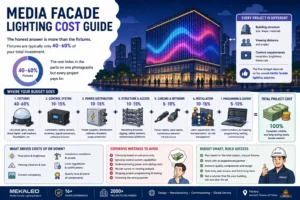
Procurement teams that buy on unit price are optimizing 30% of the real cost. Total Cost of Ownership (TCO) for a media facade over 10 years looks roughly like this:
TCO = Hardware + Installation + Energy + Maintenance + Failure Cost + Replacement Cost
Consider two suppliers for the same 5,000-fixture facade:
| 1 | Supplier A (cheap) | Supplier B (reliable) |
|---|---|---|
| Unit price | $38 | $52 |
| Hardware cost | $190,000 | $260,000 |
| Annual failure rate | ~4% (industry-typical for low-grade builds) | ~0.5% |
| Failed fixtures over 10 years | ~2,000 | ~250 |
| Access cost per repair (rope access / lift, high-rise) | $150–400 per intervention | Same rates, far fewer interventions |
| Realistic 10-year maintenance exposure | $400,000+ | $60,000–90,000 |
| 10-year TCO | ~$600,000+ | ~$340,000 |
Figures are illustrative — plug in your own access costs and failure assumptions. The pattern, however, holds across almost every high-rise project: on a facade, the cost of reaching a failed fixture exceeds the cost of the fixture. That single fact inverts the entire logic of buying cheap.
And TCO doesn’t capture the worst outcome: a landmark building with visibly dead sections is a reputational cost to the developer, the designer, and the contractor — one that no warranty reimburses.
The math is simple: a 35% cheaper fixture with 8x the failure rate is not a discount. It is a deferred invoice.
Conclusion: Vet Once, Sleep for Ten Years
The entire discipline of this guide reduces to five moves:
- Classify the supplier (trader, workshop, OEM, or full manufacturer)
- Interrogate with the 12 questions — in writing
- Verify the factory with a live remote audit and third-party report checks
- Test samples destructively, not decoratively
- Calculate TCO, not unit price
Do these before signing anything, and the most common media facade disaster — discovering in year two that your “manufacturer” was a reseller with a rendering portfolio — becomes structurally impossible.
If you’d like to see what these standards look like in practice — live factory walkthroughs, test reports, and verifiable project references — [explore our media facade lighting solutions] or request a remote audit. We’ll show you the SMT line first and the quotation second.
Frequently Asked Questions
How much does media facade lighting cost per square meter? Typically $150–800/m² for hardware depending on pixel pitch, fixture type (linear, mesh, dot), and component grade — plus installation and control systems. Beware quotes far below this range; the savings come from components you can’t see.
What is the realistic lifespan of a media facade? A well-manufactured system delivers 8–10+ years of operation. Poorly built systems commonly show visible failures (dead sections, color drift) within 2–3 years — usually from waterproofing or power supply issues, not the LEDs.
What IP rating do media facade fixtures need? IP66 minimum for exposed installations; IP67/IP68 for coastal, high-rain, or ground-adjacent positions. The rating alone is insufficient — batch waterproof testing and connector quality matter more than the number.
Can I audit a Chinese manufacturer without visiting? Yes. Request a live (not pre-recorded) video walkthrough of SMT lines, aging rooms, and waterproof testing, verify third-party report numbers directly with TÜV/SGS, and check verifiable project references with client contacts.
What’s the difference between an OEM factory and a full manufacturer? An OEM factory executes other companies’ designs; a full manufacturer designs, engineers, tests, and produces in-house — including the control system. For facades, in-house engineering is what determines long-term reliability and support.