For most of the twentieth century, lighting a building’s exterior meant choosing among halogen, metal halide, neon, and conventional floodlights — each with real strengths, each with limitations owners simply learned to live with. Within a single decade, LED made most of those compromises unnecessary. Today, specifying anything else for a new facade project is the exception that needs justifying, not the default.
This article explains why that shift happened by comparing LED directly against the four technologies it displaced. It is not about products or models — it’s about the underlying physics and economics that decided the outcome. If you’re evaluating a conversion or a new build, understanding these trade-offs is the foundation; when you’re ready to plan, explore our outdoor LED facade lighting solutions.
The Core Reason: A Different Way of Making Light
Heating vs. Semiconductors
Every traditional source makes light by brute force — heating a filament until it glows (halogen), striking an arc through pressurized gas (metal halide), or exciting gas in a tube until it fluoresces (neon). Most of the energy becomes heat; light is almost a byproduct. LEDs make light through electroluminescence — electrons crossing a semiconductor junction release energy directly as photons, with far less wasted as heat.
Why This One Difference Decides Everything
That single distinction cascades into every practical advantage: less wasted heat means higher efficiency; a solid-state device with no filament or gas means longer life; electronic control means instant dimming and color change; low operating temperature means safer, more compact fixtures. The traditional sources didn’t lose on one metric — they lost on the metric that generates all the others. Everything below is a consequence of this fundamental shift.
LED vs. Halogen
Where Halogen Came From
Halogen — an improved incandescent — was long valued for excellent color rendering and warm, natural light. For small-scale architectural accenting it produced beautiful results, which is why designers were reluctant to abandon it.
Why It Lost: Heat and Waste
Halogen’s fatal flaw is efficiency. It converts only a small fraction of energy to light; the rest becomes intense heat — hot enough to make fixtures a burn and fire consideration, and to drive up cooling loads. Its efficacy sits far below LED, so every hour of operation costs several times more in electricity for the same brightness.
Why It Lost: Lifespan
Halogen lamps last on the order of 2,000–4,000 hours — meaning frequent relamping. On a facade where fixtures are hard to reach, that replacement cycle is not just costly but genuinely disruptive. LED’s 50,000+ hour rating replaces perhaps a dozen halogen relamping cycles with none.
The Verdict
LED matched halogen’s greatest strength — warm, high-quality color, now achievable with high-CRI warm-white LEDs — while eliminating its heat and short life. Once color was no longer a reason to stay, there was no reason to stay.
LED vs. Metal Halide (HID)
The Former Workhorse of Facades
Metal halide was, for decades, the technology for large-scale facade and floodlighting. It produced high output from a single point, with reasonably good color — ideal for washing large surfaces from a distance. If any traditional source “owned” facade lighting, it was this one.
Why It Lost: Slow Start and No Real Dimming
Metal halide lamps need several minutes to warm up to full output, and if switched off, must cool before restriking. This makes them useless for any dynamic effect, scheduling flexibility, or instant response. Worse, they dim poorly or not at all — they essentially run at full power or off, forfeiting the single biggest source of energy savings available to modern lighting.
Why It Lost: Efficiency Decay and Color Shift
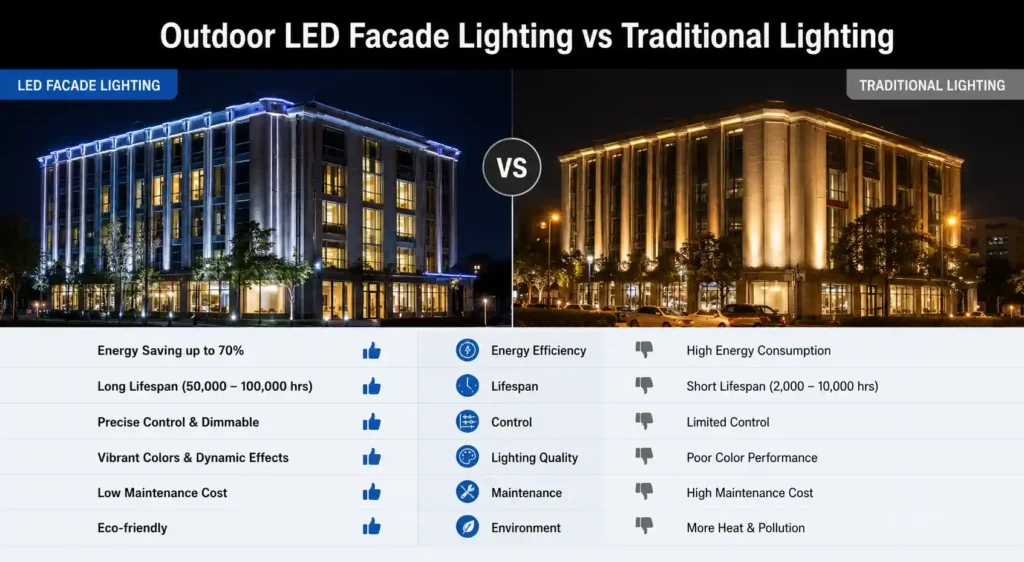
Even at their best, metal halide systems draw far more power than LED for equivalent results — the 50–70% energy gap documented in U.S. Department of Energy research. And they shift color as they age: a bank of metal halide fixtures installed together drifts to visibly different tints over time, ruining the uniformity a facade depends on.
Why It Lost: Lifespan and Maintenance
At 10,000–20,000 hours with meaningful output decline well before end of life, metal halide demands regular relamping — precisely the expensive, high-access maintenance facades can least afford.
The Verdict
LED beat metal halide on every dimension that mattered: energy, dimming, instant control, color stability, and lifespan. This is the matchup that decided the facade market, because metal halide was the incumbent LED had to defeat — and did, comprehensively.
LED vs. Neon
The Icon of Signage and Outline Lighting
Neon holds a cultural place no other source matches — the glowing tubes of mid-century signage and building outlines, prized for continuous lines of saturated color that could be bent to any shape. For linear outlining and expressive signage, neon defined the look.
Why It Lost: Fragility and High Voltage
Neon relies on glass tubes filled with gas, driven by high-voltage transformers (thousands of volts). The glass is fragile, vulnerable to weather and impact, and the high voltage raises real safety and installation-complexity concerns outdoors. Repairs require specialist glass-bending craftsmanship that is increasingly rare.
Why It Lost: Energy and Maintenance
Neon consumes significant power for its brightness and its transformers add losses and failure points. Tubes dim and fail, and each repair is a skilled, costly intervention. For a facade meant to run flawlessly for decades, neon’s maintenance burden and fragility became untenable.
Why It Lost: Flexibility
Neon is a fixed medium — one color per tube, one shape once bent. It cannot change color, animate, or be reprogrammed. LED flexible strips reproduce the continuous-line aesthetic while adding full color control, animation, low-voltage safety, and durability — delivering neon’s look without neon’s liabilities.
The Verdict
LED didn’t just match neon; it absorbed neon’s entire visual language into a safer, controllable, low-maintenance form. The aesthetic survived; the fragile high-voltage glass did not.
LED vs. Traditional Floodlight
The Default for “Just Light It Up”
Conventional floodlights — typically housing halogen or metal-halide lamps — were the pragmatic default: point high-output fixtures at a surface and flood it evenly. Simple, cheap upfront, universally available.
Why It Lost: Crude Control and Light Waste
Traditional floodlights are blunt instruments. Their broad, hard-to-shape beams spill light past the building into the sky and neighboring properties — energy wasted as light pollution and glare. Aiming is coarse, and beam shaping is limited, so a large share of the light never lands where it’s wanted.
Why It Lost: The Flat Look
Even, high-output flooding tends to make a building look flat and lifeless, erasing the shadow and contrast that give architecture depth. LED optics — precise beam angles, grazing, accenting — let designers sculpt with light rather than merely drench a surface. The result is the difference between a building that’s visible and one that’s designed.
Why It Lost: The Familiar Trio
And beneath the beam quality lie the same three defeats repeated: higher energy use, shorter life, no meaningful dimming or color control. Traditional floodlighting inherited all the weaknesses of the lamps inside it.
The Verdict
LED replaced the traditional floodlight not only by being more efficient and longer-lived, but by changing what facade lighting could be — from crude illumination to precise, controllable design. This is the qualitative leap that pure efficiency numbers understate.
Beyond the Numbers: What LED Changed Fundamentally
From Fixed to Programmable
Every traditional source was, in essence, fixed — a set brightness, a set color, a set beam. LED turned lighting into a programmable medium: any color, any brightness, any schedule, changeable from software at no marginal cost. This isn’t an incremental improvement; it’s a change in category. A facade became something you operate, not just something you switch on.
From Liability to Compliance
Traditional sources made responsible lighting nearly impossible. You couldn’t dim metal halide for a late-night curfew, couldn’t warm neon’s color for dark-sky compliance, couldn’t stop a floodlight spilling into the sky. LED’s controllability makes the DarkSky/IES Five Principles for Responsible Outdoor Lighting achievable as settings rather than aspirations — turning a regulatory liability into routine compliance.
From Recurring Cost to Long-Term Asset
Traditional lighting was a recurring expense — relamping, repairs, high energy bills, mercury disposal for HID. LED reframes facade lighting as a long-term asset: install once, run efficiently for twenty years, maintain rarely. The whole financial character of the decision changed.
Comparison Table: Facade Lighting Technologies Head to Head
| Dimension | Halogen | Metal Halide (HID) | Neon | Traditional Floodlight | LED |
|---|---|---|---|---|---|
| Light generation | Heated filament | Gas arc discharge | Excited gas in glass tube | Halogen/HID lamp in housing | Semiconductor (electroluminescence) |
| Efficacy | Very low | Moderate | Low | Low–moderate | High (100–160 lm/W) |
| Rated lifespan | ~2,000–4,000 hrs | ~10,000–20,000 hrs | Moderate; skilled repair | Short (lamp-dependent) | 50,000+ hrs |
| Dimming | Limited | Poor / none | None | Poor | Smooth 0–100% |
| Color change | No (filters only) | No (filters only) | Fixed per tube | No | Instant, any color |
| Start-up | Instant | Slow (minutes) | Instant | Lamp-dependent | Instant |
| Heat output | Very high | High | Moderate | High | Low |
| Safety concern | Burn/fire risk | Hot, UV | High voltage, fragile glass | Heat | Low-voltage options |
| Beam control | Moderate | Moderate | N/A (linear) | Crude | Precise optics |
| Dark-sky compliance | Difficult | Difficult | Difficult | Very difficult | Achievable via control |
| Hazardous material | No | Mercury | — | Lamp-dependent | None |
FAQ
Q: Was LED always better, or did it have to catch up? It had to catch up. Early LEDs lacked the brightness and warm color quality of halogen and metal halide. Once high-brightness and high-CRI warm-white LEDs matured (through the 2000s–2010s), the traditional sources’ remaining advantages disappeared and the efficiency and control gap decided it.
Q: Is there any facade job where traditional lighting is still better? Rarely, and usually for legacy or restoration reasons — matching an existing neon sign’s exact craft, or heritage contexts specifying period-authentic sources. For virtually all new work, LED is the practical choice.
Q: Why did metal halide dominate facades for so long if LED is so much better? Because before LED matured, metal halide was genuinely the best high-output option available. It “lost” not because it got worse, but because a fundamentally more efficient and controllable technology arrived.
Q: Can LED really replicate the neon look? Yes. Flexible LED strips reproduce neon’s continuous glowing line and saturated color while adding full color control, animation, low-voltage safety, and durability — the aesthetic without the fragile high-voltage glass.
Q: Do the energy savings alone justify switching from traditional lighting? Often, yes — 50–70% lower energy use plus near-eliminated relamping frequently pays back a conversion within a few years. Improved appearance, control, and compliance come on top of that financial case.
Q: What about the higher upfront cost of LED? LED systems cost more upfront but win decisively on total cost of ownership through energy savings, twenty-year lifespans, and drastically reduced maintenance — the expensive part of traditional lighting was never the purchase, it was the running.
References
- U.S. Department of Energy, Solid-State Lighting Program — comparative efficacy, energy-savings, and lifetime research 🔗 https://www.energy.gov/eere/ssl/solid-state-lighting
- The Nobel Prize in Physics 2014 — invention of efficient blue LEDs, enabling white LED lighting 🔗 https://www.nobelprize.org/prizes/physics/2014/summary/
- DarkSky International & IES — Five Principles for Responsible Outdoor Lighting 🔗 https://darksky.org/resources/guides-and-how-tos/lighting-principles/
- IES LM-79 / LM-80 — Photometric measurement and lumen maintenance test standards 🔗 https://store.ies.org/
- IEC 60529 — Degrees of protection provided by enclosures (IP Code) 🔗 https://webstore.iec.ch/publication/2452