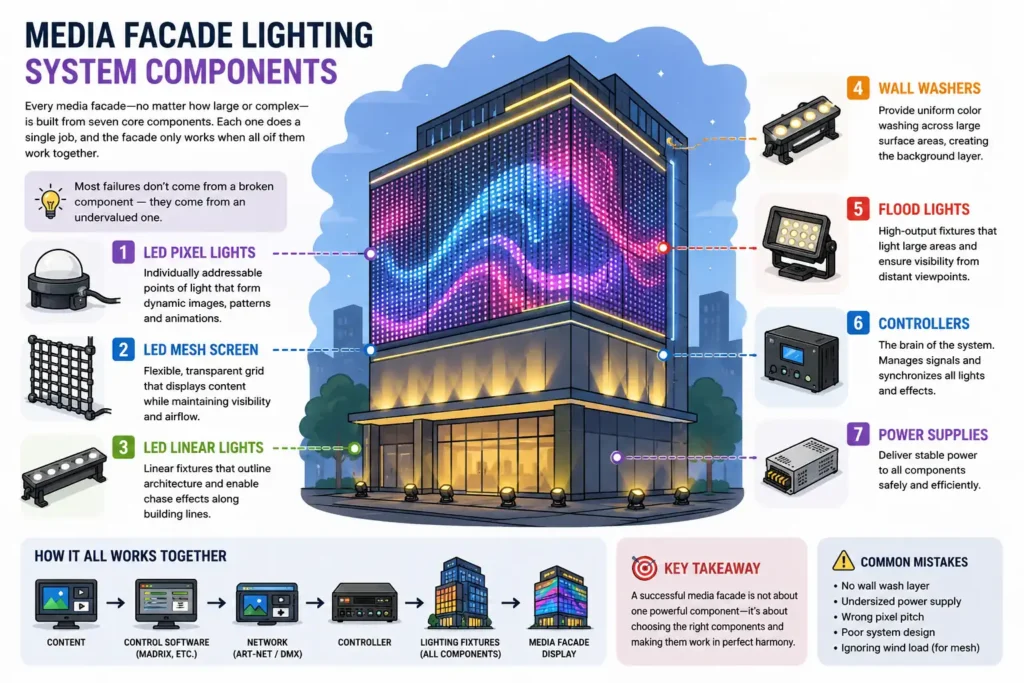
Executive Summary In the rapidly evolving smart city and landmark architecture projects of 2026, media facades are no longer just “lighting upgrades”—they are data-driven digital skins. Up to 40% of media facade projects experience severe schedule delays or visual failures on the eve of launch. The root cause is rarely damaged LED fixtures; rather, it lies in hidden flaws within the control layer, power distribution, and early-stage vendor qualification. Every successful media facade project requires precisely balancing seven core systems: LED pixel lights, LED mesh screens, LED linear lights, wall washers, floodlights, controllers, and power supplies, all anchored by a rigorous procurement strategy.
Select Components by Need: Not every building requires all 7 systems; match components strictly to functional and visual goals.
Match Pixel Pitch Precisely: Aligning pixel pitch with actual viewing distance is a powerful cost-saving lever; copying indoor resolutions only doubles budgets.
Front-Load Wind Engineering: Mesh screen projects must integrate structural wind-pressure calculations early to prevent critical delays.
Deploy Distributed Power: Power supply failure rates far exceed LEDs; distributed architectures completely eliminate high-rise voltage drop.
Look Past Marketing Hype: Build an objective B2B procurement filter based on Total Cost of Ownership (TCO), warranty commitments, and engineering execution capability.
1. LED Pixel Lights
What Are LED Pixel Lights?
LED pixel lights are individually addressable point sources where the control system can regulate the color and brightness of every single point. When arranged in a matrix grid across a building envelope, thousands of pixels combine into a low-resolution screen capable of rendering dynamic animations, patterns, and full video loops.
Core Roles and Technical Specifications
Core Role: Imparts core “media” attributes to the building, delivering dynamic effects static lighting cannot achieve.
Pixel Pitch: Determines screen resolution and must match real-world viewing distances.
Ingress Protection: Complies with IEC 60529; outdoor-exposed fixtures must achieve at least IP67.
Binning Consistency: Must maintain $\text{SDCM} \le 3$ (per ANSI C78.377) to ensure color uniformity across thousands of pixels.
Procurement Pitfalls and Decision Advice
Beware Low-Cost Encapsulation Chips: Some vendors use inferior non-tier-one chips, causing severe lumen depreciation and color drift after six months outdoors. In business and technical agreements, mandate that suppliers provide third-party optical-electrical test reports and batch binning certificates to prevent “patchwork” color faces.
Cabling and UV Resistance: Outdoor pixel cables must feature UV resistance and wide-temperature ratings (-40°C to +70°C). Never sacrifice cable aging specifications for a slightly lower initial quote, as replacement on high-rises carries prohibitive labor costs.
2. LED Mesh Screens
What Are LED Mesh Screens?
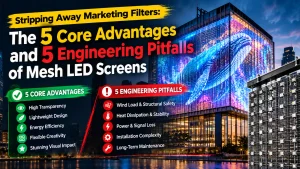
LED mesh screens are flexible, see-through grids made of LED strips, suspended from building facades or integrated into structural frameworks. They display vivid video content at night while preserving interior visibility, airflow, and natural daylight penetration during the day.
Core Roles and Technical Specifications
Core Role: Transforms glass towers into media display walls without turning windows into opaque solid walls.
Transparency Balance: Balances LED count (image clarity) with daytime structural transparency.
Structure and Maintenance: Building envelopes must withstand static dead loads, and individual strips must support hot-swapping for easy maintenance.
Real-World Engineering Lesson
Wind load is an easily overlooked variable. In an early large-scale mesh screen project, miscalculated wind pressures forced a last-minute redesign of all mounting brackets, triggering weeks of project delays. If a supplier never asks for your local wind pressure standards, treat it as a major red flag.
Procurement Pitfalls and Decision Advice
Enforce Wind Load Compliance: When reviewing mesh screen quotes, never judge by price-per-square-meter alone. Require “structural wind pressure calculations,” “installation detail drawings,” and “wind-resistance test reports” as mandatory pre-qualification criteria.
Evaluate True Maintenance Cost (TCO): Confirm whether individual strips support front/rear hot-swapping. Requiring heavy cranes or large-scale curtain wall disassembly to replace a single strip introduces catastrophic future maintenance expenses.
3. LED Linear Lights
What Are LED Linear Lights?
Linear lights are continuous LED fixtures used to outline building geometries, vertical fins, floor edges, and rooflines. When equipped with addressable control, each segment functions as a linear pixel unit within the media network.
Core Roles and Technical Specifications
Core Role: Traces building contours and executes chase, gradient, and scanning animations along structural lines.
Addressability and Anti-Glare: Only addressable linear units tie into media mapping networks; roof units require strict anti-glare shielding designs.
Connector Integrity: Linear fixtures have the highest connector density per meter, with every joint representing a potential water ingress point.
Real-World Engineering Lesson
Addressable linear lights deliver much of the visual “media impact” at a fraction of a full pixel grid’s cost. On an office project where the budget only allowed sparse pixels or dense linear lighting, we recommended linear lighting. The chase animation running across 40 floors was so stunning that the client completely abandoned the idea of an expensive pixel screen.
Procurement Pitfalls and Decision Advice
Guard Connector Waterproofing: The Achilles’ heel of linear lights is the connector. Prioritize suppliers using double-sealed, professional IP68 waterproof molded plugs to prevent micro-gaps from thermal expansion.
High-Value Alternatives: For B2B projects with constrained budgets seeking landmark visual appeal, substituting high-density mesh screens with addressable linear lights can cut material budgets by over 40% while preserving impact.
4. Wall Washers
What Are Wall Washers?
Wall washers are optically engineered fixtures designed to cast smooth, uniform light across expansive architectural surfaces, establishing rich base background colors and brightness levels.
Core Roles and Technical Specifications
Core Role: Fills the vast spaces behind and between fine media elements with rich background color. Synchronized via the same control ecosystem, it works with pixel content to deliver deep visual layering.
Photometric Uniformity: Evaluate IES distribution files rather than relying solely on lumen ratings.
Layout and Control: Precisely plan projection distance and beam angles, incorporating wall washers into the same controller network to prevent color drift.
Real-World Engineering Lesson
The most common budgeting mistake we encounter in bidding is allocating funds solely for pixels while completely omitting wall washers. Renderings look flawless on paper, but on opening night, dynamic video content awkwardly floats against a dark, lifeless building facade. On a hotel retrofit project, adding subtle wall washer bases beneath existing pixels elevated overall visual texture far more effectively than doubling pixel density.
Procurement Pitfalls and Decision Advice
Reject “Lumen-Only” Claims, Demand Optical Data: Require suppliers to provide authentic IES photometric test files for professional lighting simulation software (such as DIALux) to prevent uneven light spots, patchy walls, or inadequate height coverage.
Lock In System Compatibility: Explicitly mandate in commercial contracts that wall washers share the same control and power ecosystem as the pixel system, avoiding finger-pointing over communication protocols or color desynchronization.
5. Floodlights
What Are Floodlights?
High-output fixtures designed to project illumination across massive architectural planes or long distances, providing the strong visual presence necessary to anchor a building in the urban skyline.
Core Roles and Technical Specifications
Core Role: Anchors baseline facade luminance, ensuring the building remains clearly legible at extreme distances where pixel details dissolve.
Anti-Glare Standards: Employs shields, louvers, and precise aiming angles to comply with DarkSky and IES responsible lighting guidelines.
IK Impact Resistance: Ground-level or accessible fixtures must meet high mechanical impact standards (IEC 62262).
Real-World Engineering Lesson
Always test facade lighting from the furthest true viewpoint. On a waterfront tower project, illumination looked flawless from the street directly below, but appeared washed out and pale when viewed from across the river (the primary angle for professional media photography). Since then, we mandate multi-perspective testing during commissioning and tune floodlights primarily for long-range visibility.
Procurement Pitfalls and Decision Advice
Prioritize Environmental and Anti-Glare Metrics: Commercial landmark projects must account for neighboring residents and traffic safety. Verify that fixtures feature honeycomb louvers or anti-glare shields and comply with international DarkSky environmental protection standards to avoid complaints or regulatory violations.
Require Long-Range Simulations as Contract Attachments: During vendor technical reviews, demand illuminance calculations tailored to target building heights and distant sightlines as binding contractual criteria.
6. Controllers
What Are Controllers?
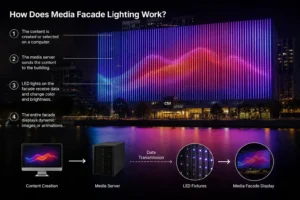
The central processing hub of the entire installation. It ingests video sources, timeline cues, and lighting scenes, routing frame-by-frame data packets to every pixel, mesh strip, linear fixture, wall washer, and floodlight.
Core Roles and Technical Specifications
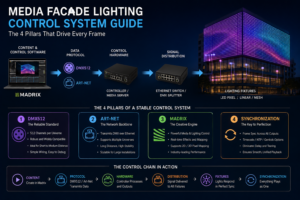
Core Role: Manages pixel mapping coordinates, DMX universes (following ANSI E1.11), Art-Net/sACN network streaming, and automated scheduling.
Capacity and Protocol: Output bandwidth must exceed total pixel allocation with built-in headroom; prioritize open communication protocols like DMX/RDM, Art-Net, and sACN.
Standalone Playback: Ensures independent loop execution without requiring a permanent PC connection.
Real-World Engineering Lesson
Our most painful early lessons happened at the control layer: individual fixtures passed bench tests easily, but failed to synchronize over long data runs due to poor network topology and node overloading. Today, we map comprehensive data diagrams (universe allocations, node locations, cable run limits) before freezing fixture coordinates, validating full-link integrity on a single-bay prototype first.
Procurement Pitfalls and Decision Advice
Strictly Forbid Proprietary/Closed Protocols: Absolute prohibition against systems utilizing proprietary, closed communication protocols. This traps projects when upgrading or replacing local parts later. Mandate standard open protocols (Art-Net, sACN, DMX/RDM) in contracts.
Lock In Bandwidth Headroom: Clearly specify in technical agreements that controllers must reserve at least 20% to 30% data bandwidth headroom to accommodate future holiday effects or pixel expansions.
7. Power Supplies
What Are Power Supplies?
The conversion layer responsible for stepping down commercial AC electricity into stable low-voltage DC power (typically 24V DC) required by all lighting nodes and controllers.
Core Roles and Technical Specifications
Core Role: Delivers stable current to maintain consistent output brightness and protects sensitive electronics from electrical stress.
Distributed Layout: Places power supplies close to lighting clusters to eliminate remote voltage drop caused by long low-voltage wire runs.
Load Margins: Maintains a strict 70% to 80% maximum load capacity threshold, utilizing tier-one branded units backed by reliable warranties (Mean Well, Inventronics).
Real-World Engineering Lesson
On a 28-story tower, an initially centralized power distribution design caused upper-floor lighting to dim noticeably at night due to voltage drop. We solved this by deploying distributed power boxes every 6 vertical floors, instantly eliminating gradient voltage drop. Power supply failure rates vastly exceed LED burnout rates; evaluate an engineering project by its power architecture, not marketing lumen stats.
Procurement Pitfalls and Decision Advice
Specify Brands and Forbid Substitutions: Explicitly name power supply brands (such as Mean Well, Inventronics) in BOMs (Bills of Materials) and contracts, strictly prohibiting vendors from substituting cheaper alternatives.
Load Rate and Distributed Enclosure Clauses: Mandate that actual power supply loads do not exceed 70%–80%, and require suppliers to define distributed enclosure locations during the design phase to prevent costly rework caused by voltage drop.
What Systems Does Your Project Actually Need?
You do not need to deploy all 7 systems for every facade. Match component choices directly to your target visual effects:
| Target Visual Effect | Required System Combination | System Complexity | Procurement Focus |
| Solid Gradients & Fades | Linear Lights + Wall Washers + Controllers + Power | Low | Control connector waterproofing and wall washer uniformity |
| Architectural Outlining & Chases | Linear Lights + Floodlights + Controllers + Power | Low–Medium | Balance long-range flood intensity with anti-glare standards |
| Patterns & Dynamic Animation | Pixel Lights + Wall Washers + Controllers + Power | Medium | Focus on pixel binning consistency and open protocols |
| Full Video Content Playback | Pixel Lights or Mesh + Washers + Floodlights + Controllers + Power | High | Evaluate total data bandwidth, control topology, and distributed power |
| Transparent High-Rise Video Wall | Mesh Screen + Controllers + Power | High | Core audit of wind load calculations, transparency, and hot-swapping |
Component selection should serve actual visual requirements rather than exaggerated sales pitches.
Core System Quick Reference Table
| System Name | Primary Function | Key Technical Spec | First-Line Risk Factor | Procurement Compliance Point |
| LED Pixel Lights | Dynamic video rendering | Pixel pitch vs. viewing distance | Over-configured resolution | Check optical-electrical test reports |
| LED Mesh Screens | Transparent video display | Transparency vs. pixel density | Ignoring wind load | Mandatory wind-resistance calculations |
| LED Linear Lights | Contour tracing and chases | Addressability, connector quality | Water ingress at joints | Confirm double-seal and molded plug standards |
| Wall Washers | Expansive background color | Photometric uniformity (IES files) | Omitted from initial budgets | Request DIALux simulation data |
| Floodlights | Skyline-grade long-range coverage | Beam angle, anti-glare control | Insufficient long-range reach | Comply with DarkSky environmental standards |
| Controllers | Pixel mapping and data sync | Bandwidth capacity, open protocols | Poor data network planning | Ban proprietary protocols; lock in Art-Net |
| Power Supplies | Stable low-voltage output | Distributed layout, 70–80% headroom | High-rise voltage drop | Specify tier-one brands (e.g., Mean Well) & warranties |
Avoid Project Pitfalls by Choosing the Right Upstream Manufacturing Partner
In multi-million-dollar, tight-deadline landmark and commercial complex projects, paper specifications and glossy renderings often mask hidden engineering risks. A manufacturer with extensive cross-border project experience provides not only high-stakes, reliable hardware but also full technical closure from early optical simulations, structural wind calculations, and data network topology design through to final commissioning.
As a seasoned outdoor lighting and media facade solution provider with 16 years of industry expertise, we remain committed to strict manufacturing standards and full lifecycle support, helping architects, lighting designers, and general contractors worldwide mitigate engineering risks and ensure flawless long-term execution.
Contact Us:
Address: 6th Floor, Room 11, No. 398 East Anbei Road, Guzhen Town, Zhongshan City
Phone: +86 13415384610
Official Website: https://ledmediafacade.com/
Request Your Free Custom Component Package & Engineering Evaluation
If you are currently planning a new landmark, commercial complex, or cultural tourism project and screening suppliers, feel free to send us your architectural drawings and target visual goals.
Our team of senior engineers will return an objective, rigorous, and cost-effective component list, layout plan, and detailed quotation within 48 hours to give your project a winning start.
Reference Standards and Metadata
Update Date: September 24, 2026
IEC 60529 — Degrees of Protection Provided by Enclosures (IP Code)
IEC 62262 — Degrees of Protection Provided by Enclosures Against External Mechanical Impacts (IK Code)
ANSI E1.11 (DMX512-A) — Entertainment Technology Standard
ANSI C78.377 — Specifications for the Chromaticity of Solid State Lighting Products
U.S. Department of Energy (DOE) — LED Reliability Research
DarkSky International & IES — Five Principles for Responsible Outdoor Lighting