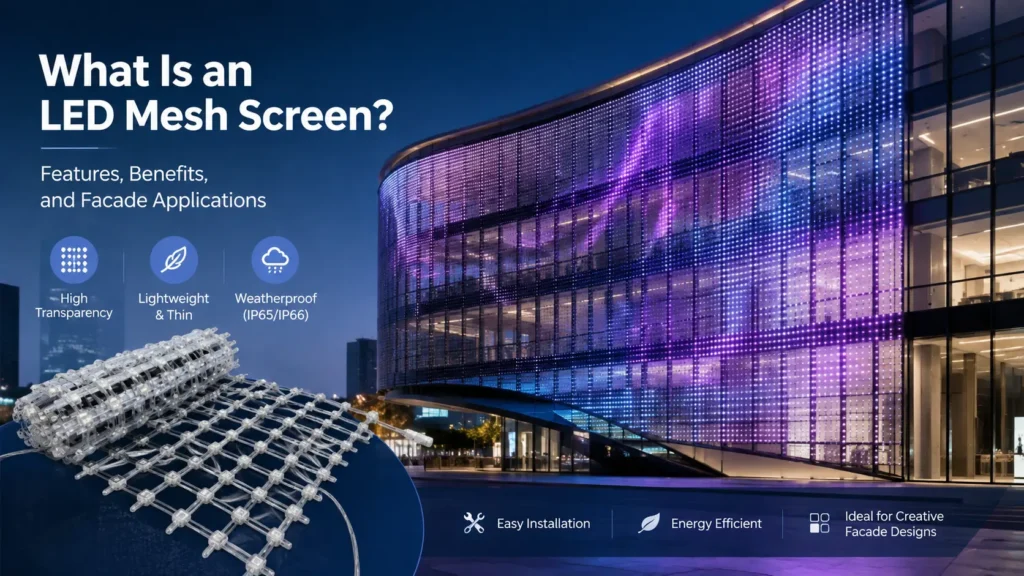
An LED mesh screen is an open-grid LED display in which RGB pixels sit on narrow bars, strings or nodes separated by open gaps, so daylight, air and the view through the facade pass between the pixels. The open area is set by pixel pitch and bar width: on the MEKALEO MDL-Grid series, transparency rises from 39.2% at P15.625 to more than 88% at P83.3, while weight falls from 10.2 kg/m² to 0.78 kg/m².
Choose an LED mesh screen for large building facades, glass curtain walls and high-wind locations viewed from roughly 15 m or more. Choose a solid cabinet LED display for close viewing under about 10 m where dense image detail matters more than transparency.
1. What Is an LED Mesh Screen?
Definition: An LED mesh screen is a lightweight LED display built from LED bars, strips, pixel strings or modules arranged in a grid-like structure that does not form a solid surface. The open spaces between the LED elements reduce weight, let wind pass through and preserve part of the view behind the screen.
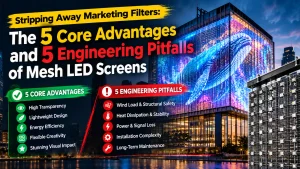
The open-grid construction of an LED mesh screen produces five practical characteristics:
- Lower overall weight than a solid cabinet display of the same area.
- Airflow through the display, which reduces the solid area exposed to wind.
- Reduced visual obstruction for building occupants and for the facade behind the screen.
- Flexible installation on cables, stand-off frames or curved substructures.
- Suitability for large and irregular building surfaces.
Suppliers also use the terms LED mesh, mesh LED screen, LED grid screen, transparent LED mesh and LED screen fabric. These terms are not used consistently across the industry, so product construction, transparency, brightness and installation method should always be confirmed from the technical datasheet rather than the product name. A manufacturer-level overview of customization options is available in the LED mesh screen complete guide.
2. How an LED Mesh Screen Works: Components and Signal Path
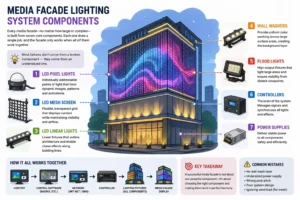
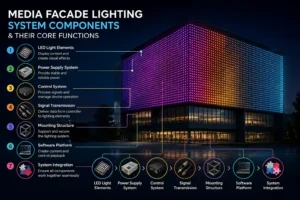
An LED mesh screen produces images, video, text and animation by driving each RGB pixel at an independently controlled brightness. Content travels from a media player or video processor to a sending card, through data cables to receiving cards on the screen, and finally to the driver ICs on each LED bar. Power supply units convert mains AC into the low-voltage DC used by the LED bars; the MDL-Grid series uses DC 24 V on P15.625 and P25 models and DC 12 V on P50 to P83.3 models.
| Component | Function in an LED mesh screen | What to confirm |
|---|---|---|
| LED bars, strips or modules | Carry the RGB pixels and driver ICs that create the image. | Pixel pitch, LED package, bar width and bar depth. |
| Power supply units | Convert mains AC into DC 12 V or DC 24 V for the LED bars. | Location, IP rating, load margin and heat dissipation. |
| Receiving cards | Translate the data stream into pixel data for one screen section. | Section mapping and spare-card availability. |
| Sending card or video processor | Scales source video to the screen resolution and distributes data. | Input formats, resolution and backup signal path. |
| Structural mounting system | Holds the screen on the facade or on a stand-off frame. | Dead load, wind load, anchor type and maintenance access. |
| Control software or media player | Stores, schedules and plays content; adjusts brightness by time of day. | Scheduling, remote monitoring and brightness control. |
The visible result of an LED mesh screen depends on more than the LED chips. Pixel pitch, brightness, viewing distance, content design and the facade behind the screen all affect how the image appears on a real building. A wide pixel pitch can still read as a smooth image on a large facade viewed from across a plaza, while the same configuration would look coarse in a close-viewing retail window.
3. How LED Mesh Transparency Works: The Geometry Behind the Percentage
LED mesh transparency is the open-area ratio of the screen: the share of the screen area that is not blocked by LED bars, PCBs, cables or frame members. Transparency is determined by two dimensions — the pixel pitch (p), the center-to-center distance between pixels, and the bar width (w), the width of each LED bar seen from the front.
A P50 mesh with 9 mm-wide vertical bars therefore has an open-area ratio of about 1 − 9 ÷ 50 = 82%. Halving the pitch to P25 with the same 9 mm bar drops the open-area ratio to 64% and quadruples pixel density from 400 to 1,600 pixels/m². Denser pitches usually also need wider bars with more LEDs and driver ICs, so transparency falls faster than the formula alone suggests.
Viewing angle reduces perceived LED mesh transparency. When the screen is seen at an angle θ from the perpendicular, the depth d of each LED bar hides an extra d·tanθ of every gap. For a P50 mesh with a 9 mm bar and 10 mm bar depth viewed at 45°, the effective gap shrinks from 41 mm to 31 mm and the apparent openness falls from about 82% to about 62%. Occupants looking straight out of a window see the full open ratio; pedestrians looking up the facade at a steep angle see a denser screen.
MEKALEO MDL-Grid Transparency, Density and Weight by Pitch
| Model | Pixel density | Optical transparency | Weight | Max power | DC voltage |
|---|---|---|---|---|---|
| MDL-Grid P15.625 | 4,096 /m² | 39.2% | 10.2 kg/m² | 614.4 W/m² | 24 V |
| MDL-Grid P25 | 1,600 /m² | 24.0%–39.2% | 8.2 kg/m² | 240 W/m² | 24 V |
| MDL-Grid P50 | 400 /m² | 80.0%–85.0% | 1.54 kg/m² | 120–288 W/m² | 12 V |
| MDL-Grid P62.5 | 256 /m² | 85.0%–88.0% | 1.14 kg/m² | 76.8–184.3 W/m² | 12 V |
| MDL-Grid P83.3 | 144 /m² | > 88.0% | 0.78 kg/m² | 43.2–103.7 W/m² | 12 V |
Source: MEKALEO LED mesh screen technical matrix. Values are model-specific factory data, not industry-wide constants; other manufacturers’ bar widths and transparency values differ.
Engineering tip: test transparency on the real facade
A catalog transparency percentage does not show how the LED mesh screen will look on a specific building. Perceived openness also depends on background color, content brightness, daytime versus nighttime conditions and viewing angle. Before ordering, request daytime and nighttime photos, video samples, viewing-angle data, a physical sample and a facade simulation. The useful question is not “What is the transparency rate?” but “How will this screen look on my facade from the actual viewing distance?”
4. Four Types of LED Mesh Screens
LED mesh screens fall into four construction types. The type determines the transparency range, the weight, how the screen bends and how the screen is installed. The fourth type, the flexible curtain built from discrete pixel nodes, overlaps with LED pixel lights and is covered in the LED pixel light guide.
| LED mesh type | Construction | Typical pitch range | Shape capability | Best application |
|---|---|---|---|---|
| Rigid aluminum-profile bar mesh | Extruded aluminum LED bars fixed into a frame | P15–P50 | Flat or faceted | Glass curtain walls needing a precise, flat video surface |
| Flexible strip curtain | Soft LED strips held on stainless steel cables | P25–P100 | Single-curved and large-radius surfaces | Curved towers, atria, stages and temporary events |
| Pixel-node mesh curtain | Discrete round or square pixel nodes on cables | P50–P300+ | Free-form, double-curved | Landmark crowns, bridges and maximum-transparency facades |
| Modular cabinet mesh | Framed tiles with louvre-style LED bars | P10–P31 | Flat, standard tile sizes | Billboard-style media walls needing fine pitch with some airflow |
The pitch ranges above are typical market ranges, not MEKALEO specifications. Confirm the exact pitch, bend radius and bar size for each product from its datasheet.
5. LED Mesh Screen vs. Traditional LED Video Wall
An LED mesh screen trades image density for transparency, weight and airflow. A traditional LED video wall uses solid cabinets that block the background, weigh several times more per square meter and present a closed surface to the wind. The full cost, structure and selection comparison, including pixel-point matrix facades, is in Media Facade vs. Traditional LED Display.
| Feature | LED mesh screen | Traditional LED video wall |
|---|---|---|
| Structure | Open-grid bars, strips or nodes | Mostly solid cabinets |
| Weight | 0.78–10.2 kg/m² (MDL-Grid range) | Generally several times heavier per m² |
| Airflow and wind | Air passes through the open area | Closed surface takes the full wind pressure |
| Visual openness | Preserves part of the view and daylight | Blocks the background |
| Close-up image quality | Depends strongly on pixel pitch | Optimized for dense images |
| Installation | Custom cables, frames or stand-offs | Standard cabinets on a steel frame |
| Typical use | Media facades, curtain walls, outdoor structures | Indoor walls, stages, roadside billboards |
6. Outdoor Protection: IP Rating, Materials and Weathering
Outdoor LED mesh screens are protected against rain and dust by sealed LED bars, potted electronics and waterproof connectors. The IP code defined in IEC 60529 describes protection against solid objects and water under specified laboratory test conditions. The MEKALEO MDL-Grid series is rated IP66 with silicone potting and a UL94-V0 flame rating.
| IP code | Solids protection | Water protection (IEC 60529 test) | Relevance to LED mesh screens |
|---|---|---|---|
| IP65 | Dust-tight | Water jets from a 6.3 mm nozzle, 12.5 L/min | Baseline for sheltered or low-rise facades |
| IP66 | Dust-tight | Powerful water jets from a 12.5 mm nozzle, 100 L/min | Recommended for exposed high-rise and wind-driven rain |
| IP67 | Dust-tight | Temporary immersion | Relevant for connectors and parts at risk of pooling water |
| IP68 | Dust-tight | Continuous immersion under conditions agreed by the manufacturer | Usually specified for in-ground fixtures, rarely needed for mesh bars |
An IP rating alone does not prove that an LED mesh screen suits every outdoor environment, and an IP rating says nothing about wind resistance. Long-term outdoor reliability also depends on UV-stable materials, corrosion-resistant fasteners, sealed cable entries, drainage paths and heat dissipation for the power supplies. The acceptance tests used to verify IP65 and IP66 in practice are detailed in How to Choose an Outdoor LED Mesh Screen.
7. Wind Load and Structural Considerations
Wind load on an LED mesh screen is proportional to the solid area of the screen, not its gross area. Because air passes through the open area, a high-transparency mesh presents a much smaller solid area to the wind than a solid cabinet of the same size. The force is estimated from the dynamic wind pressure, a force coefficient and the solid area:
Worked Example: Solid Area and Wind Force
The example below compares a 100 m² solid cabinet display with a 100 m² MDL-Grid P50 mesh (80% open ratio) at a design wind speed of 35 m/s. The force coefficient Cf = 1.8 is an illustrative value used for both cases to isolate the effect of solid area; the governing code and the screen geometry set the real Cf, which differs between solid and porous surfaces.
| Step | Solid cabinet display | LED mesh screen, 80% open |
|---|---|---|
| Dynamic pressure q = 0.613 × 35² | 751 Pa | 751 Pa |
| Solid area Asolid | 100 m² | 20 m² |
| Illustrative force F = q × 1.8 × Asolid | ≈ 135 kN | ≈ 27 kN |
| Display dead load (gross 100 m²) | Heavy cabinet weight | 154 kg (1.54 kg/m²) |
Structural responsibility
The worked example shows why open area matters; the example is not a design calculation. A lightweight LED mesh screen still transfers wind, dead and maintenance loads into brackets, anchors and the building structure. The project structural engineer must determine the design wind speed, exposure, height factor, gust factor, force coefficient and connection design under the governing code, such as ASCE/SEI 7 in the United States or EN 1991-1-4 in Europe.
A structural review for an LED mesh screen on a building facade should cover the existing facade structure, mounting points, wind exposure, screen weight, mounting distance from the facade, cable and power routes, maintenance and emergency access, and local construction requirements. The WBDG Building Envelope Design Guide explains why a facade-mounted system must be treated as part of the building envelope rather than as a decorative surface.
8. LED Mesh Screen Installation Methods
LED mesh screens are installed with three main methods: cable-hung suspension, frame mounting on the facade, and stand-off steel frames. The method follows from the building structure, the screen size, the installation height and whether the project is permanent or temporary.
| Installation method | How the mesh is held | Best for | Key checks |
|---|---|---|---|
| Cable-hung suspension | Stainless steel support cables from a top outrigger to bottom anchors | High-rise buildings, glass curtain walls, landmark towers | Cable tension, roof anchor capacity, wind-induced movement |
| Frame-mounted | Aluminum profiles or brackets fixed to curtain-wall mullions or structure | Flat or curved facades needing precise module alignment | Mullion capacity, curtain-wall warranty, drainage paths |
| Stand-off steel frame | Independent frame holds the mesh away from the facade | Uneven facades, large screens, rear maintenance access | Dead and wind load on the frame, walkway clearance |
| Custom architectural integration | Mesh recessed into or combined with facade cladding | Angled, recessed and decorative facade designs | Interface details, heat dissipation, access for repair |
The full step-by-step process — site survey, frame alignment, power and signal wiring, DMX/RDM commissioning and handover — is covered in the Media Facade Installation guide.
9. LED Mesh Screen Applications
LED mesh screens are used where a large display must coexist with the architecture. The table matches each application to a typical viewing distance and a starting pitch range; the final pitch should be confirmed against the actual viewing positions.
| Application | Typical viewing distance | Starting pitch range | Main design priority |
|---|---|---|---|
| High-rise media facade and landmark tower | 100 m and more | P50–P83.3 | Transparency, weight and long-distance visibility |
| Glass curtain-wall office building | 30–80 m | P25–P50 | Daylight and outward view for occupants |
| Shopping mall and retail complex facade | 20–50 m | P15.625–P35 | Advertising image quality and brand content |
| Hotel and hospitality facade | 30–100 m | P35–P62.5 | Ambient animation without an advertising look |
| Stadium, arena and transport hub | 50–200 m | P50–P83.3 | Large area, wind exposure and maintenance access |
| Retail storefront and glass window | 3–15 m | Fine-pitch transparent LED film or glass display | Close-up detail without fully blocking the window |
Typical content on an LED mesh media facade includes brand advertising, building identification, cultural content, event information, artistic animation, public messages and seasonal campaigns. The design objective is not always the brightest possible screen; in many architectural projects the better solution balances image visibility with the appearance of the building. Local rules on outdoor advertising, facade lighting and light pollution should be checked before installation, and the CIE publications provide international lighting guidance for planning.
For close-viewing retail windows under roughly 10–15 m, a transparent LED film or glass-integrated LED display usually outperforms an LED mesh screen, because pixel pitch and image quality matter more than airflow.
10. Advantages and Limitations of LED Mesh Screens
Advantages
- Low weight: 0.78–10.2 kg/m² across the MDL-Grid range reduces structural demand on the facade.
- High transparency: up to 88%+ open area keeps daylight and outward views for occupants.
- Lower wind exposure: only the solid bar area takes wind load.
- Passive cooling: open airflow removes heat without enclosed cabinets.
- Daytime discretion: the facade remains readable when the screen is off.
- Scalable shape: modules and cables cover very large and curved surfaces.
Limitations
- Lower image density: coarse pitches look grainy at close range.
- Lower peak brightness per m²: fewer LEDs per area than a solid cabinet.
- Custom engineering: mounting, cabling and wind design are project-specific.
- Angle-dependent openness: transparency drops for steep viewing angles.
- Access planning: high-rise maintenance needs cradles, rope access or walkways.
- Not plug-and-play: unsuitable when a standard indoor cabinet would do.
11. How to Specify an LED Mesh Screen: A Five-Step Process
- Define the viewing distance. A preliminary industry estimate is minimum viewing distance (m) ≈ pixel pitch (mm) × 1, so a 25 mm pitch suits viewers from about 25 m. A 10 mm pitch suits roughly 10 m. The rule is a starting point; content type, brightness and camera use also matter. The full method is in the pixel pitch and viewing distance formula.
- Check the building structure. Confirm the existing facade structure, mounting points, wind exposure, screen weight, cable and power routes, maintenance and emergency access, and local construction requirements.
- Confirm brightness requirements. Outdoor screens need enough brightness for daylight visibility, set by direct sunlight, screen orientation, viewing distance and content design. The control system should reduce brightness at night to limit glare for nearby residents and drivers and to meet local lighting regulations.
- Evaluate transparency in real conditions. Request daytime and nighttime photos, video samples, viewing-angle information, a physical sample and a facade simulation before ordering.
- Review maintenance requirements. Ask whether LED bars can be replaced individually, whether front or rear access is required, whether repairs are possible without removing the whole screen, how spare parts are stocked, the delivery time for replacement components and whether the control system reports faults.
Is an LED Mesh Screen Suitable for Your Project?
| An LED mesh screen fits when the project needs | Another display type fits better when the project needs |
|---|---|
| A large display area on a building facade | Very close viewing under about 10 m |
| A lightweight structure and airflow through the screen | Extremely dense image detail |
| Reduced visual obstruction and daylight for occupants | A completely opaque display surface |
| Outdoor or semi-outdoor operation | A standard indoor cabinet solution |
| A customized mounting solution and digital content integrated with architecture | A simple plug-and-play installation |
12. Frequently Asked Questions
What is the difference between an LED mesh screen and a transparent LED display?
An LED mesh screen uses an open structure of LED bars, strips or nodes suspended on cables or frames, typically for building facades viewed from 15 m or more. A transparent LED display usually refers to a fine-pitch LED film or glass-mounted panel installed behind or on glazing for close viewing. Both let light through, but the structure, pitch range and installation method differ.
How transparent is an LED mesh screen?
LED mesh screen transparency depends on pixel pitch and bar width. On the MEKALEO MDL-Grid series, optical transparency is 39.2% at P15.625, 80%–85% at P50, 85%–88% at P62.5 and more than 88% at P83.3. Perceived transparency also falls when the screen is viewed at a steep angle.
How much does an LED mesh screen weigh?
MEKALEO MDL-Grid LED mesh screens weigh from 0.78 kg/m² at P83.3 to 10.2 kg/m² at P15.625; the P50 model weighs 1.54 kg/m². The total installed load also includes brackets, cables, power supplies and the support frame, so the structural engineer should assess the complete system.
Is an LED mesh screen suitable for outdoor use in heavy rain?
Yes, when the screen, connectors and power supplies carry a suitable IP rating and the installation includes sealed cable entries and drainage. MEKALEO MDL-Grid screens are rated IP66, which under IEC 60529 covers powerful water jets. An IP rating does not cover wind resistance or poor installation details.
Can an LED mesh screen be installed on a glass curtain wall?
Yes. Glass curtain-wall projects usually use cable-hung suspension or brackets fixed to the curtain-wall mullions, so the glass itself carries no load. The final method depends on mullion capacity, curtain-wall warranty conditions and the structural engineer’s wind-load assessment.
What pixel pitch should I choose for a building facade?
Start from the closest important viewing distance: pitch in millimeters roughly equals the minimum viewing distance in meters. Glass office facades viewed from 30–80 m commonly use P25–P50, and high-rise landmarks viewed from 100 m or more commonly use P50–P83.3, where transparency also rises above 80%.
13. Conclusion
An LED mesh screen is the open-structure LED display for large building facades: lightweight, transparent, ventilated and flexible in shape. On the MEKALEO MDL-Grid series, the trade-off is explicit — moving from P15.625 to P83.3 lowers pixel density from 4,096 to 144 pixels/m² while transparency climbs from 39.2% to more than 88% and weight falls from 10.2 to 0.78 kg/m². The right LED mesh screen is therefore chosen from the viewing distance, the facade structure, the wind exposure, the IP protection, the maintenance access and the control system together, not from the product name. For a project review, send MEKALEO the facade drawings, installation size, viewing distance, required pitch, project location and brightness requirement.
References
- IEC 60529 — Degrees of protection provided by enclosures (IP Code)
- ASCE/SEI 7 — Minimum Design Loads and Associated Criteria for Buildings and Other Structures
- WBDG — Building Envelope Design Guide
- CIE — International Commission on Illumination publications
- EN 1991-1-4 — Eurocode 1: Actions on structures, wind actions (European projects)
- MEKALEO MDL-Grid technical matrix — model-specific transparency, weight, power and IP data
Send elevations, viewing distance and location. MEKALEO engineers return a pitch recommendation, transparency simulation and project quotation.
Updated: October 29, 2026 · MEKALEO Engineering Team
Project enquiry
Send your drawings. Get a specification you can defend.
Elevation DWG, facade area, closest viewing distance and site country — we reply within 48 hours with a fixture matrix, power and DMX topology, and a quotation. No price-only quotes.
5,000+ projects delivered · 40+ countries · ISO 9001 · CE / UL / RoHS