Media Facade vs LED Billboard: Two Different Businesses Behind Two Screens
Both are LED. Both face a street. Almost everything else — structure, approval route, pixel pitch, content model and who earns the money — is different. A decision guide for developers, property owners and contractors.
The question usually arrives in the middle of a project, when someone has already sketched a screen on an elevation: should this be a media facade or a billboard? By then, half the answer is already fixed, because the two are not interchangeable products that can be swapped on the same wall. They are two different assets with different structures, different approval routes and different revenue logic.
This is written from the manufacturing side, where we see both. We build mesh and grid facade systems, and we are routinely asked to quote a “billboard” that turns out to need a facade system, or the reverse. The distinction is worth an hour of clarity before a deposit, because it is very expensive to discover later.
1. The short answer
| Question | LED billboard | Media facade |
|---|---|---|
| What is it for? | Selling advertising time on a defined display face | Making the building itself the medium — brand, art, city identity |
| Who pays and who earns? | Media operator pays, then earns from advertisers | Building owner pays; return comes from brand value, property positioning or planning benefit |
| Structure | Self-supporting steel frame on its own foundation | Integrated into the facade, loads shared with the building envelope |
| Typical pitch | P6–P25, sized to be read from 50–200 m | P25–P100, sized to the building’s viewing distance |
| Content | 16:9 or 9:16 advertising loops, scheduled and sold | Building-scale media art, brand films, generative or interactive content |
| Approval | Outdoor advertising consent, often content-level | Building permit, facade alteration, lighting and sometimes heritage consent |
| Failure is | A dark advertising asset with no revenue | A dark patch on an architectural elevation |
Table 1. The distinction that drives every other decision: a billboard is a media asset, a facade is a building element.
If you are monetising an advertiser, you are building a billboard. If you are improving a building, you are building a facade. Most project failures come from trying to do both with one structure and one approval.
2. Two business models, not two screen types
The hardware difference is visible. The business difference is what actually decides the specification.
A billboard is measured in impressions and rent. Its value is a function of traffic volume, dwell time, sightline and audience quality. That produces specific design priorities: the display must be legible from a long distance and at speed, so pixel pitch stays coarse and brightness stays high; the aspect ratio follows advertising standards; the structure is optimised to be built quickly on a plot with no building attached; and maintenance access is designed for a crew that visits on a schedule.
A media facade is measured in architectural effect. Its value is a function of how the building reads at night, how the content suits the elevation, and whether the result is worth the planning argument. That produces almost the opposite priorities: the display must disappear into the architecture by day, the pixel pitch is set by the nearest realistic viewer rather than the furthest, brightness is capped by glare concerns rather than maximised, and the whole system has to be serviceable from whatever access the building already provides.
One consequence is easy to miss: a billboard can be relocated. A media facade cannot. If the advertising market shifts, a billboard operator moves the asset. A facade is a permanent commitment to a particular building, which is why the specification quality of a facade matters more than that of a billboard — there is no second site.
3. Eight differences that change the design
| Dimension | LED billboard | Media facade | Practical consequence |
|---|---|---|---|
| Position | Freestanding or rooftop, sited for a sightline | Applied to an existing elevation or designed into a new one | Facade work starts with drawings you did not produce; billboard work starts with a plot |
| Structure | Own steel frame and foundation, designed for wind on a flat face | Loads transferred into the curtain wall or slab; wind behaviour depends on the envelope | Facade wind load is a structural engineer’s calculation, not a supplier’s assumption |
| Pixel pitch | P6–P25 for 50–200 m viewing | P25–P100 for 20–200 m, often deliberately coarse | Coarse pitch on a facade is a design choice, not a cost compromise |
| Brightness | 6,000–10,000 nits to beat direct sun at distance | 3,000–7,000 nits, capped by glare and planning conditions | Over-bright facade screens generate complaints and enforcement |
| Transparency | Not required; a solid face is normal | Often essential for daylight, views and glass facades | A 50–75% open mesh changes the product category entirely |
| Approval | Advertising consent, frequently content-specific | Building permit, facade alteration, lighting and heritage constraints | Facade approvals take longer and involve more parties |
| Access for service | Catwalk, ladder or rear door designed in | Must use the building’s BMU, gondola or rope access | Access strategy should be agreed before the module layout is drawn |
| Revenue | Advertising rent, measured per site per month | Usually indirect: brand, property value, tenant appeal | Different payback logic, different tolerance for downtime |
Table 2. Eight dimensions where the two diverge. Transparent and access are the two that most often get missed at concept stage.
Transparency deserves its own paragraph. A billboard with 20% open area is a billboard with ventilation. A facade with 60% open area is a different product: the wind load drops, the daylight transmission rises, the perceived brightness falls (because less emissive area faces the viewer), and the pixel pitch has to be re-thought because the eye integrates the pattern rather than resolving individual pixels. Projects that specify a “screen on the wall” and then ask for transparency are effectively asking for a new product after the design is frozen.
Access deserves its own paragraph too. On a billboard, maintenance is a design input: you add a catwalk. On a facade, access is a constraint you inherit. If the building has a BMU rated for window cleaning, your modules must be reachable from it; if it has none, you are pricing rope access or a temporary scaffold for every intervention. We have seen facade projects where the screen cost was 60% of the budget and the access strategy was 30%, and it was the 30% that decided whether the project was viable.
4. What each one costs, and where the money actually goes
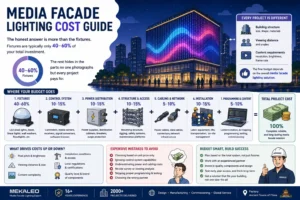
Comparing headline price per square metre is misleading, because the two products include different things. The ranges below are planning numbers for delivered hardware, consistent with the 2026 cost ranges we publish for facade systems; they are not quotations.
| Cost element | LED billboard | Media facade | Why it differs |
|---|---|---|---|
| Display hardware | $600–2,500/m² | $250–1,200/m² | Billboards use denser pitch and sealed cabinets; facades use mesh and coarser pitch |
| Structure / interface | $150–400/m² for a steel frame and foundation | Often $100–350/m², but may be absorbed into the curtain wall contract | Facade steelwork is frequently hidden inside another trade’s package |
| Control and power | Player, scheduling, remote monitoring | DMX512 or Art-Net, media server, pixel mapping, often show control integration | Facade content is more complex to author and map |
| Access provision | Catwalk or rear service door | BMU interface, davits, rope anchors, or a maintenance contract | The facade rarely owns its access |
| Approvals | Advertising consent, sometimes per campaign | Building permit, lighting assessment, heritage review | Facade approval is slower and more document-heavy |
| Content | Advertising creative, refreshed on a commercial cycle | Commissioned media art or brand content, refreshed on an artistic cycle | Facade content is a capital cost, not a media buy |
| Operating cost | Electricity plus media operations staff | Electricity plus a service contract; no sales team | Different ongoing overhead, similar power profile |
Table 3. Indicative ranges for planning. A facade at P50 mesh sits near the bottom of the hardware band; a dense P16 elevation sits at the top.
Two cost traps are worth naming. The first is comparing hardware only: a billboard quotation that excludes the foundation and the access catwalk is not comparable with a facade quotation that includes the mounting interface. Normalise to “installed, commissioned and serviceable” before comparing.
The second is underestimating power. Both categories draw serious current, and both have a peak-brightness figure that is not the average. A 500 m² facade at an average of 200 W/m² draws 100 kW when running; at eight hours a night and $0.15/kWh that is roughly $43,800 a year, before cooling or tariff changes. On a billboard the same calculation applies, but it is easier to justify because the asset is selling something. On a facade, the electricity is a permanent cost with no direct revenue line, which is why automatic dimming is not optional.
5. The approval route decides the project more often than the technology
In most cities the two products sit under different regulatory regimes, and this is where schedules die.
Billboard. Outdoor advertising is usually controlled as advertising: a permit for the structure, and often a separate consent for the content or the illuminated face. Rules frequently limit total advertising area, distance from junctions, and hours of operation, and some jurisdictions cap luminance at night. The process is well-trodden, and a media operator usually knows it intimately.
Media facade. A facade screen is generally treated as an alteration to a building, which pulls in the building permit system, sometimes a lighting or light-pollution assessment, and — on older or listed buildings — heritage review. In several European cities an illuminated facade requires advertisement consent even when it carries no advertising, because the regulation is written around “illuminated surface” rather than “advertising”. This is the single most common surprise for international developers.
Practically: if the project needs a planning argument, start it before the pixel pitch is fixed. A scheme that can demonstrate automatic dimming, a defined curfew, a capped luminance and no light spill into residential windows is far easier to approve than one that promises to “be careful”. We have found that a one-page lighting control specification, submitted early, changes the tone of the conversation more than any render.
6. Structure and wind: where the engineering actually lives
A billboard’s structure exists to hold a screen. A facade’s screen exists to tolerate a structure somebody else designed.
On a billboard, wind load is calculated on a defined, flat, usually elevated face with known exposure. The frame can be over-designed cheaply because it is a steel structure on a plot, and a heavier frame is a simple answer.
On a facade, the load path runs into the building’s secondary structure, the curtain wall mullions or the slab edge. The screen is usually the lightest element in the assembly and the least able to dictate terms. Three consequences:
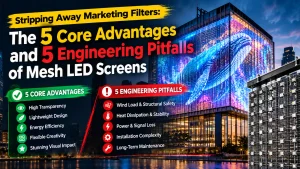
- Open area is a structural variable. A mesh screen with 60% openness passes much of the wind through; a solid cabinet wall takes the full pressure. On an exposed corner, this can be the difference between a standard bracket and a bespoke steel subframe.
- Thermal movement matters. A facade module array runs tens of metres; the building moves, the aluminium moves, and the fixings have to accommodate it. A billboard’s 12 m wide face has a much simpler expansion problem.
- Water management is a facade problem. A billboard sheds water off its own face. A facade screen sits inside a wall that must still drain, ventilate and remain weathertight behind the modules.
If a supplier quotes a facade screen without asking for elevation drawings, structural grid and exposure, they are quoting a billboard and calling it a facade.
7. Content: the difference nobody budgets for
Advertising content is made to be understood in three seconds from 100 metres. Facade content is made to be experienced from a plaza, across a river, or from a passing car at a distance that changes minute by minute.
That changes the pixel pitch decision. For a billboard, the pitch is derived from the furthest viewer who matters, and coarse is fine. For a facade, the nearest viewer sets the upper bound and the building’s proportions set the layout: a 40-storey elevation is not a 16:9 canvas, and content designed for a rectangle often looks like a postage stamp applied to a tower.
The practical consequences are worth stating in a budget review:
- Facade content is a capital item. Commissioning media art or a generative system costs real money and is usually a one-off, unlike an advertising loop that is refreshed commercially.
- Content governance is required. Who approves what appears on the building at 2 a.m.? On a billboard the answer is the media operator’s sales process. On a facade it is a policy the owner has to write.
- Test content before specifying pitch. We ask clients to send a representative frame from the intended content, not a stock image, because a photograph of a building at night and a logo animation have completely different pitch requirements.
8. How to choose: eight questions
Answer these in order. The first three usually settle it.
| # | Question | If the answer is… |
|---|---|---|
| 1 | Will the display sell advertising time to third parties? | Yes → billboard logic, advertising consent, media operations. No → facade logic |
| 2 | Does the building’s elevation have to remain readable as architecture by day? | Yes → facade, with transparency and a low-profile module |
| 3 | Is there a defined viewing face with concentrated traffic? | Yes → billboard may be cheaper and clearer. Multiple approach directions → facade |
| 4 | Can the building structure take a concentrated point load, or must loads be spread? | Spread → facade with a distributed subframe; concentrated → billboard frame possible |
| 5 | Does the site have planning history for illuminated surfaces? | None → expect a lighting assessment; budget time for it |
| 6 | How will a technician reach module 4,000 in year six? | No answer → stop; this decides viability more often than price |
| 7 | Is there a revenue line, or is the return indirect? | Indirect → plan for lower tolerance of downtime and a service contract |
| 8 | Who owns the content decision in year three? | Undefined → write the governance before commissioning the screen |
Table 4. The order matters: questions 1–3 determine the category, 4–6 determine cost, 7–8 determine whether the asset stays useful.
9. The hybrid case, and why it is the hardest
Some projects want a facade that also carries advertising. This is legitimate and common — a commercial tower with a media elevation that runs brand content and, in defined windows, paid campaigns. It is also the most difficult route, because it inherits both approval regimes: the building permit for the elevation plus the advertising consent for the content.
If this is the plan, decide three things early:
- What percentage of time is advertising? Some consents cap it. A facade running 100% advertising is an advertising structure with a facade-shaped argument.
- Is the advertising area a separate, defined zone? A clearly delineated advertising panel within a larger architectural treatment is far easier to approve than a whole elevation that sometimes sells.
- Who can switch it off? Regulators increasingly ask for a demonstrable curfew and a luminance cap. Build that into the control system, not into a promise.
10. Five mistakes we see repeatedly
1. Specifying a facade and pricing a billboard. The quotation covers a sealed cabinet wall with no transparency, no interface to the curtain wall and no access strategy. It is cheaper because it is a different product.
2. Setting brightness for daylight and forgetting the neighbours. A 7,000-nit elevation facing apartments is a complaint generator. Automatic dimming with a light sensor is a design requirement, not a feature.
3. Deciding the pixel pitch from the render. The pitch follows the nearest realistic viewer and the content. Renders flatter both.
4. Leaving access to the contractor. The screen is specified, the access is “to be confirmed”, and then the maintenance cost turns out to be the largest line item in the lifecycle.
5. Assuming approval is the architect’s problem. On a facade, the applicant is usually the owner. The supplier can supply the lighting data and the control spec; nobody else will.
11. Frequently asked questions
What is the main difference between a media facade and an LED billboard?
A billboard is a self-supporting display built to sell advertising time. A media facade is an LED surface integrated into a building’s envelope, built to make the architecture itself the medium. The structure, approval route, pixel pitch, content model and revenue logic all differ; the hardware overlap is smaller than it looks.
Is a media facade more expensive than a billboard?
Per square metre of hardware, usually less, because facades often use coarser pitch and open mesh: roughly $250–1,200/m² against $600–2,500/m² for billboard hardware. Total project cost can be higher once facade interfaces, access provision and approval work are included, and a facade has no advertising revenue to offset it.
Can I put advertising on a media facade?
Sometimes, and it is the hardest approval case because it can fall under both building and advertising rules. Decide early what share of airtime is advertising, whether the advertising area is a separately defined zone, and whether the control system can enforce a curfew and a luminance cap. Those three answers usually determine whether consent is realistic.
Which needs higher brightness?
Generally the billboard, at 6,000–10,000 nits, because it must be read from 100 m or more in direct sun. Facades typically run 3,000–7,000 nits depending on orientation, and are often capped lower by glare rules. Higher is not better: an over-bright elevation creates complaints and enforcement risk.
What pixel pitch do I need for a building facade?
Set it from the nearest realistic viewer, not the building height. Most facades run between P25 and P100 for viewing distances of 20–200 m. A coarse pitch is often a deliberate design decision, because it lets the content read as texture rather than as a video wall stuck on a tower.
Can a facade screen be transparent enough to keep the glass readable?
Yes. Mesh and grid products commonly offer 50–75% open area, which preserves daylight and views while providing an emissive surface at night. The trade-off is lower apparent brightness and a coarser effective resolution, both of which should be tested with real content before the pitch is fixed.
Do I need planning permission for a media facade?
In most jurisdictions, yes: it is an alteration to a building elevation and often a lighting installation. Some cities additionally require advertisement consent for any illuminated surface, even without advertising. Expect a lighting or light-spill assessment and, on older buildings, heritage review. Start before the design is frozen.
How is a facade screen maintained if it is 80 metres up?
Through whatever the building provides: a BMU, davits for a gondola, rope access anchors, or a temporary scaffold. That decision should be made before the module layout, because it determines module size, fixing method and spares strategy. It is also routinely the largest lifecycle cost item.
Which is better for a stadium or arena?
Usually a facade approach, because the surface wraps the building, audiences approach from several directions, and wind permeability matters. A single-face billboard suits a stadium only when there is one dominant approach road and a defined advertising business behind it.
Can I convert an existing billboard into a facade screen?
Rarely worth it. The structure is designed for a flat, self-supporting face; a facade system needs an interface to a building envelope and an access strategy the billboard frame does not have. You would be replacing the structure, the cabinet, the control and possibly the approval — which is a new project with a reused plot.
What is a realistic lifespan for each?
Both are commonly specified at 50,000–100,000 hours to 70% lumen maintenance, which is roughly 8–15 years at typical evening operation. A facade usually outlives its LED modules: the structure and cabling stay, and modules are replaced in stages. That is why documentation, batch traceability and spare-module strategy matter more on a facade than on a billboard.
Who should specify the lighting controls?
The supplier should provide the control topology, the dimming curve and the luminaire data; the designer or owner should decide the curfew, the luminance cap and who holds the override. Splitting it the other way — supplier decides policy, owner discovers it later — is how a good installation becomes a planning dispute.
Not sure which category your elevation needs?
Send the elevation drawing, the viewing distance and whether the surface will carry advertising. We will tell you which category fits, what it implies for structure and approval, and where the cost actually sits — including the parts a hardware quotation leaves out.
Project enquiry
Send your drawings. Get a specification you can defend.
Elevation DWG, facade area, closest viewing distance and site country — we reply within 48 hours with a fixture matrix, power and DMX topology, and a quotation. No price-only quotes.
5,000+ projects delivered · 40+ countries · ISO 9001 · CE / UL / RoHS