Facade Wall Washing
Uniform grazing of stone, concrete and render elevations with asymmetric optics, keeping brightness even from podium to parapet without hot spots.
Hospitality & Hotel Exterior Lighting
MEKALEO designs, manufactures and supplies LED facade lighting for luxury hotels — from guest-room-safe wall washing and linear outline lighting to full media facades — engineered for glare control, colour accuracy and long-term reliability.
Definition
A specification-driven discipline, not decorative floodlighting — and the four parameters every hotel scheme is judged on.
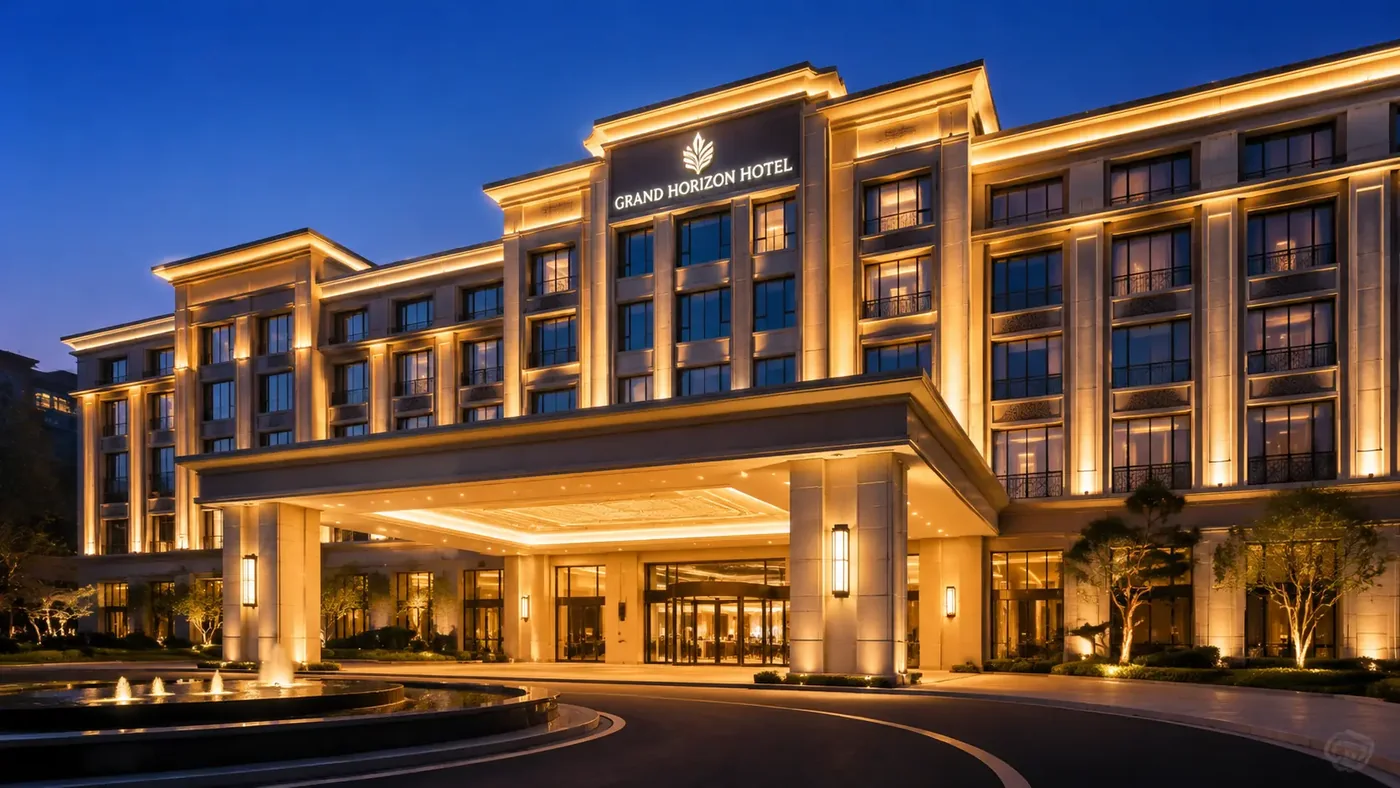
Luxury hotel facade LED lighting is the engineered illumination of a hotel’s exterior envelope, from curtain wall, podium and entrance canopy to crown and landscaping, using LED fixtures set to a consistent colour temperature, with strict glare and light-trespass limits so guest rooms, neighbours and the skyline are not affected. It is a specification-driven discipline, not decorative floodlighting: the goal is a calm, premium night image that supports the brand while protecting guest comfort.
Design Challenges
A hotel facade is one of the hardest lighting briefs in architecture: the client wants a striking night image, the guests want darkness in their rooms, and the consultant wants proof before sign-off. These are the four issues that decide whether a scheme passes.
Uplights and wall washers aimed at a glass tower throw light into guest-room windows and ruin the view at night. We set fixtures back from the glass line, use asymmetric and wall-grazing optics with hoods and louvers, and simulate spill light before a single fixture is built.
Warm 2700–3000K light with CRI ≥ 90 keeps stone, timber and metal finishes looking as the interior designer intended. Bin-matched LEDs prevent the patchwork colour that appears across large elevations when fixtures come from different batches.
High-efficacy fixtures and DMX dimming profiles cut connected load and running cost, while IP67 sealing and front-access drivers reduce maintenance visits to guest areas — a critical point for operating hotels where access is difficult and disruptive.
International hotel groups publish lighting standards, and consultants require photometric proof. We work to the specification — CCT tolerance, beam angle, fixture finish — and issue IES/LDT files so the design can be verified in the designer’s own model.
Our Solutions
Five fixture families cover the full hotel exterior, from the podium to the crown. Each can be supplied as a standard product or engineered to the project’s photometric and mechanical specification.
Uniform grazing of stone, concrete and render elevations with asymmetric optics, keeping brightness even from podium to parapet without hot spots.
Clean architectural lines on mullions, cornices and edges using extruded aluminium linear fixtures in custom lengths and RAL finishes.
Transparent mesh screens and DMX512 pixel nodes for brand content, seasonal campaigns and dynamic facades, with high transparency for daytime views.
Remote-controlled rooftop and crown illumination that defines the hotel on the skyline without spilling light into the sky or neighbouring buildings.
Guest-approach lighting with low glare and high colour rendering for porte-cochère, canopy soffits, planting and pathways.
DMX512/RDM or DALI control with timeclock scenes, astronomical switching and remote monitoring for low-maintenance operation.
Facade Zoning
A hotel elevation is never lit as one surface. Consultants specify it zone by zone, because every zone has a different viewer, a different material and a different tolerance for glare. This is the zoning every hotel scheme is built on.
Control
The podium can dim to 30 % after 23:00 while the crown holds its show level. Splitting the facade into separate circuits is settled before a single fixture is chosen.
Typical split: five dimmer channels, one timeclock, one BMS interface
| Arrival & porte-cochère | Warm, even light on vehicles, faces and the first eight metres of facade. The one zone where brightness is allowed to sell. | Recessed downlights, in-ground uplights, linear grazing under the canopy | 2200–2700K · CRI ≥ 92 · source shielded from driver eye height |
|---|---|---|---|
| Podium & street-level mass | Gives the building a base. Separates lobby and retail glazing from the tower above. | Asymmetric wall washers, 15°×45° grazers, recessed linear slots | Uniformity ≥ 0.4 · zero flux above the horizontal |
| Tower shaft, pilasters & window bands | Vertical rhythm and apparent height. Also the zone most likely to leak light into guest rooms. | Narrow wall-grazing optics in reveals, deep-recessed spots on pilasters | No line of sight from any guest window to an LED · spill modelled in DIALux against the project limit |
| Crown, signage & skyline | Long-distance identity. Read from one to three kilometres rather than from the kerb. | High-output floodlights, linear contour, mesh screen or media crown | ≥ 3840 Hz refresh if it is a screen, so it stays clean on phone cameras |
| Landscape, driveway & pool deck | Wayfinding and arrival sequence. At eye level, in the zone guests actually walk through. | Bollards, hooded in-ground uplights, submersibles for water features | ≤ 3000K · no uplight into canopies · curfew dimming on a separate circuit |
If your consultant has already issued a zone-by-zone specification, send it with the elevations. We quote against it line by line rather than substituting catalogue products, and we will say so if a specified fixture cannot meet the glare or colour-temperature limit the same document sets.
Technical Data
Standard ranges below; all parameters can be engineered to a project specification. Photometric files and test reports are issued with each batch.
| Colour temperature | 2200K / 2700K / 3000K / 4000K / RGBW, bin-matched |
|---|---|
| Colour rendering (CRI) | ≥ 80 standard, ≥ 90 on request |
| Ingress protection | IP66 / IP67, salt-spray tested for coastal sites |
| Control protocols | DMX512 / RDM / DALI / 0-10V / on-off |
| Beam angles | 10°–120°, asymmetric and wall-grazing optics |
| Housing | 6063-T5 anodised aluminium, die-cast or stainless steel |
| Lifetime | L80B10 > 50,000 hours |
| Warranty | 5 years manufacturer warranty, project-dependent |
| Compliance | CE, RoHS, IEC 60598 |
| 10°–15° | Columns, pilaster edges, sculpture and logo detail | Tight pools of light; needs accurate aiming and a mock-up to sign off |
|---|---|---|
| 20°–30° | Accent on entrance portals, canopy fascia and signage boxes | Balanced falloff; the safe default for feature work |
| 30°–45° | General wall washing on stone, render and metal panel | Even coverage with clean overlap between adjacent fixtures |
| 45°–60°+ | Soffit and canopy downlighting, podium base wash | Wide and soft; keep output low or the facade reads flat and flooded |
| 10° × 45° asymmetric | Wall grazing along a window band or mullion line | Holds light on the panel and dies at the glass — the hotel standard |
| 2200K | Heritage stone, listed facades, candle-lit arrival | Warmest option; can read amber on white render and pale limestone |
|---|---|---|
| 2700K | Classic five-star, natural stone, timber, warm metal | The default for luxury hospitality |
| 3000K | Modern luxury, glass and aluminium curtain wall | Still warm, and the most common dark-sky compliant choice |
| 4000K | Contemporary brand standards, back-of-house, service yards | Exceeds many exterior CCT caps; avoid on guest-facing elevations |
| RGBW / tunable | Crown, media facade, event mode | Only where the brand and the planning authority both allow it |
Colour consistency matters more than the headline CRI figure: two batches that both read “CRI 90” can still look different side by side. We bin to ≤ 3 SDCM and quote TM-30 alongside Ra: Rf ≥ 90 with Rg between 95 and 105, because fidelity and saturation are separate promises. Sealing is specified to match the mounting position, and the difference between IP67 and IP68 is decided by where the fixture sits, not by catalogue preference.
Compliance & Light Trespass
This is the part of a hotel facade scheme that decides whether it clears planning, and whether the property is still complaint-free in year two.
The governing constraint on a hotel facade is not brightness. It is direction and spectrum. A scheme can be beautifully lit and still fail if light crosses a property line, reaches a guest-room window or pushes skyglow past the local cap. We treat those limits as design inputs from the first simulation, not as a correction after the first complaint.
| Light trespass at the boundary | Calculation with the property line drawn, horizontal illuminance grid and a vertical-plane check at guest windows |
|---|---|
| Uplight & skyglow | BUG rating to IES TM-15 for every luminaire type, U0 where the ordinance requires it |
| Glare | Luminaire luminance in cd/m² at the specified viewing angle, shielding angle, and the aiming schedule |
| Colour & spectrum | CCT, SDCM ≤ 3, TM-30 Rf/Rg and Duv per batch; spectral power distribution on request |
| Energy | Connected load, watts per square metre of lit facade, dimming profile and annual kWh estimate |
| Standards reference | ANSI/IES RP-43 exterior lighting practice, EN 12464-2 outdoor work places, IEC 60598 for the luminaire itself |
Where a hotel group is working towards DarkSky certification, we design to the programme guidelines directly: downward-only facade lighting confined to the lit surface, colour temperature at or below 3000K, curfew dimming, and no ornamental uplighting of trees or sculpture. The evidence pack is issued with the design, not assembled afterwards in response to a planning comment.
Facade Expression
Most hotel groups arrive asking for a media facade. For a luxury property it is usually the wrong answer, and it is worth saying so before the budget is committed.

Static warm white
The default for luxury, resort and heritage hotels. Dimmable drivers, a timeclock and a fixed 2200–3000K spectrum. Lowest capital cost, lowest running cost, easiest to get through planning — and it does not date.
Choose it ifThe brand is built on calm, and the facade is stone, timber, render or painted metal.
Tunable white
Two or three white channels mixed in the driver, so the same elevation reads golden at dinner and neutral for a conference or a broadcast. Also the simplest way to hold a 3000K cap by default while keeping a cooler option for events.
Choose it ifThe property has a real events or MICE business, or the podium and tower need different colour temperatures.

RGBW & media facade
High impact, high cost, high maintenance. Content has to be commissioned and refreshed, the control system needs an operator, and the entire elevation becomes a display that must not be allowed to look tired.
Choose it ifThe building is itself the attraction: a casino, an arena-adjacent tower, a landmark crown. Not if the brand promise is quiet.
We quote all three. If the honest answer is static warm white, that is what the proposal will recommend. A facade the operations team cannot maintain becomes a dark patch on the skyline within three years, and no opening-night photograph survives that.
Control & Scenes
A hotel rarely needs the most capable protocol. It needs the one its BMS, its facility team and its brand standard can actually run at two in the morning.
512 channels per universe with per-fixture addressing, and RDM telemetry coming back from the fixture. The right answer for media crowns, RGBW scenes and any pixel count above a few hundred.
Use it forMedia and RGBW facades. Allow roughly 20% spare universe headroom and get the daisy-chain termination right — most on-site faults live there.
64 addresses per line, individually or in groups, reporting driver failure and burning hours. Well suited to tunable white and dimming-only schemes, and the easiest protocol to hand to a hotel BMS through a KNX or BACnet gateway.
Use it forTunable white and BMS integration. It is not a content protocol — do not expect it to drive a pixel facade.
One analogue level per driver, no addressing. The cheapest way to dim a single zone, and perfectly adequate for a static warm-white facade.
Use it forSimple zone dimming. There is no feedback and no scene memory, and the dimming curve follows the driver rather than the design.
Where the facade must follow hotel-wide scenes, occupancy schedules or an energy-shedding signal, scene recall lives in the building management system and our gateway exposes the facade as a device on it.
Use it forProperty-wide scenes. Agree who commissions the gateway before the package is split between trades.
Three states cover almost every hotel: arrival, from dusk to about 23:00, at full programmed output; night, after 23:00, with the tower dropped to 30–40% and the crown reduced to contour only; and rest, after 01:00, with decorative zones off and only entrance, egress and wayfinding live on a separate circuit. An astronomical timeclock tracks sunset through the year, and RDM fault reporting pushes a fixture-level alert to the engineering desk instead of waiting for a guest to notice a dark column. Commissioning detail for the addressing and controller workflow sits in our DMX/RDM auto-addressing guide.
How We Work
From the first elevation drawing to on-site commissioning, one team owns the design, the fixture and the test record — so what is approved on paper is what is delivered to site.
We review your elevation DWG/CAD, brand standard and consultant specification to confirm scope, viewing distances and control requirements.
Illuminance, glare and spill-light simulation with a fixture schedule, circuit plan and DMX addressing layout.
Factory or on-site mock-up built before approval, so the client and consultant see the real effect on the real surface.
SMT assembly, silicone potting and IP67 sealing on our own line, with batch-level traceability from LED bin to finished fixture.
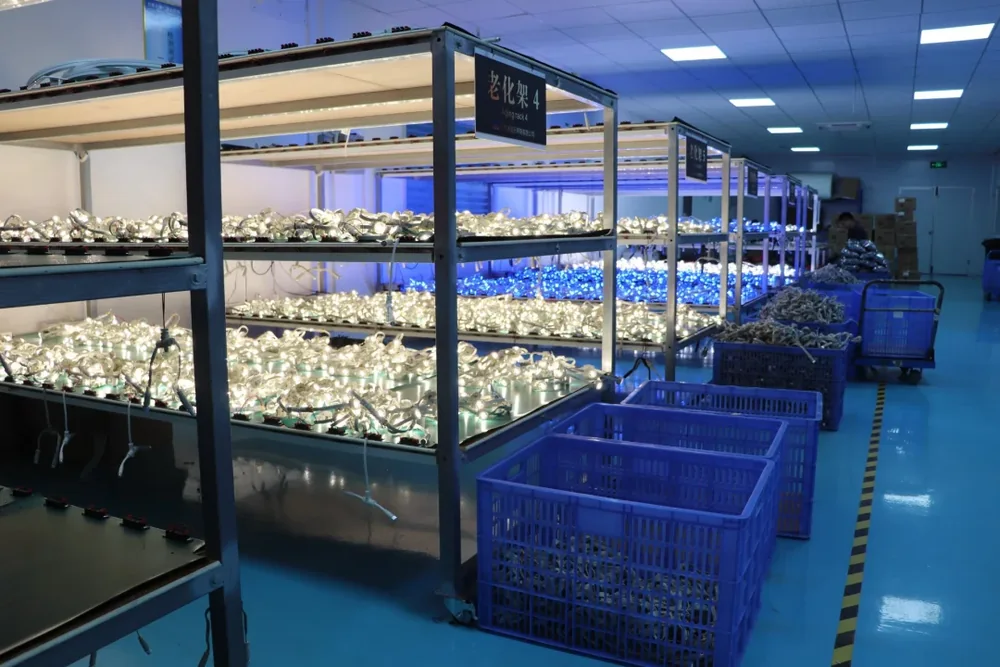
72-hour full-load burn-in and integrating-sphere measurement on every batch, with a report issued before shipment.
Export packing, DDP/CIF freight, DMX programming guides and remote or on-site commissioning support.
Project Experience
Representative facade typologies we light for hotel and mixed-use developments. Full project packs — photos, fixture schedules and DMX plans — are available on request under NDA.

Warm wall washing across the stone podium with linear grazing under the canopy, so the arrival reads warm without spilling into the rooms above.
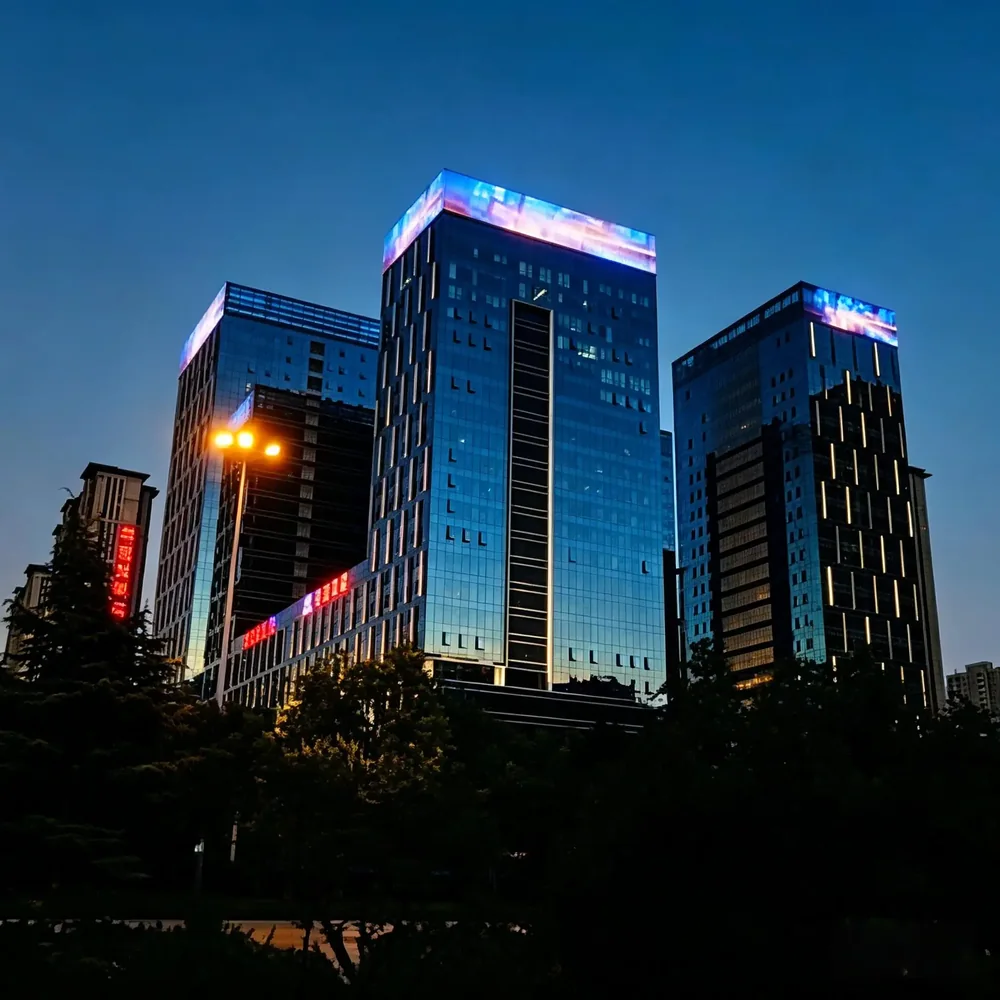
Media facade screening and crown floodlighting on a high-rise tower, balanced against guest-room glare and skyglow limits.
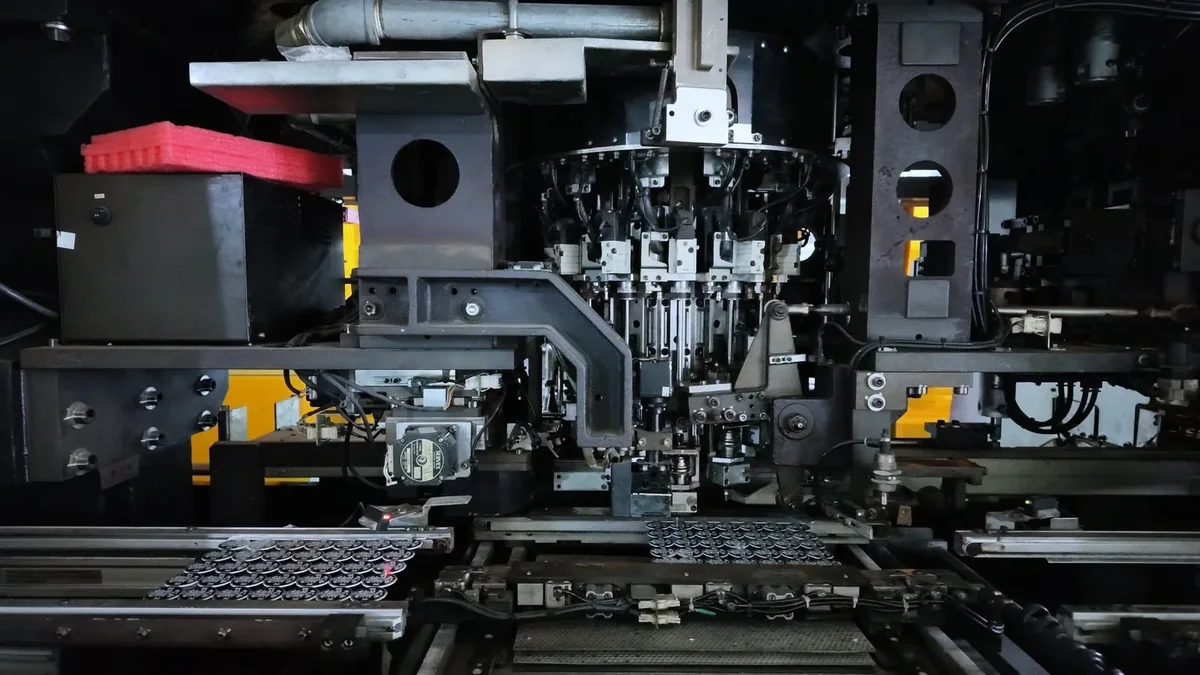
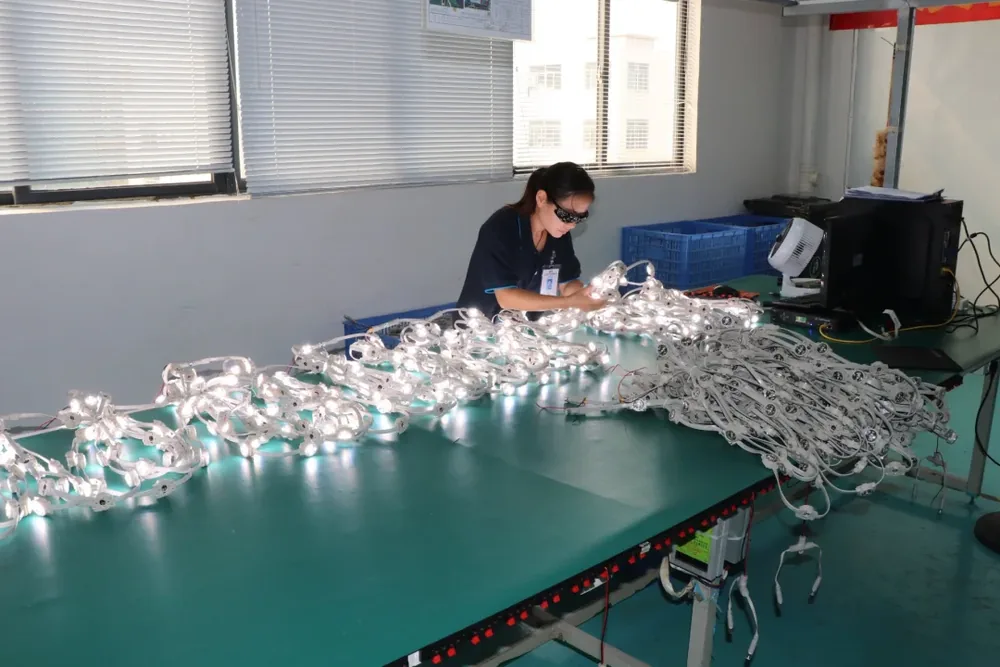
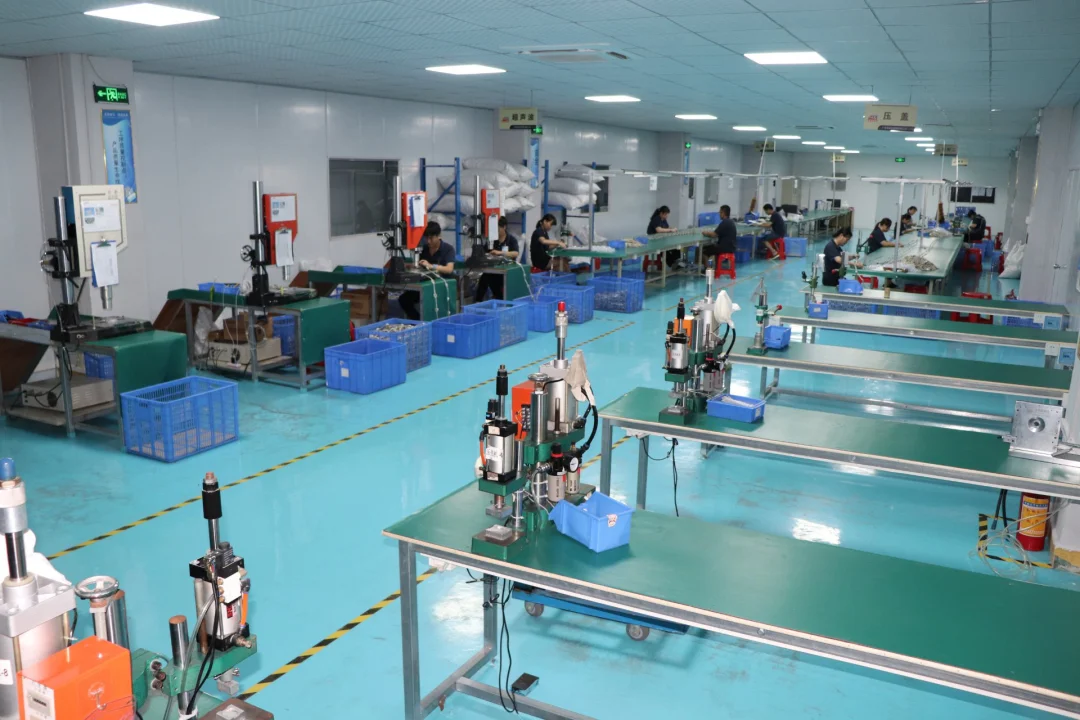
Every hotel fixture is built and tested on our own line — board assembly, silicone potting, sealing and burn-in under one roof.

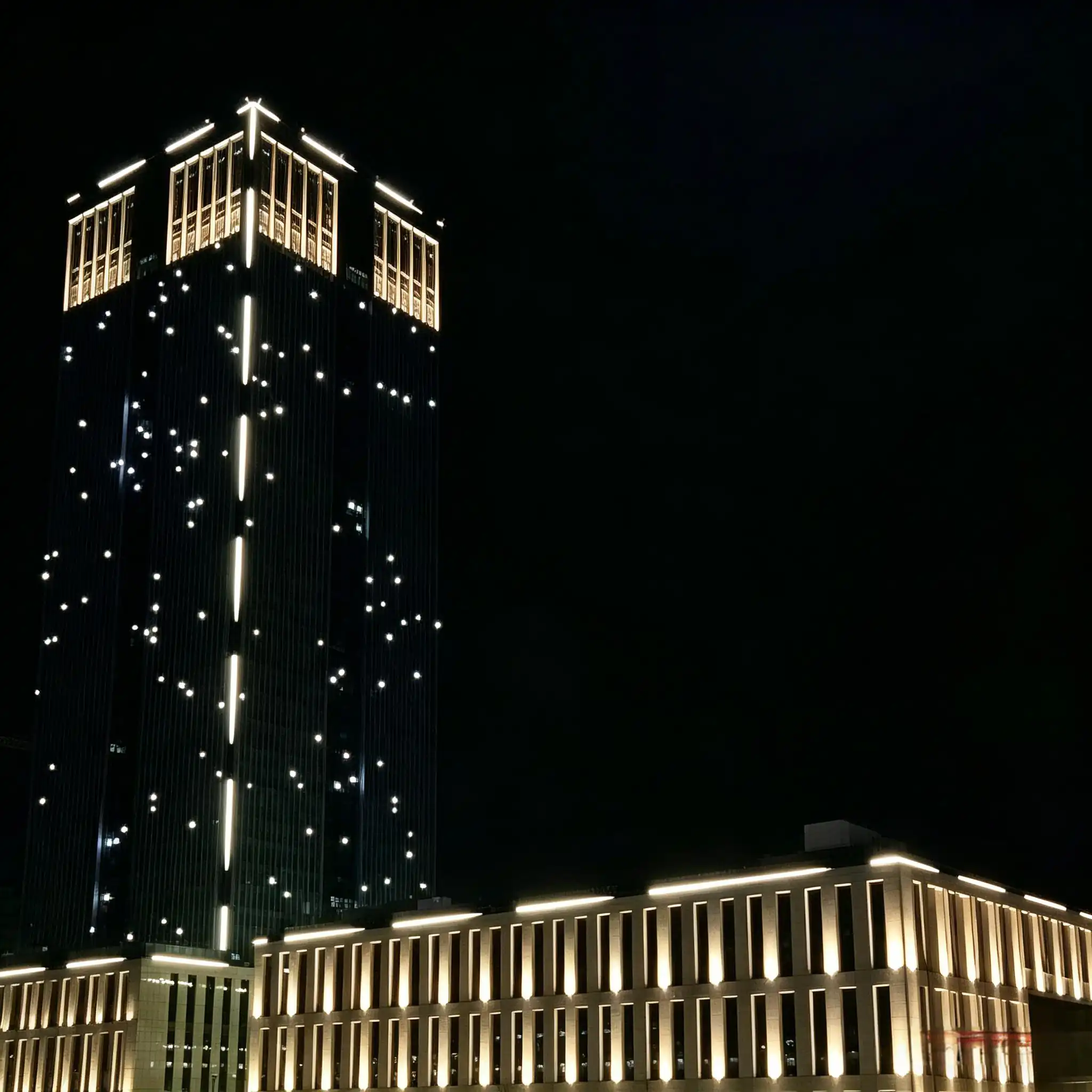
Point-source outlines and crown accents across a multi-building block, tuned so the group reads as one composition rather than five competing elevations.
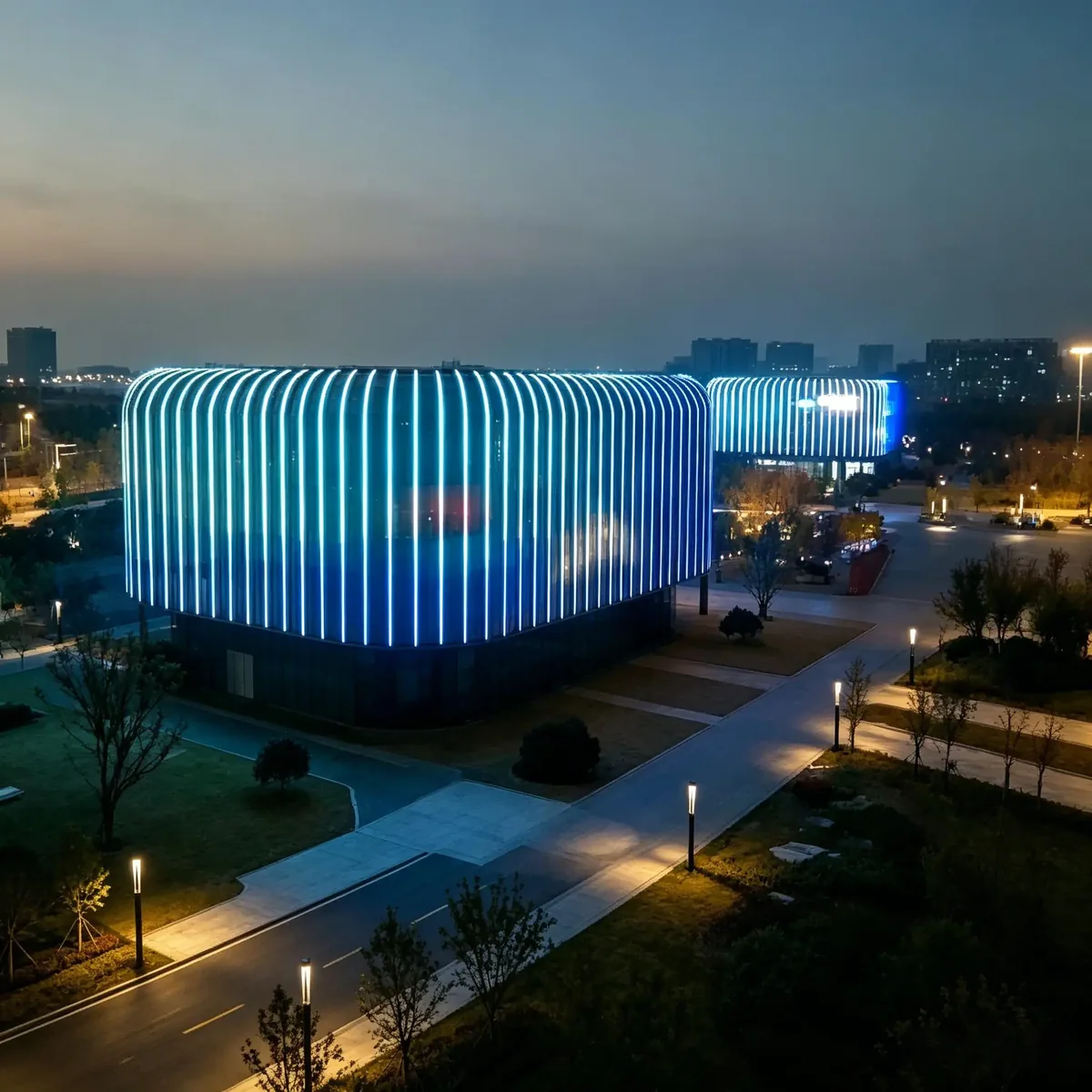
Line of light on the curved vertical fins with a separately controlled podium, so the retail base can stay bright after the tower dims for the night.

Linear lighting on the arch ribs and deck edge, sealed to the same IP67 standard we apply to hotel facade fixtures, on a river crossing that floods every season.
Quality & Compliance
Hotel projects are won on trust. Our factory is open to audits and visits, and every batch ships with a test record rather than a claim.

Frequently Asked
The questions hotel developers, facade consultants and lighting designers ask before they specify.
Request a Proposal
Send your elevation drawings or project parameters. Our engineering team will return a tailored BOM, optical simulation and quotation within 24 hours.