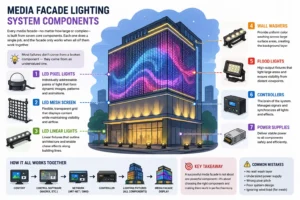
In modern architectural lighting and dynamic media facade engineering, LED pixel lights (also widely known as LED point light sources or DMX pixel dots) have become the indispensable fundamental building blocks. From outlining the majestic silhouettes of super-tall skyscrapers to forming massive 3D media matrix displays across irregular building surfaces and suspension bridges, these individually addressable lighting nodes bridge the gap between architectural structure and digital visual art.
However, for architectural lighting designers, facade contractors, and electrical procurement engineers, selecting the correct LED point light source involves far more than simply picking a lumen output. It requires balancing dimensional casing sizes (D30 to D120), optical lens dispersion angles, color rendering systems (RGB vs. RGBW), control communication protocols (DMX512 vs. SPI), and rigorous ingress protection standards such as secondary optical silicone potting.
This comprehensive engineering guide examines every critical technical parameter, manufacturing standard, and installation methodology you need to specify, procure, and install high-reliability LED pixel lights for commercial outdoor facade projects.
1. What Is an LED Pixel Light (Point Light Source)?
An LED pixel light is a compact, self-contained, individually addressable outdoor lighting fixture comprising one or multiple high-efficiency SMD LED chips, an integrated driver IC (or external sub-controller decoder), and a rugged optical housing. Unlike traditional floodlights that wash broad areas with uniform light, each pixel dot functions as an independent “pixel” on an architectural facade canvas.
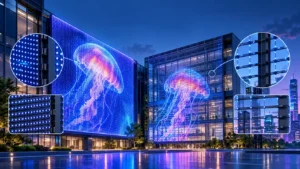
When arranged in linear arrays, 2D curtain grids, or custom 3D structural mapping, thousands of synchronized pixel lights work together to display smooth color transitions, chasing effects, text banners, and full-motion dynamic video content.
- Individual Pixel Addressability: Full independent control over color (16.7M to 4.3B colors) and 256–65536 levels of grayscale dimming.
- High Ingress Protection: Fully sealed against dust and water (IP67/IP68 rating), purpose-built for continuous outdoor exposure.
- Low Profile & Flexible Pitch: Minimal visual impact on daytime architectural facades with customizable center-to-center spacing.
- Extreme Weather Resistance: Engineered to withstand thermal expansion (-40°C to +80°C), UV radiation, and coastal saline corrosion.
2. Dimensional Classification: D30, D40, D50, D100 & D120 Matrix
In standard architectural manufacturing, LED point light sources are categorized by their outer diameter (designated as “D” in millimeters). Selecting the appropriate diameter is governed by the viewing distance of pedestrians or motorists, the desired lumen output per node, and the structural mounting space available on curtain wall mullions.
| Housing Size | Wattage Range | Typical LED Config | Optimal Viewing Distance | Primary Facade Applications |
|---|---|---|---|---|
| D30 (Ø30mm) | 0.7W – 1.2W | 3–4 pcs SMD3535 / 5050 | 5m – 25m (Close Range) | Building outline contouring, indoor atrium matrices, dense window reveals. |
| D40 (Ø40mm) | 1.0W – 1.5W | 4–6 pcs SMD3535 / 5050 | 10m – 40m | Commercial storefront borders, hotel balcony balustrades, medium-density grids. |
| D50 (Ø50mm) ★ Industry Standard | 1.5W – 2.4W | 6–7 pcs SMD3535 / 5050 | 20m – 80m (Medium-Long) | Large curtain wall media displays, skyscraper facade matrices, Ferris wheel spokes. |
| D100 (Ø100mm) | 3.0W – 6.0W | 12–18 pcs SMD3535 / 5050 | 50m – 200m (Long Range) | High-altitude tower crown illumination, suspension bridge stay-cables, landmark nodes. |
| D120+ (Ø120mm+) | 6.0W – 12.0W | 18–36 pcs High-Power SMD | 100m – 500m+ (Ultra-Long) | Mega-scale city skyline landmarks, stadium exterior rings, broadcast-level media towers. |
3. Optical Systems, Color Mixing & Lens Cover Types
A. Color Systems: Monochrome, RGB vs. RGBW
While basic single-color white (Monochrome) points are used for static edge highlighting, dynamic architectural facades predominantly deploy multi-channel color mixing:
- RGB (Red, Green, Blue): 3-in-1 color mixing capable of creating millions of saturated colors. However, producing a pure architectural white (e.g., 3000K Warm White or 4000K Neutral White) by mixing R+G+B often results in a bluish tint with poor Color Rendering Index (CRI < 70).
- RGBW (Red, Green, Blue + Dedicated White): Features an independent pure white LED die (2200K, 3000K, or 6500K) within each node. This provides true architectural white illumination during standard weekdays, while maintaining the capability to switch instantly to full dynamic RGB video shows during holidays and municipal festivals.
B. Lens Cover Form Factors
The optical cover directly influences beam dispersion and daytime aesthetic integration:
- Milky / Frosted Dome Cover: Provides 180° ultra-wide diffusion with zero glare. Ideal for direct-view media facades and low-resolution video playback where smooth visual uniformity is critical from wide observation angles.
- Transparent Flat / Diamond Facet Cover: Maximizes lumen transmission with a focused 110°–120° beam angle, delivering high sparkle and maximum punch for long-distance skyline visibility.
- Secondary Optical Lensed Cover: Integrates narrow beam optics (e.g., 30°, 45°, 60°) to project punchy accent beams outward or along curtain wall fins.
4. Manufacturing Standards: Secondary Optical Silicone Encapsulation (Why True IP68 Matters)
One of the most frequent causes of premature failure in outdoor architectural lighting is moisture penetration and thermal cracking resulting from substandard encapsulation materials. Low-grade suppliers often use conventional epoxy resin or single-layer polyurethane (PU) glue.
❌ Conventional Epoxy Resin (High Failure Risk)
Epoxy is rigid and possesses a drastically different thermal expansion coefficient than copper PCBs and aluminum casings. Under continuous solar UV radiation and rapid temperature fluctuations (-20°C to +50°C), epoxy yellows quickly, turns brittle, and micro-cracks—allowing water vapor ingress and driver IC short circuits.
✅ MEKALEO Secondary Silicone Potting (True IP68)
MEKALEO utilizes high-grade optical-grade organosilicon potting. The silicone remains highly flexible across -40°C to +80°C, absorbs mechanical stress, blocks UV yellowing, and forms a hermetic seal over all LED wire bonds and IC solder pads, guaranteeing certified IP68 submersion reliability.
5. Control Communication Protocols: DMX512 / RDM vs. SPI / TTL
Selecting the right transmission protocol is vital for system stability, signal refresh rates, and long-term project maintenance:
DMX512 + RDM (Recommended for Commercial & Municipal Projects)
- Differential Signal Transmission (RS485): Uses balanced differential pairs (D+ / D-) capable of transmitting signals over 100 meters between controllers without attenuation or EMI interference.
- Break-Point Continuous Transmission (Dual Signal Line): Advanced DMX pixel lights feature dual signal lines (Main + Backup Data). If a single pixel node suffers physical damage or is disconnected, subsequent nodes automatically pick up data from the backup line—preventing chain-failure blackouts across the facade.
- RDM Remote Device Management: Allows engineers to remotely assign DMX addresses, read fixture operating temperatures, and diagnose faults directly from the control room without climbing the building facade.
SPI / TTL (Suitable for Short-Distance / Cost-Sensitive Installations)
- Single-ended data transmission (e.g., WS2811, UCS1903, SM16703).
- Cost-effective for small signage or indoor accent runs, but vulnerable to electromagnetic noise and limited to < 2–5 meters signal runs between nodes without repeaters.
6. Physical Mounting & Mechanical Installation Methods
To preserve building curtain wall warranties and structural integrity, engineering contractors deploy three standardized installation methods:
- Extruded Aluminum Profile Track (Snap-In Mounting):
Custom powder-coated aluminum U-channels (matched to the curtain wall RAL color code) are secured to mullions. The pixel lights snap securely into pre-punched holes at fixed intervals. Power and signal cables are hidden neatly inside the channel profile for a clean daytime appearance.
- Stainless Steel Tension Wire / Mesh Cable (Direct Facade Suspensions):
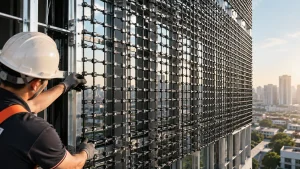
For open-span architectural voids or large glass surfaces without vertical mullions, high-tensile 316 stainless steel aircraft cables are tensioned vertically. Point lights snap onto the cables using UV-resistant polycarbonate brackets, creating an ultra-lightweight LED pixel mesh curtain.
- Perforated Cladding / Aluminum Panel Embedded Installation:
Pixel lights are mounted from the rear through CNC-punched holes in architectural aluminum facade panels. Only the frosted optical dome protrudes through the outer panel, completely integrating lighting into the building skin.
7. Electrical Engineering: Power Injection & Voltage Drop Calculations
Most commercial LED point light sources operate on DC12V or DC24V low-voltage power supplies for safety and international compliance. However, low voltage introduces the risk of DC voltage drop over long wire runs, which causes downstream lights to dim or exhibit pinkish color drift.
⚡ Power Injection Best Practices:
- DC12V Pixel Lights: Inject power every 30 to 50 nodes (approx. every 5–8 meters depending on wire gauge).
- DC24V Pixel Lights (Recommended): Higher operating voltage reduces line current by 50%, allowing power injection intervals to extend to 100 to 150 nodes (approx. 15–20 meters).
- Power Supply Loading Margin: Always size MeanWell or equivalent IP67 outdoor switching power supplies with an 80% continuous load cap (e.g., a 350W PSU should power a maximum of 280W of LED pixel load).
8. Frequently Asked Questions (FAQ) for Engineering Buyers
Q1: How do I choose between LED Pixel Lights and an LED Mesh Screen?
Choose LED Pixel Lights when you need custom spacing (Pitch > 100mm), 3D geometric contouring, or direct integration into architectural mullions without obstructing window glass. Choose an LED Mesh Screen when you require higher pixel densities (P16 to P50) specifically for broadcasting clear text, commercials, and high-definition video over glass curtain walls.
Q2: What is the lifespan of outdoor DMX pixel dots in high-temperature or coastal environments?
High-spec fixtures manufactured with secondary optical silicone potting and gold-wire SMD3535 LEDs deliver a rated lifespan of 50,000+ hours (L70). With 500-hour salt spray testing and IP68 sealing, they operate reliably in harsh coastal salt-air and ambient temperatures up to +55°C.
Q3: Can MEKALEO customize the housing color, cable lengths, and node spacing?
Yes. As a direct manufacturer, MEKALEO provides comprehensive OEM & ODM customization, including custom aluminum channel RAL powder-coating, custom center-to-center cable spacing (from 50mm to 1000mm), and pre-wired breakout harnesses tailored to your facade CAD drawings.
Q4: Do you provide DMX pixel mapping files and DIALux photometric simulations?
Yes. Our engineering department provides complete project support including DIALux lighting calculations, CAD wiring schematics, controller channel budgeting, and Madrix / LEDEdit pixel mapping files. Contact our engineering team to request a custom technical proposal.