OEM & ODM Media Facade Manufacturing: What You Outsource, What You Must Keep
A working guide for lighting brands, facade contractors and distributors who want a Chinese manufacturing partner without handing over their product line, their certification or their customer list.
Most buyers arrive at an OEM conversation with one question: how much per unit? It is the wrong first question, and the suppliers who answer it fastest are usually the ones who will cost you most later. A facade product is not a t-shirt. It carries an IP rating that a client will hold you to for a decade, a certification file that a customs officer or a specifying engineer may ask to see, and a tooling investment that determines whether you can ever move supplier without starting again.
This guide is written from the manufacturing side of that table. It describes the four contract models, what is genuinely customisable and what is not, where the money actually goes in an OEM quotation, and the ownership questions that decide whether the arrangement is still yours in year three. Where we describe our own capability, we say so plainly; where a number is an industry range rather than a fixed price, we mark it as a range.
1. OEM, ODM and OBM: three different contracts
The three labels get used interchangeably in quotations, which is exactly why disputes happen. They describe who designed the product, not who manufactures it.
| Model | Who designed the product | What you receive | Where the risk sits |
|---|---|---|---|
| OEM Original Equipment Manufacturer | You. You own the design, the drawings and the brand; the factory builds to your specification. | Your product, your label, your packaging, your part numbers. | Design faults are yours. The factory is responsible for build quality to the drawing, not for whether the drawing is right. |
| ODM Original Design Manufacturer | The factory. It has a catalogue design that several customers buy, relabelled. | A proven product with your branding, usually with limited structural changes. | Speed and lower cost, but the design is shared with competitors and the tooling is not yours. |
| OBM Original Brand Manufacturer | The factory designs and sells under its own brand. | A finished branded product, usually through distribution. | You are a channel, not an owner. Little differentiation and full dependence on the supplier’s roadmap. |
Table 1. The difference is design ownership, not who runs the machines. A factory can be your OEM supplier and someone else’s ODM supplier on the same production line.
In facade lighting, the practical split usually looks like this:
- Pure OEM is rare below a few thousand units, because the tooling for a new housing profile or a new lens can cost more than the order. It becomes realistic when you are building a product family you intend to sell for years.
- ODM with modification is the common middle ground: an existing pixel light or linear profile, with a changed housing colour, a different beam angle, your connector, your cable length and your silkscreen. This is where most brand owners should start.
- Private label of a catalogue item is not really manufacturing. If nothing changes except the label, you have bought a product, not built one, and your competitor can buy the same product tomorrow.
One caution that costs people real money: a factory that offers “free OEM” is telling you that no new tooling is involved. That is fine if you accept the consequences — the housing remains a catalogue profile that other customers can also buy. It is not fine if you believed you were commissioning a proprietary product.
2. What a facade OEM order actually customises
Below the level of “we can customise anything”, a facade fixture has about a dozen parameters that can genuinely be changed, each with a different cost and lead-time consequence. Knowing which are cheap and which are expensive is most of the negotiation.
| Parameter | Cost impact | Lead-time impact | What to watch |
|---|---|---|---|
| Housing colour / finish | Low | None | Anodised colours are batch-dependent. Ask for a physical sample of the actual batch, not a colour card. |
| Cable length and connector type | Low | +3–7 days | Connector choice decides whether your installer can use standard tooling. A proprietary connector locks you to one supplier for spares. |
| Silkscreen / laser marking | Low | None | Mark the mould cavity and date code. It is how you trace a batch two years later. |
| Beam angle / lens swap | Low–medium | +1–2 weeks | Only available at angles the existing lens family covers. A genuinely new optic means a new mould. |
| LED bin and colour consistency | Medium | +1–3 weeks | Narrow bins cost more and are worth it on a facade where modules sit side by side. Ask for the bin code on the datasheet. |
| Pixel pitch / module size | Medium–high | +2–4 weeks | Changing module size usually changes the PCB, the mask and the mounting frame, even if the housing looks the same. |
| Control protocol and driver firmware | Medium | +2–4 weeks | DMX512 is standard. Art-Net, sACN or a proprietary protocol adds engineering and a compatibility test you should witness. |
| New housing profile (new tooling) | High | +6–12 weeks | Tooling cost is typically quoted separately and is where IP ownership disputes start. See section 5. |
| IP rating upgrade | High | +3–6 weeks | IP67 is a construction method (gaskets, potting, pressure equalisation), not a claim. A higher rating on an unchanged housing is a red flag. |
| Certification for a new market | High | +4–10 weeks | UL/ETL and CE involve a lab, not a factory. Budget for it explicitly. See section 6. |
Table 2. Indicative impacts for a mid-volume facade order. Actual figures depend on quantity, existing tooling and the factory’s current load.
Two of these deserve more than a table row.
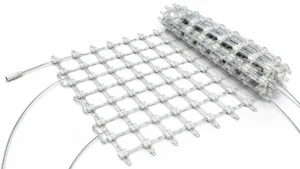
Pixel pitch is not a label. Moving from P50 to P37.5 on a mesh screen is not a printing change — it means a new PCB, a new mask, a re-spaced mounting grid and a re-run of the wind-load calculation if the open area ratio shifts. Buyers who treat pitch as a configurable option at the quotation stage are the ones who discover a four-week delay after the deposit.
IP rating is a process, not a specification. A fixture rated IP67 has to survive temporary immersion, which means gaskets with a defined compression, potted cable entries and a housing that does not breathe. If a supplier offers to “upgrade” an existing IP65 housing to IP67 without changing the sealing method, the honest answer is that they are relabelling. Ask what changed: the gasket, the potting compound, the pressure-equalisation vent, or nothing.
3. The nine-step workflow, with realistic lead times
An OEM facade order that runs cleanly has nine stages. The durations below are typical for a mid-volume order (roughly 2,000–10,000 units) with an existing housing design. A genuinely new tooling project adds six to ten weeks at step 3.
| # | Stage | Duration | What you should receive at the end of it |
|---|---|---|---|
| 1 | Brief and specification freeze | 3–10 days | A written spec with tolerances, not a chat transcript. This document is what a dispute is settled against. |
| 2 | DFM review (design for manufacture) | 3–5 days | A list of changes the factory recommends and the cost consequence of each. A factory that returns no comments has not looked. |
| 3 | Tooling and fixture build | 0–10 weeks | Tooling drawings, cavity count, estimated tool life, and a written statement of who owns the tool. |
| 4 | Golden sample | 7–15 days | Signed samples, one retained by each side, with photo record and measured photometric data. |
| 5 | Pilot run | 7–14 days | Typically 50–200 units. This is where process problems surface. Do not skip it to save two weeks. |
| 6 | Reliability testing | 7–21 days | Aging report, IP test report, thermal data, and any salt-spray or UV results your market requires. |
| 7 | Mass production | 15–35 days | Daily or weekly output reports once production starts, not silence until shipping day. |
| 8 | Pre-shipment inspection | 2–4 days | AQL sampling report with photos of cartons, labels and pallet configuration, plus the measured data for the sample. |
| 9 | Documentation handover | 3–5 days | The full package in section 9. Withholding it until final payment is a legitimate factory position; not producing it at all is not. |
Table 3. Nine to fourteen weeks end to end for a repeat order. A first order with new tooling realistically runs sixteen to twenty-four weeks.
Three scheduling mistakes account for most late facade deliveries:
- Starting tooling before the spec is frozen. A change after the mould is cut costs both the modification and the weeks, and the factory will charge for it because it genuinely costs them.
- Treating the pilot run as optional. The pilot is the only cheap opportunity to find that a new gasket does not seat at the corner radius. Discovering it in unit 4,000 of a 6,000-unit order is the expensive version.
- Not booking lab time early. UL/ETL and CE testing runs on the lab’s calendar, not yours. A four-week lab queue at the end of a project is a four-week delay that production cannot recover.
4. MOQ: what each product line can realistically start at
Published MOQs are often aspirational. The table below reflects what a factory with its own SMT and assembly lines can actually run without losing money, which is the only number that survives contact with a quotation.
| Product line | Typical MOQ | What drives it | How to reduce it |
|---|---|---|---|
| Pixel / point light | 500–2,000 pcs | SMT setup, potting batch size, cable assembly jig | Accept a standard cable length and connector; take a catalogue housing colour |
| LED mesh / grid screen module | 50–200 m² | PCB panel utilisation, mask tooling, frame extrusion run | Use an existing module size and pitch; vary only the mask and branding |
| Linear light | 300–1,000 m | Extrusion run length, anodising batch, potting trough length | Standard profile with a custom length increment rather than a new profile |
| Wall washer | 200–500 pcs | Die-cast batch, lens mould, gasket tooling | Existing die-cast body, custom LED bin and beam angle |
| Floodlight | 100–500 pcs | Die-cast body, driver configuration, thermal design | Standard body with custom bracket and cable entry |
Table 4. Ranges for a factory with in-house SMT. A trading company quoting below these numbers is usually aggregating from several factories, which changes who is accountable.
There is a structural reason MOQ exists, and it is worth understanding rather than arguing with. An SMT line has a setup cost that does not change whether you run 200 boards or 2,000. Anodising is priced by batch, not by piece. Potting compound is mixed in a quantity that must be used within its pot life. A factory that accepts 100 units at a 2,000-unit price is either absorbing a loss it will recover elsewhere, or quietly substituting components.
The honest way to negotiate below MOQ is not to push the number but to remove cost: accept a stock housing colour, accept a standard cable length, accept a longer delivery window so your order can be scheduled alongside a similar run. Each of those gives the factory something real in exchange.
5. Tooling, drawings and IP: who owns what after the invoice
This is the section that decides whether your OEM arrangement is an asset or a hostage situation. Four things are commonly conflated and should be treated separately in the contract.
| Asset | Default if unstated | What you should contract for | Why it matters |
|---|---|---|---|
| Tooling / moulds | Stays with whoever paid, which is usually the factory’s existing mould | If you paid for it: written ownership, a tool number, and the right to take it to another moulder | A mould you paid for and cannot move is a permanent single-source dependency |
| Product drawings and 3D files | Factory retains them; you receive PDFs only | STEP files of the housing, PCB Gerbers, BOM with approved vendor list, on delivery | Without files you cannot price a second source, and you will not know if a component was substituted |
| Industrial design and patents | Ambiguous; whoever filed first wins in practice | A clause stating that design rights in your specification belong to you, plus a warranty that the design does not infringe a third party | The second half is the one that gets forgotten, and it is the one that produces injunctions at trade fairs |
| Customer list and project data | Factory may market the same product to your competitors | Non-solicitation of your named accounts, and a confidentiality term on project names and drawings | An ODM product with your branding sold to your customer by your supplier ends the relationship’s value |
Table 5. The four assets to settle in writing before the first tooling payment, not after.
Two practical notes. First, a factory that has invested in its own moulds in Guangdong typically holds 100+ patents across fixture structures and control systems — we hold ours — and will not hand over a mould it owns just because you asked. The realistic negotiation is over new tooling paid for by you, and over exclusive use of an existing design for a defined market and period. Ask for that explicitly: exclusivity is worth more than ownership in most distribution arrangements.
Second, exclusivity without a volume commitment is not exclusivity; it is a promise the factory cannot afford to keep. If you want a territory locked, expect to agree a minimum annual quantity and a consequence if you do not reach it. A supplier who grants exclusive rights for free has either misunderstood the request or does not intend to honour it.
6. Certification ownership: the trap nobody quotes for
Certification is where a private-label arrangement most often breaks, because the certificate belongs to a legal entity, not to a product shape. If your supplier holds the CE declaration and the UL file, and your brand is on the label, you are selling a product whose compliance paperwork names someone else.
Here is how the four common cases actually resolve:
| Case | Who holds the file | What your customer sees | What to do about it |
|---|---|---|---|
| CE (EU) | The entity placing the product on the EU market — which, if your name is on the label, is you | A declaration of conformity with your name and address | You need a technical file and a signed DoC in your own name. The factory supplies test reports and component certificates; you sign the declaration. A factory-issued DoC in their name is the wrong document for your label. |
| UKCA | Same logic as CE, for Great Britain | UKCA marking and a UK DoC | Post-Brexit this is a separate file, not an automatic CE extension. Budget for a gap assessment. |
| UL / ETL (North America) | The listing holder. Listings attach to a manufacturer’s facility and are inspected quarterly | Your brand can appear only under a private-label listing or a recognised-component arrangement | Either the factory adds your brand to its listing (they must agree, and UL must be notified), or you obtain your own listing. Neither is quick. Confirm which, in writing, before you quote a US project. |
| RoHS / REACH | Whoever assembles the finished product | A declaration and material test reports | Ask for test reports by homogeneous material, dated within the last two years, naming the actual LED and driver part numbers you approved. |
Table 6. A certificate is not a product feature. It is a legal instrument that names a company, a factory address and specific component part numbers.
The practical consequences are worth spelling out, because they surface late and expensively:
- A private-label CE declaration with no technical file behind it is a piece of paper. If a market-surveillance authority asks for the file, the declaration alone will not satisfy them.
- UL private labelling has a cost and a lead time. It is not a favour a factory can absorb silently, and it is not transferable if you later change supplier.
- Component substitution invalidates certification. If the LED or driver in production differs from the one in the test report, the report no longer describes the product. This is the single most common compliance failure in OEM facade supply, and it is invisible unless you specify the approved vendor list and audit against it.
We hold ISO 9001 and our fixtures carry CE and RoHS compliance with UL-recognised component arrangements on request, and we will tell you clearly which of the four cases above applies to your market rather than implying that “certified” covers everything. If your plan requires your own UL listing, we will quote the lab coordination and the sample programme as a separate line, because pretending it is free is how projects lose a month.
7. How an OEM price is actually built
When two quotations for the same drawing differ by 40%, the gap is rarely in the labour rate. It is in what was included. A facade fixture quotation decomposes roughly like this:
| Cost element | Typical share | How it gets manipulated | How to protect yourself |
|---|---|---|---|
| LED and driver (BOM) | 30–45% | Unbranded bins, lower lumen maintenance, cheaper driver with no surge protection | Approve part numbers and bin codes in writing; require the AVL in the documentation package |
| Housing and mechanical parts | 15–25% | Thinner wall section, lower-grade alloy, fewer gasket compression points | Specify alloy grade, wall thickness and gasket material; check the golden sample against them |
| Assembly labour | 8–15% | Faster potting, skipped reflow inspection, fewer functional test points | Require test-point count and aging duration in the spec, then verify in the PI report |
| Tooling amortisation | 0–8% | Spread over the first order instead of the product life, or charged twice | Agree the amortisation quantity explicitly; ask what happens if you reorder |
| Testing and certification | 2–6% | Quoted as “included” but only a basic function test is performed | Name each test and its duration in the spec; ask for the report, not the claim |
| Packaging | 2–4% | Thin cartons, no edge protection, pallet height that exceeds container clearance | Specify carton drop test and pallet configuration; photograph the first pallet |
| Margin | 8–15% | The variable that a low quotation moves first, then recovers through change orders | Expect change-order pricing to be higher than first-order pricing; negotiate a rate card up front |
Table 7. Indicative shares for a mid-volume outdoor fixture. Use them to interrogate a quotation, not to benchmark a final number.
The most useful question in a price review is not “can you do better” but “which line item changes if I halve the quantity”. A supplier who can answer that precisely understands their own cost structure. One who cannot is quoting from a spreadsheet they did not build.
Be equally suspicious of a price that is too stable. If three quotations at 1,000, 5,000 and 20,000 units come back within 5% of each other, the volume curve is fictional and someone is either buying market share or planning to substitute components at production.
8. Quality gates you can audit from another continent
Remote quality management is not about trusting a certificate; it is about designing checkpoints where a failure is still cheap to fix. Five gates cover almost everything that goes wrong in facade OEM.
| Gate | Checkpoint | Evidence to demand | Failure it catches |
|---|---|---|---|
| Q1 | Incoming component inspection | LED bin code and date code on the reel label, driver model, photographed against the AVL | Substitution before assembly, when rework is still free |
| Q2 | First-article inspection on the pilot run | Dimensional report against the drawing, photometric measurement, IP test on 3 units | Process drift between sample and production |
| Q3 | Aging test | Continuous run duration, ambient temperature, count and failure mode of any unit that dropped out | Early-life LED and driver failures that would otherwise appear on the facade |
| Q4 | Pre-shipment inspection | AQL sample size and accept/reject numbers, functional test results, packing photos | Cosmetic and functional defects, and shipping damage in transit |
| Q5 | Retained sample archive | Units kept from each batch, labelled with batch and date, held for the warranty period | Disputes where nobody can prove what was shipped two years ago |
Table 8. Five gates, each producing a document. A supplier who cannot produce the document at gate 3 will not produce it after a failure either.
Two things make remote auditing work in practice. The first is a third-party inspection with a defined checklist rather than a general “quality check”; generic inspectors measure cartons, not lumen maintenance. The second is a video walkthrough of the aging room during the run. It takes fifteen minutes and it is very hard to fake a room full of fixtures that have been running for 72 hours with a data logger attached.
9. The documentation package that protects you for ten years
A facade installation outlives the transaction by a decade. The documentation package is what makes year-eight maintenance possible without the original project engineer.
- Approved vendor list (AVL) — LED, driver, connector, gasket and potting compound, with part numbers and the manufacturer’s name. This is the document that makes substitution detectable.
- Electrical drawings — single-line diagram, power supply sizing, cable schedule, earthing arrangement, and the DMX512 addressing plan with universe allocation.
- Photometric files — IES or LDT for every beam angle supplied, measured on the production fixture rather than copied from an LED datasheet.
- Test reports — aging, IP, thermal, and any salt-spray or UV results relevant to the project’s climate.
- Installation and maintenance manual — torque values for fixings, gasket replacement procedure, allowable cleaning agents, and the spare-parts list with order codes.
- Warranty statement — what is covered, what voids it (voltage transients, unauthorised repair, cleaning solvents), and the response time for a claim.
- Batch traceability record — which batch went to which shipment, so a future failure can be bounded rather than treated as a total loss.
If you take only one item from this list, take the AVL. It is the cheapest document to produce and the only one that lets you prove, years later, whether the fixture in your hand is the fixture that was certified.
10. Five failures we see repeatedly
These are the patterns that turn a workable OEM relationship into an expensive one. None of them is exotic; all of them are avoidable at the contract stage.
1. Buying a private label and calling it OEM. Nothing was designed, nothing is owned, and the same housing is on three competitors’ websites within a season. If differentiation is the goal, the change has to be structural — a different optic, a different sealing method, a different control board — not a different silkscreen.
2. No specification freeze. Changes requested during production feel small to the buyer and are genuinely expensive to the factory. Without a frozen spec document, every change becomes a negotiation and the schedule becomes the casualty.
3. Certification assumed rather than contracted. The buyer quotes a US project on the strength of a CE certificate, then discovers that UL listing is a separate process owned by a different entity. This one routinely costs a quarter.
4. Component substitution after approval. A driver goes out of stock, an equivalent is fitted, and the test report no longer describes the product. It is the most common compliance failure in OEM facade supply and it is undetectable without the AVL and an incoming inspection gate.
5. No retained samples. Two years later, a section of facade discolours. Without retained units and batch records, the conversation becomes about opinion instead of evidence, and the resolution is usually that the buyer pays.
11. What we can and cannot do as your OEM partner
We are a manufacturer, not a trading company, and it is more useful to state our limits than our capabilities.
| We can | We cannot |
|---|---|
| Build to your drawings on pixel lights, LED mesh and grid screens, linear lights, wall washers and floodlights | Manufacture a fixture family outside those five lines — we do not quote what we do not make |
| Offer ODM modification on our existing platforms: housing colour, cable and connector, beam angle within the lens family, LED bin, silkscreen and packaging | Claim a new IP rating on an unchanged housing. IP67 is a sealing method here, not a label |
| Run new tooling for a product family you intend to sell for years, with written ownership terms on tooling you pay for | Absorb tooling cost into the unit price of a one-off order, or grant free exclusivity without a volume commitment |
| Supply IES/LDT files, wiring diagrams, DMX address schedules and a full documentation package with every order | Issue a CE declaration in our name for a product carrying your brand — that document must be yours |
| Coordinate certification testing for your market, quoted as a separate line with the lab’s lead time | Promise a UL listing we do not hold as if it were a formality; private labelling takes time and agreement |
| Support from 8,000 m² of production in Guzhen, Zhongshan, with in-house SMT, potting and aging, ISO 9001 processes and 100+ patents across fixture structures and control systems | Compete on price against a trader quoting an unbranded BOM. The difference is in the components and the test reports |
Table 9. Stated plainly, because a supplier who claims everything is telling you nothing. Product experience across 5,000+ facade projects in 40+ countries since 2004 shapes what we decline as much as what we quote.
If your requirement sits in the right-hand column, we will say so at the first call rather than at the deposit. That is cheaper for both of us.
12. Frequently asked questions
What is the difference between OEM and ODM in facade lighting?
In OEM, you own the design and the factory builds to your drawings. In ODM, the factory owns the design and you buy it with your branding. The distinction is design ownership, not who manufactures. Most brand owners start with ODM plus modification and move to OEM only when the annual volume justifies tooling.
What is a realistic MOQ for a custom LED facade product?
For pixel lights, 500–2,000 pieces; for mesh screen modules, 50–200 m²; for linear lights, 300–1,000 metres. These come from SMT setup, anodising batch size and potting pot life, not from arbitrary policy. You can negotiate below them by accepting stock colours, standard cable lengths or a longer delivery window.
Who owns the mould if I pay for the tooling?
You should, and it must be written down with a tool number. In practice, get the right to move the tool to another moulder and a statement of tool life. For moulds the factory already owns, negotiate exclusive use for a territory and period instead of ownership — and expect to commit to a minimum annual quantity in exchange.
Can you put my brand on a CE certificate?
No. Under EU rules the entity placing the product on the market signs the declaration of conformity, so if your name is on the label, the DoC must be in your name. We supply the test reports, component certificates and technical file inputs; you sign the declaration. A factory-issued DoC naming us is the wrong document for your product.
Do you arrange UL or ETL listing for my brand?
We can coordinate the sample programme and the lab correspondence, quoted as a separate line with the lab’s lead time. The listing itself must either be a private label added to a listing we hold, which requires our agreement and notification to UL, or a listing you obtain in your own name. Neither is a two-week process, and we will not quote a US project as if it were.
How long does a first OEM order take?
Sixteen to twenty-four weeks for a project with new tooling, and nine to fourteen weeks for a repeat order on an existing housing. The long poles are tooling, lab testing queues and ocean freight, not assembly. Production itself is typically 15–35 days.
Can you supply a golden sample before the mass order?
Yes, and it should be signed and retained by both sides with measured photometric data and a photo record. An unsigned sample is an opinion; a signed one is a specification. We keep retained units from each production batch for the warranty period.
What happens if a component is discontinued mid-project?
This is why the approved vendor list matters. Any substitution has to be proposed in writing, re-tested where it affects photometry, thermal behaviour or certification, and approved by you before production. A supplier who substitutes silently has invalidated the test report that your compliance depends on.
How do I verify quality without visiting the factory?
Five checkpoints: incoming component inspection against the AVL, first-article inspection on the pilot run, an aging test with a data logger, a third-party pre-shipment inspection on an AQL sampling plan, and retained samples per batch. Ask for the document at each gate. A video walkthrough of the aging room during a run is a cheap supplement that is very hard to stage.
Do you offer exclusivity for my market?
Yes, against a minimum annual quantity and a defined territory and period. Exclusivity without a volume commitment is not exclusivity; it is a promise that cannot be kept when a larger order arrives. We would rather agree a number you can hit than sign a term neither side intends to enforce.
Can you match a competitor’s lower quotation?
Usually the gap is a component or a test that was omitted, not labour. Bring the two specifications side by side and we will tell you which line differs — LED bin, driver brand, wall thickness, aging duration or certification scope. If the difference is genuinely efficiency, we will say so; if it is a missing test, matching the price would mean removing it.
What documentation comes with an OEM order?
Approved vendor list, electrical drawings with DMX addressing, IES or LDT files measured on production fixtures, test reports, installation and maintenance manual, warranty statement and batch traceability. If you take one item, take the AVL — it is the only document that lets you prove years later whether the fixture you are holding is the fixture that was certified.
Have a facade product you want built to your specification?
Send the drawing, the target market and the annual quantity. We will reply with a DFM review, an honest MOQ, and the certification route that applies to your market — including the parts that take longer than you would like.
Project enquiry
Send your drawings. Get a specification you can defend.
Elevation DWG, facade area, closest viewing distance and site country — we reply within 48 hours with a fixture matrix, power and DMX topology, and a quotation. No price-only quotes.
5,000+ projects delivered · 40+ countries · ISO 9001 · CE / UL / RoHS