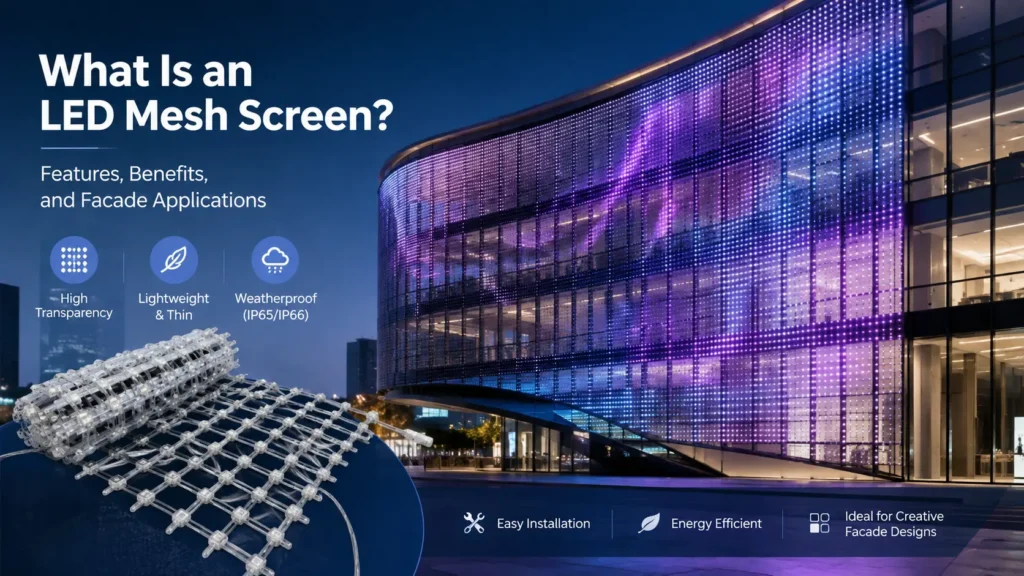
LED mesh screens are lightweight digital displays that utilize an open mesh structure rather than a fully enclosed enclosure. This design allows for air circulation, and depending on the configuration, light can also pass through the display.
Due to their lightweight and open structure, LED mesh screens are frequently used in large building facades, media facades, glass surfaces, stages, retail storefronts, and outdoor advertising structures.
In this guide, we will explain what an LED mesh screen is, how it works, how it differs from traditional LED video walls, and what project conditions should be considered before selecting it.
What Is an LED Mesh Screen?
An LED mesh screen is a type of LED display designed with LED bars, strips, or modules arranged in a grid-like structure. Unlike a conventional LED video wall, the display does not form a completely solid surface.
The open structure creates several important characteristics:
- Lower overall weight
- Better airflow through the display
- Reduced visual obstruction behind the screen
- Flexible installation options
- Suitability for large and irregular surfaces
Some suppliers also use terms such as LED mesh, mesh LED screen, or LED screen fabric to describe lightweight and flexible LED display products. However, these terms are not always used consistently across the industry. Product construction, transparency, brightness, and installation method should always be confirmed through technical specifications.
How Does an LED Mesh Screen Work?
An LED mesh screen uses light-emitting diodes to produce images, video, text, and animation. The LED units are connected to a control system that receives content from a media player, computer, or other video source.
The main components normally include:
- LED bars, strips, or modules
- Power supply units
- Receiving cards
- Control system
- Structural mounting system
- Software or media player
The visual result depends on more than the LED chips themselves. Pixel pitch, brightness, viewing distance, content design, and the structure behind the display all affect how the screen looks in a real project.
For example, a screen with a relatively wide pixel pitch may still produce a suitable visual effect on a large building facade when viewed from a long distance. The same configuration may not be appropriate for a close-viewing indoor application.
What Makes LED Mesh Screens Different?
Open-Grid Structure
The most recognizable feature of an LED mesh screen is its open-grid structure. The screen is not designed as a solid wall, which can help reduce the amount of material and weight required for large installations.
This feature is particularly valuable when the screen is installed over an existing facade rather than mounted as a conventional indoor video wall.
Lightweight Construction
A large media facade can cover hundreds or thousands of square meters. For this type of project, the weight of the display system can affect the supporting structure, transportation, installation equipment, and maintenance plan.
A lightweight LED mesh screen may reduce structural demands compared with a traditional solid LED display. The actual structural impact still depends on:
- Screen size
- Mounting distance from the facade
- Wind conditions
- Steel structure
- Cable arrangement
- Local building requirements
The display weight should therefore be evaluated together with the mounting system, not as an isolated product number.
Transparency and Visual Openness
An LED mesh screen can allow part of the background facade to remain visible when the content is not fully bright or when viewed from a distance. This is why the product is often considered for media facades and architectural lighting projects.
However, “transparent” does not mean that every LED mesh screen provides the same level of visibility through the screen. The final result depends on:
- Pixel pitch
- LED bar spacing
- LED density
- Viewing angle
- Brightness
- Background color
- Content brightness
- Daytime and nighttime conditions
For this reason, transparency should not be judged only by a percentage shown in a catalogue. A project simulation or sample test is often more useful.
Airflow Through the Display
The open structure allows air to pass through more easily than a solid LED wall. This can be helpful for outdoor installations, especially when the screen covers a large facade.
However, airflow through the screen does not eliminate the need for structural engineering. Wind pressure, wind direction, mounting brackets, and the condition of the building facade must still be evaluated by qualified professionals.
The WBDG Building Envelope Design Guide explains why facade systems need to be considered as part of the building envelope and not simply as decorative surfaces.
LED Mesh Screen Applications
LED Mesh Screen for Building Facades
A building facade LED mesh screen can turn the exterior surface of a commercial or landmark building into a dynamic media display.
Compared with a conventional solid LED wall, a facade-oriented LED mesh screen may be better suited to projects where the design team needs to consider:
- Building appearance
- Natural light
- Ventilation
- Structural loading
- Large installation areas
- Maintenance access
- Viewing distance
Typical applications include:
- Commercial buildings
- Shopping malls
- Hotels
- Airports
- Entertainment venues
- Landmark buildings
- High-rise media facades
- Cultural and public buildings
For a facade project, the display should be planned together with the architecture. The screen position, mounting depth, cable routes, maintenance zones, and nighttime brightness should be reviewed before production.
LED Media Facade Screen Mesh Projects
A media facade combines architecture, lighting, and digital content. In this type of project, an LED mesh screen facade can be used to display:
- Brand advertising
- Building identification
- Cultural content
- Event information
- Artistic animation
- Public messages
- Seasonal campaigns
The design objective is not always to create the brightest possible screen. In many architectural projects, the better solution is to balance image visibility with the appearance of the building itself.
The International Commission on Illumination(CIE) provides international lighting guidance and publications that can support lighting-related planning. Local regulations regarding outdoor advertising, facade lighting, and light pollution should also be checked before installation.
Outdoor LED Mesh Screen Applications
An outdoor LED mesh screen may be used for:
- Outdoor advertising
- Stadiums
- Concerts
- Festivals
- Construction-site media displays
- Retail exteriors
- Transportation hubs
- Architectural lighting projects
Outdoor suitability should be confirmed through the product’s technical documentation. Important parameters include:
- Brightness
- Refresh rate
- Operating temperature
- Wind resistance
- Water and dust protection
- Power consumption
- Maintenance method
- Control system compatibility
An IP rating describes protection against solid objects and water under defined test conditions. It does not, by itself, confirm that a screen is suitable for every outdoor environment or that it can withstand building wind loads. The relevant protection standard is IEC 60529:Degrees of protection provided by enclosures(IP Code).
LED Mesh Screens for Retail and Glass Storefronts
LED mesh screens and transparent LED displays can also be used in retail environments where brands want to show video content without completely blocking the storefront.
Common applications include:
- Product launches
- Seasonal promotions
- Brand storytelling
- Window advertising
- Interior design features
- Shopping mall displays
For a close-viewing retail application, pixel pitch and image quality may be more important than for a large building facade. The right solution depends on the distance between the viewer and the screen.
LED Mesh Screen vs. Traditional LED Video Wall
| Feature | LED Mesh Screen | Traditional LED Video Wall |
|---|---|---|
| Structure | Open-grid design | Mostly solid cabinet design |
| Weight | Usually designed for lightweight applications | Generally heavier |
| Airflow | Air can pass through the open structure | Airflow is more restricted |
| Facade suitability | Often suitable for large facade installations | Requires careful structural planning |
| Visual openness | Can preserve part of the background view | Usually blocks the background |
| Close-up image quality | Depends strongly on pixel pitch | Often optimized for dense images |
| Installation | May require custom mounting | Usually uses standard cabinets |
| Typical use | Media facades, outdoor structures, creative displays | Indoor walls, stages, control rooms, advertising walls |
This comparison is a general guide. Different manufacturers may use different construction methods, so the technical specifications of each product should be reviewed before making a decision.
How to Choose the Right LED Mesh Screen
1. Define the Viewing Distance
Viewing distance is one of the first parameters to determine. A facade viewed from across a street may not require the same pixel pitch as a retail display viewed from several meters away.
A preliminary estimate sometimes used in the LED display industry is:
Minimum viewing distance ≈ pixel pitch in millimeters × 1,000
For example, a 10 mm pixel pitch may be considered for a preliminary viewing distance of approximately 10 meters. This is only a starting point, not a universal design rule. Content type, screen brightness, camera use, and viewer expectations should also be considered.
2. Check the Building Structure
For a building facade project, the display cannot be selected only by screen dimensions. The complete installation should be reviewed, including:
- Existing facade structure
- Mounting points
- Wind exposure
- Screen weight
- Maintenance access
- Emergency access
- Cable and power routes
- Local construction requirements
The ASCE 7 standard is widely used in the United States for structural loading considerations, including wind loads. Local engineers should confirm which codes apply to the project location.
3. Confirm Brightness Requirements
Outdoor screens need enough brightness to remain visible in daylight. At the same time, excessive nighttime brightness can affect nearby residents, drivers, or the appearance of the building.
The required brightness depends on:
- Direct sunlight
- Screen orientation
- Viewing distance
- Content design
- Local lighting regulations
- Daytime and nighttime operation
A suitable control system should support brightness adjustment according to the time and environment.
4. Evaluate Transparency in Real Conditions
A product catalogue may list a transparency percentage, but the perceived result can change significantly after installation.
Before selecting a screen, request:
- Daytime photos
- Nighttime photos
- Video samples
- Viewing-angle information
- A physical sample, if possible
- A facade simulation
The most useful question is not simply “What is the transparency rate?” but:
How will the screen look on my facade from the actual viewing distance?
5. Review Maintenance Requirements
Ask the supplier how the screen will be maintained after installation.
Important questions include:
- Can the LED bars be replaced individually?
- Is front or rear access required?
- Can maintenance be performed without removing the entire screen?
- Are spare parts available?
- What is the expected delivery time for replacement components?
- Does the control system provide fault monitoring?
These details can have a major effect on the long-term operating cost of a large display.
Is an LED Mesh Screen Suitable for Your Project?
An LED mesh screen may be suitable if your project requires:
- A large display area
- A lightweight structure
- Airflow through the screen
- Reduced visual obstruction
- Installation on a building facade
- Outdoor or semi-outdoor operation
- A customized mounting solution
- Digital content integrated with architecture
It may not be the best choice if you need:
- Very close viewing
- Extremely dense image detail
- A completely opaque display surface
- A standard indoor cabinet solution
- A simple plug-and-play installation
The right choice depends on the building, viewing distance, content, local environment, and installation budget.
Final Summary
An LED mesh screen is an open-structure LED display designed for lightweight, flexible, and large-scale installations. Its main characteristics include:
- Open-grid construction
- Lightweight design
- Airflow through the display
- Visual openness
- Flexible mounting options
- Suitability for outdoor and architectural applications
Its strongest application is often the building facade or media facade, where a traditional solid LED wall may create additional structural, ventilation, or visual challenges.
However, choosing an LED mesh screen requires more than comparing product names. Pixel pitch, brightness, transparency, wind conditions, facade structure, IP protection, maintenance access, and control systems should all be evaluated as part of the complete project.
If you are looking for an LED mesh screen for a building facade, retail storefront, outdoor advertising project, or media facade, contact an experienced LED mesh screen manufacturer for technical recommendations, project drawings, product samples, and a customized quotation.
Need an LED Mesh Screen for Your Project? Contact MEKALEO for a Custom Solution.
Sources and References
The following sources are recommended for reference when publishing this article:
WBDG — Building Envelope Design Guide
Used to support information related to building envelope design, curtain wall systems, facade conditions, and installation planning.
WBDG — Building Envelope Design GuideIEC 60529 — Degrees of Protection Provided by Enclosures (IP Code)
Used to support explanations of IP protection ratings and to clarify that an IP rating describes protection against solid objects and water under specified test conditions; it should not be interpreted as a measure of wind resistance. (IEC Webstore)
IEC 60529 — IP CodeASCE/SEI 7 — Minimum Design Loads and Associated Criteria for Buildings and Other Structures
Used as a reference for information related to wind loads, structural loads, and building design considerations for facade installations.
Note: The previously provided ASCE URL is currently unavailable, so I recommend linking to the current ASCE 7 page rather than keeping the old URL.CIE — International Commission on Illumination
Used as a reference for information related to lighting, outdoor visual environments, photometry, luminance, and lighting quality. CIE publishes technical reports, international standards, technical notes, and other technical publications covering lighting and visual environments. (CIE)
CIE Publications
Product-Specific Data
Specifications such as pixel pitch, brightness, transparency, weight, power consumption, and other performance parameters should not be presented as fixed industry-wide values.
These specifications can vary depending on the LED mesh screen model, LED configuration, installation environment, viewing distance, screen size, and project requirements.
Where possible, use MEKALEO’s actual product specifications, laboratory test reports, technical documentation, or project data to support product-specific claims.
This approach helps ensure that technical information remains accurate and reflects the actual performance of the LED mesh screen being offered.