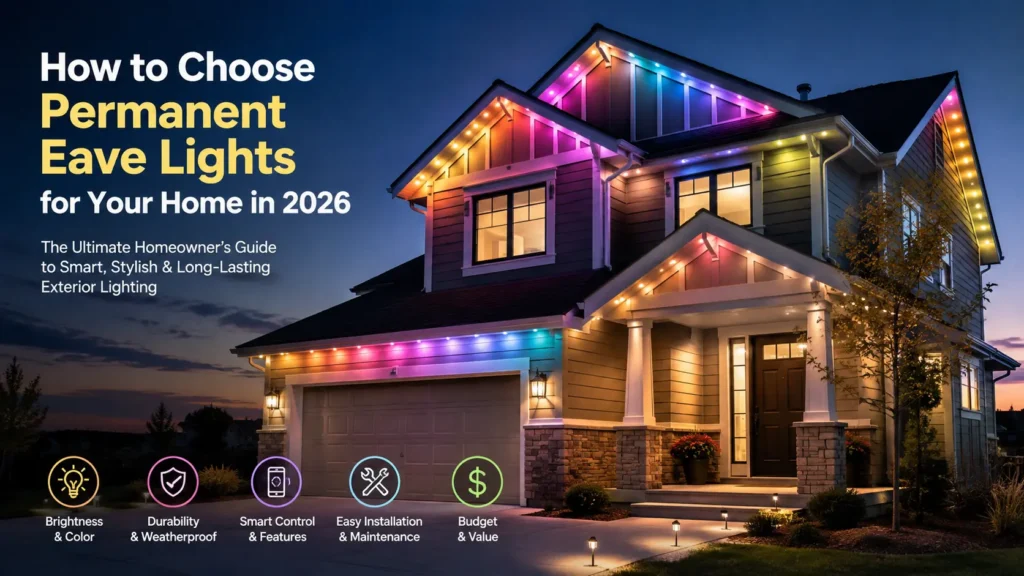
The best permanent eave lights are not necessarily the brightest, the cheapest, or the ones with the most app effects.
As a permanent eave light manufacturer, we have seen how differences in LED quality, light spacing, weather protection, mounting systems, controllers, and installation design can affect the performance of a lighting system over time. That’s why choosing the right permanent eave lights requires looking beyond color options and promotional claims. You should consider the LED type, white-light quality, light spacing, weather resistance, mounting hardware, maximum run length, controller, warranty, and replacement-part availability.
Permanent eave lights can make a home look finished year-round. They can create warm architectural lighting for ordinary evenings, colorful scenes for holidays, and programmable effects for parties or events. But they are also a long-term exterior installation. Choosing the wrong system can lead to visible wiring, uneven lighting, water-related failures, difficult repairs, or a product that does not match how you actually plan to use it.
In this guide, we share what homeowners should look for when choosing permanent eave lights—from a manufacturer’s perspective. Rather than focusing only on appearance or price, we’ll explain the product and installation factors that can make a real difference in long-term performance, reliability, and overall value.
Are Permanent Eave Lights Right for Your Home?
Permanent eave lights work best when the home has a suitable mounting surface, accessible power, and a roofline that can be measured and planned accurately.
Before comparing products, inspect your home conditions.
| Home Condition | Usually Suitable? | What to Check |
|---|---|---|
| Flat soffit with accessible eaves | Usually yes | Mounting surface, power access, roofline length |
| Textured stucco or uneven surfaces | Possible | Adhesive compatibility and mechanical mounting |
| No visible eaves | Depends | Alternative mounting location and daytime appearance |
| Multiple gables and corners | Usually yes | Cuttable sections, corner connectors, separate zones |
| Two- or three-story roofline | Possible | Installation safety and future maintenance access |
| HOA-restricted property | Depends | Local rules for exterior lighting and drilling |
| Coastal or humid climate | Yes, with suitable components | Corrosion resistance, sealed connectors, UV-rated cable |
A flat soffit is generally the easiest installation surface because it helps direct light toward the wall while keeping the fixtures less visible during the day.
Rough stucco, uneven trim, old painted surfaces, or exposed fascia boards may require more planning. Adhesive alone may not be reliable on every exterior surface, especially in areas with high heat, humidity, freezing temperatures, or heavy rain.
If your home has no traditional eaves, permanent lighting may still be possible, but daytime visibility becomes more important. A color-matched track, channel, or trim system can help create a cleaner appearance.
For tall homes, complex rooflines, or difficult-to-reach areas, consider professional installation. The initial installation is only part of the decision. You should also think about how a controller, power supply, cable, or individual light module could be serviced later.
Choose Your Lighting Goal First
The best permanent eave light system depends on how you will use it most often.
| Your Main Goal | Features to Prioritize |
|---|---|
| Year-round architectural lighting | RGBW or RGBICW, warm white, dimming, scheduling |
| Holiday decoration | RGB or RGBIC, scenes, animation effects |
| Everyday exterior ambiance | Adjustable brightness, low glare, reliable timers |
| Parties and events | Individually addressable LEDs, custom scenes, music sync |
| Discreet daytime appearance | Color-matched track, compact fixtures, hidden wire routing |
| Long-term maintenance | Replaceable modules, controller, power supply, and connectors |
If you expect to use the lights during ordinary evenings—not only on holidays—white-light quality matters more than many buyers realize.
A system that produces vivid red, green, and blue colors may still create a weak or unnatural-looking white light. For year-round use, choose a system with a dedicated white channel whenever possible.
Permanent eave lights can improve the appearance and visibility of a home, but they should not automatically replace dedicated security lights, driveway lights, stair lighting, or code-required exterior lighting. Decorative lighting and safety lighting serve different purposes.
RGB vs. RGBW vs. RGBICW: Which Should You Choose?
LED terminology can be confusing, especially because different sellers use similar names for different product designs.
| LED Type | White-Light Quality | Color Effects | Best For |
|---|---|---|---|
| RGB | Mixed white from red, green, and blue LEDs | Standard color scenes | Occasional holiday use |
| RGBIC | Mixed white with advanced segmented effects | Multiple colors on one run | Parties and animated effects |
| RGBW | Dedicated white LED channel | Strong everyday and holiday flexibility | Year-round home lighting |
| RGBICW / RGBWWIC | Dedicated white plus advanced individual control | High flexibility and dynamic scenes | One system for all seasons |
RGB
RGB lights combine red, green, and blue LEDs to create colors. They can also create “white” by mixing those colors, but the result may appear cool, bluish, purple-tinted, or less natural than dedicated white light.
RGB can be suitable if your main goal is holiday decoration and colorful scenes.
RGBIC
RGBIC systems use integrated circuits to control different sections—or sometimes individual lights—separately. This allows multiple colors, gradients, chasing effects, and animated patterns along one run.
RGBIC is a strong option for homeowners who prioritize dynamic effects. However, not every RGBIC system includes a dedicated white LED.
RGBW
RGBW adds a dedicated white channel. This usually produces more useful white light for year-round architectural lighting, warm evening ambiance, and subtle daily use.
RGBICW or RGBWWIC
These systems combine individually controllable lighting effects with dedicated white light. They are often the most flexible option for homeowners who want both colorful holiday scenes and comfortable everyday lighting.
A practical rule: Choose RGBW or RGBICW if you plan to use your eave lights throughout the year. Choose RGB or RGBIC if colorful effects are your main priority and natural white light is less important.
Do not rely only on claims such as “16 million colors.” A high color count does not tell you whether the white light is warm, neutral, consistent, or comfortable to look at.
The 8 Components That Determine Long-Term Reliability
A permanent eave lighting system is more than a row of LEDs. The light modules are important, but the complete system also depends on cables, connectors, controllers, power supplies, mounting hardware, and installation quality.
| Component | Why It Matters | What Buyers Should Ask |
|---|---|---|
| LED module | Determines color, brightness, and heat generation | Is there a dedicated white channel? |
| PCB and IC | Affect signal stability and thermal performance | Are lights individually controllable? |
| Cable | Faces UV, heat, cold, and moisture | Is the cable rated for outdoor use? |
| Connector | A common point for water entry | Is it sealed, protected, and replaceable? |
| Controller | Manages scenes, schedules, and connectivity | Can it be replaced separately? |
| Power supply | Affects safety and system reliability | What certifications and enclosure rating apply? |
| Mounting track | Affects appearance and mechanical security | Is it corrosion-resistant and color-matched? |
| Adhesive, clips, or screws | Determines whether the system stays attached | Is mechanical mounting available where needed? |
From a manufacturing perspective, long-term reliability depends on the entire system—not only on LED brightness or advertised lifespan.
For example, a high-quality LED module may still be part of an unreliable installation if the controller is poorly protected, the cable jacket is not UV-resistant, the connector is not properly sealed, or the power supply is installed in an unsuitable location.
When comparing systems, ask for product specifications that identify each major component separately.
How to Read IP Ratings for Permanent Eave Lights
IP ratings are useful, but they are often misunderstood.
An IP rating applies to a specific component under defined test conditions. It does not automatically mean that every part of a complete lighting system has the same protection level.
Under IEC 60529, the first IP digit refers to protection against solid objects and dust. The second digit refers to protection against water.
| Rating | General Meaning | Practical Interpretation |
|---|---|---|
| IP44 | Protected against splashing water | Better for sheltered locations |
| IP65 | Dust-tight and protected against water jets | A practical benchmark for exposed light modules |
| IP67 | Dust-tight and protected against temporary immersion | Added protection in very wet conditions |
| IP68 | Protection under specified immersion conditions | Verify exact test conditions and product scope |
For permanent eave lights, check the protection of these items separately:
- Light modules
- Connectors
- Controller
- Power supply
- Cable jacket
- Junction boxes or extension connections
For exposed roofline installations, IP65 or better is often a practical target for the lighting modules. But the correct requirement depends on the mounting location, local weather, installation method, and whether components are directly exposed to rain.
A controller or power supply may require a sheltered location even when the light modules themselves are rated for outdoor use. Always follow the manufacturer’s installation instructions and local electrical requirements.
Compare Spacing, Beam Angle, and Brightness
Light spacing affects the final appearance as much as LED color or app features.
If lights are spaced too far apart, the wall may show uneven gaps. If they are too close together or too bright, you may see harsh individual light spots instead of a smooth wash effect.
| Installation Situation | Practical Starting Point |
|---|---|
| Light mounted close to wall | 12–18 in. spacing |
| Typical soffit installation | 16–24 in. spacing |
| Deep soffit or greater wall distance | Test before choosing wider spacing |
These are starting points, not universal rules. The ideal layout depends on:
- Soffit depth
- Distance from the light to the wall
- Beam angle
- Fixture brightness
- Wall color and texture
- Mounting height
- Desired visual effect
White siding often reflects light differently from dark brick, stone, wood, or textured stucco. A layout that looks smooth on one home may look more segmented on another.
Before final installation, test a short section at night if possible. This is one of the simplest ways to check whether the spacing, brightness, and direction create the effect you want.
Estimate the Number of Lights
Use this basic formula: Estimated number of lights = roofline length ÷ light spacing
For example: 120 ft ÷ 1.5 ft = approximately 80 lights
However, the manufacturer’s maximum run length, voltage-drop limits, power capacity, and controller limits always take priority over a simple spacing calculation.
How to Measure Your Roofline Correctly
Do not buy a kit that exactly matches your measured roofline length.
You may need additional length for corners, gables, routing to the power source, controller placement, connection slack, and future adjustments.
A useful planning formula is: Recommended system length = measured roofline × 1.10–1.15
For a 120-foot roofline: 120 ft × 1.15 = 138 ft
A homeowner with a 120-foot roofline should usually consider a system with at least 132 to 138 feet of usable coverage, depending on the layout.
| Roofline Section | Example Length |
|---|---|
| Front eave | 42 ft |
| Garage eave | 24 ft |
| Side eave | 31 ft |
| Gable sections | 18 ft |
| Total measured length | 115 ft |
| 15% planning allowance | 17 ft |
| Recommended minimum | 132 ft |
Before ordering, confirm:
- Maximum continuous run length
- Whether sections can be cut
- Whether cut sections can be reconnected
- Whether corner connectors are available
- Whether extra power injection is required
- Whether separate roofline areas can be controlled by zones
- Whether long runs may show brightness or color variation
A detailed roofline sketch can prevent expensive ordering mistakes.
DIY vs. Track-Based vs. Professional Systems
There is no single best installation method for every home.
| System Type | Best For | Advantages | Trade-Offs |
|---|---|---|---|
| DIY light strings | Budget-conscious homeowners | Lower upfront cost, flexible purchase | Visible wires and owner-managed installation |
| Consumer track systems | Homeowners wanting a cleaner DIY finish | Better wire management and appearance | Product quality and support vary |
| Professional track systems | Complex homes and low-maintenance buyers | Custom layout and professional mounting | Higher upfront cost |
| Custom hardwired systems | Large or unusual properties | Integrated electrical planning | May require licensed electrical work |
DIY may be a suitable choice if you have a one-story home, a straightforward roofline, safe ladder access, a flat mounting surface, and nearby power.
Professional installation may be worth considering if your home has multiple stories, steep rooflines, complex gables, difficult exterior surfaces, or limited access for future service.
If discreet daytime appearance matters, prioritize a color-matched aluminum track or channel system. If future repairability matters most, prioritize modular components that can be replaced without removing the entire installation.
Compare Total Cost, Not Just Kit Price
The kit price is only one part of the ownership cost.
| Cost Item | DIY System | Professional System |
|---|---|---|
| Light kit and controller | Often purchased separately | Usually included in quote |
| Mounting materials | May be extra | Often included |
| Installation labor | Your time and tools | Varies by roofline and height |
| Electrical work | May be needed | May be quoted separately |
| Tracks or channels | Sometimes extra | Often included or optional |
| Future repairs | Usually owner responsibility | Depends on service agreement |
| Warranty support | Varies by seller | Varies by provider and product |
Use this framework:
Total cost of ownership =
equipment
+ accessories
+ installation
+ electrical work
+ expected maintenance
− warranty-covered replacements
A lower-cost system may be a good value if it fits your home and has accessible replacement parts. A more expensive system may be worthwhile if it includes professional installation, longer support, cleaner daytime appearance, and easier service.
Prices vary by location, roofline length, home height, installation complexity, product design, and service coverage. Treat any market price range as an estimate—not a fixed standard.
Evaluate Warranty and Repairability Before You Buy
Many permanent eave light buyers focus on a long LED lifespan claim, such as “50,000 hours.” That number can be useful, but it should not be treated as the guaranteed lifespan of the entire system.
A 50,000-hour rating usually refers to the LED source under specified operating conditions. It does not automatically mean that the controller, power supply, connectors, cable, adhesive, mounting track, or app connectivity will last for the same period.
Ask these questions before buying:
- Does the warranty cover only LED modules, or the complete system?
- Are the controller and power supply covered separately?
- Does the warranty include replacement parts only, or labor as well?
- Can connectors and extension cables be purchased individually?
- Can one failed section be replaced without removing the full system?
- Is repair handled locally, remotely, or through factory return service?
- Can the lights still operate if the app is no longer updated?
- Does the supplier provide replacement parts after the warranty ends?
A repairable system can be more valuable than one with a longer marketing claim but no available replacement parts.
10 Mistakes to Avoid When Buying Permanent Eave Lights
- Buying a kit that exactly matches your measured roofline length.
- Looking only at the IP rating of the light modules.
- Treating a 50,000-hour LED claim as a complete-system warranty.
- Choosing RGB-only lights when you want warm white year-round lighting.
- Ignoring maximum run length and power limits.
- Relying only on adhesive in demanding weather conditions.
- Forgetting to check controller and power-supply installation requirements.
- Buying a system with no replaceable modules or components.
- Treating decorative eave lights as a replacement for dedicated security lighting.
- Comparing only product price instead of total installation and maintenance cost.
About This Guide
This article is written by [MEKALEO], a China-based manufacturer of permanent eave lighting systems.
We publish this guide to help homeowners understand how to compare outdoor LED lighting before making a purchase. The recommendations are based on product specifications, applicable standards, manufacturing considerations, and installation requirements.
Final Checklist Before You Buy
Before requesting a quote or placing an order, confirm that you can answer these questions:
- Is my roofline suitable for permanent eave lights?
- How many feet of lighting do I need, including extra allowance?
- Do I need RGB, RGBW, RGBIC, or RGBICW?
- Is the white light suitable for everyday use?
- What is the maximum continuous run length?
- Are the light modules, connectors, controller, and power supply protected appropriately?
- Is the mounting method suitable for my soffit or exterior surface?
- Can failed components be replaced individually?
- What exactly does the warranty cover?
- What will the complete installation cost over time?
Permanent eave lights are a long-term exterior upgrade. Compare the complete system—not only the color effects, app features, or kit price.
The best system for your home should look attractive at night, remain discreet during the day, perform reliably in your local climate, and be serviceable if a component eventually fails.
Before buying, review the specifications, installation requirements, warranty terms, and replacement-part policy carefully.