Sourcing guide · 2026 edition
Top 10 LED Point Light Manufacturers in China
Ranked on what can be checked: annual reports, registry filings, plant footprint, export records. Each entry also says where the company is weak — because a list where everyone is excellent is a brochure, not a shortlist.
Editorial disclosure
MEKALEO publishes this page and is not on the list. Nobody paid for a place. We build facade lighting for hotels and towers in small custom runs, we have no public financials, and we would fail our own scale test in the first round. The company in full — entity, plant, projects and the orders we turn down — is set out further down the page.
If your project needs 20,000 identical point lights on a six-week lead time, several companies below are a better fit than we are. If you need 400 units in three colours with a custom bracket, that is a different conversation — talk to us instead.
Method
How this ranking was built — and what it cannot tell you
“Top 10” lists for Chinese lighting factories usually come from who advertises most. This one is scored, weighted in public, and deliberately keeps the negative findings in.
Four dimensions, weighted once and applied to every company. Two of them (scale, specialisation) account for 65% of the score, because for a buyer the two questions that matter are “can they carry the volume” and “is point lighting their actual business, or a catalogue line”.
- Scale · 35%
- Latest published revenue, employee count, plant area, registered capital. For unlisted firms: registry records plus company-published figures, cross-checked against at least one independent source.
- Specialisation · 30%
- How much of the line is genuinely point/pixel lighting — and whether they publish real specifications (pixel pitch, beam angle, protocol, potting method) instead of one landing page.
- Export & project evidence · 20%
- Countries served, named projects that a third party can verify, and export documentation: CE, UL, CQC, IES/LDT photometric files.
- System & test capability · 15%
- In-house control protocol or driver firmware, an accredited lab (CNAS or equivalent), ageing and IP test equipment on site.
Three honest limits
This is not a factory audit. We did not visit these plants for this article. Registered capital is not capacity, and headcount is not output.
The scores are editorial. Change the weights and companies move two or three places. The ordering is a starting point for RFQs, not a verdict.
Small specialists are structurally excluded. If a factory has no public filings, it cannot be scored — so absence from this list says nothing about quality. A large share of China’s point-light capacity sits in companies too small to appear here.
Definition
What actually counts as an LED point light factory
The category gets blurred on purpose: display-screen makers, strip-light makers and contractors all list “点光源” somewhere. Four tests separate a factory from a reseller.
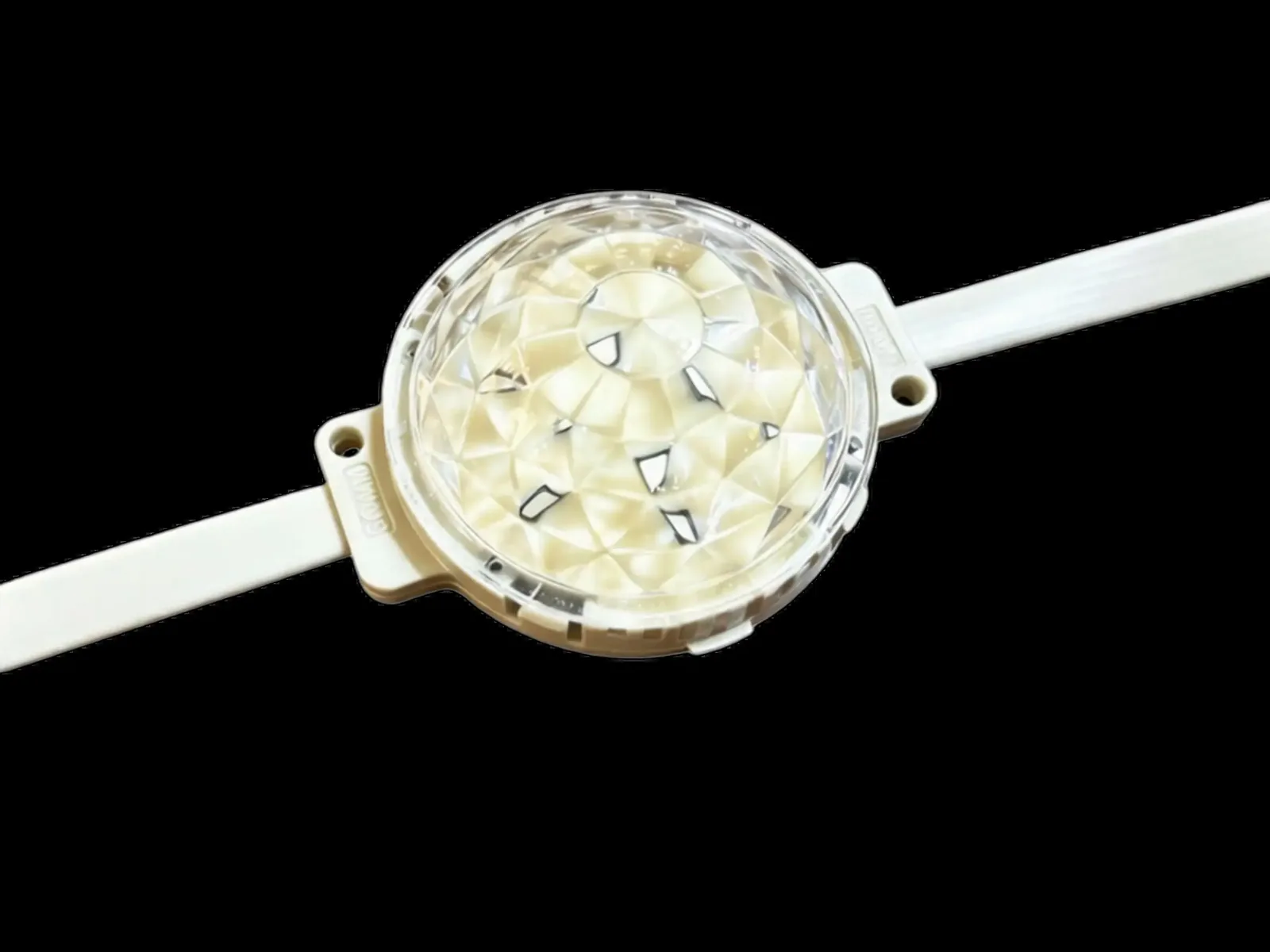
An LED point light — sold as a pixel light, dot light, or 点光源 in Chinese — is a single-addressable LED fixture, usually 30–80 mm across and 0.5–3 W, fixed directly to a façade, bridge, canopy or handrail. Each unit is one pixel in a larger image; you drive hundreds of them in series. It is not a downlight, not a strip, and not a mesh panel, although they share a control protocol.
The layer problem
China’s point-light supply chain has four layers: chip (Sanan, HC Semitek), package (MLS, Nationstar, Refond and the volume houses behind most Chinese point lights), luminaire (the ten companies here), control, and contractor. Most “factories” a buyer meets online are layer 3 or 4 buying from layer 2, and a fair number of “manufacturers” are contractors with a trading licence. Knowing which layer you are talking to decides who owns the warranty.
Market context
The 2025 numbers most buyers never see
Chinese landscape lighting grew fast in 2025 and still lost money. Both facts matter when you choose a supplier, because they explain the price pressure you are about to meet.
According to CSA Research’s 2025 review of listed LED companies, China’s seven A-share landscape-lighting firms booked CNY 5.54bn of revenue, up 35.6% year on year — the first real recovery after several weak years. Their combined net result was still a loss of CNY 358m, although that loss narrowed by 28%. By contrast, general lighting shrank 1% to CNY 74.2bn with profit down 7.4%. Point lighting lives inside that recovering-but-unprofitable landscape segment.
Read together: demand is back, pricing is not. Expect aggressive quotations, longer payment terms asked of suppliers, and consolidation among small factories. It also means supplier financial stability is now a sourcing criterion — a factory that disappears in year two takes your spare-parts pipeline with it.
The category leader illustrates the split. EXC’s 2025 group revenue rose 30.5% to CNY 1.18bn, but its lighting segment fell 17.4% to CNY 520m; growth came from EV charging and new-energy materials. Scale in this industry no longer implies growth in point lighting.
The ranking
Ten Chinese point light factories, ranked
Every entry carries the same five fields: who they are, what they are good at, four checkable numbers, the score, and where they are weak. Read the weakness first — it is the part that saves money.
EXC · 爱克股份
Shenzhen · SZSE 300889The closest thing China has to a pure-play point-light manufacturer. EXC has spent fifteen years on outdoor point lighting and its control layer, and it is the only company on this list whose own description of itself is built around the category rather than around “LED” in general. Its pixel-mapping and control work is the reason it supplies large-scale city light shows.
Where it is weak — group revenue grew 30% in 2025 while lighting fell 17%. The growth came from EV charging and battery materials, not from façade products. Ask which point-light models are still actively tooled. Also: the “world’s largest outdoor point light producer” line on its own site is marketing, not an audited claim — no independent ranking supports the phrasing.
YD Illumination · 勇电
Hangzhou · privateThe most export-shaped company in the list. YD patented its own second-generation encapsulation, which is why it can publish an IP68 claim for outdoor fixtures rather than quoting a supplier’s datasheet. 30,000+ installed projects and 80+ countries make it the safest choice for a buyer who needs a factory that has already cleared customs in your market.
Where it is weak — private company, so there are no audited figures and no external way to size its revenue. The catalogue is very wide — strips, wall washers, screens, controllers, 3D-printed housings — which is good for one-stop buying and bad if you want a supplier whose survival depends on point lights alone. Export support runs through distributors, so technical answers can arrive second-hand.
SANSI · 上海三思
Shanghai · private, national tech centreThe largest engineering organisation on this list, and one of the few with a genuine point-light pedigree: SANSI developed independently heat-dissipated pixel lights back in 2007 and has been supplying pixel products alongside displays ever since. If your project has a public-authority client, a named bridge, or a specification that will be challenged, its paperwork is the hardest to argue with.
Where it is weak — displays and intelligent transport are the core business; point lighting is one line inside a very broad “LED lighting” division. You are a small account to a company this size, which means longer RFQ cycles and less flexibility on 500-unit custom runs. If you want a supplier whose entire year depends on your order, look further down the list.
StrongLED · 大峡谷照明
Suzhou · listed in TaiwanThe control-system house. StrongLED writes its own protocols and player software rather than buying a third-party DMX stack, which is why its pixel work holds up on complex media façades where timing between fixtures matters. The 2022 CNAS lab accreditation and the 2023 merger into the Tangshih group give it a corporate structure most private factories here cannot match.
Where it is weak — headcount around 220 is small for the brand’s reputation, so peak-season capacity is limited and lead times flex. The 2023 change of parent company is worth asking about directly: product priorities after an acquisition are not always the same as before it. Pricing sits mid-to-high, which is defensible on media façades and hard to justify on simple outline runs.
DELOS · 德洛斯照明
Guangzhou / Foshan · privateA full-range outdoor landscape manufacturer with an unusually deep standards footprint: 500+ patents and participation in 30+ national and industry standards, plus a CNAS lab on site. DELOS is strongest in low-level and road/tunnel lighting, and carries point lights as part of a complete façade package — useful when one supplier has to cover outlines, grazing and wall washing on the same building.
Where it is weak — the range is built around low-level and road lighting, so point-light stock depth is thinner than a 400-page catalogue suggests — ask for the current mould list, not the brochure. The Guangzhou entity is a small holding structure (tens of staff) with production in Foshan: make sure your PI is issued by the entity that actually runs the plant, otherwise the warranty chain gets murky.
ROLEDS · 罗莱迪思
Hangzhou · private, pre-IPOThe most software-forward company here: CMMI5 process certification, DCMM data management, an in-house AI lighting platform and a national “little giant” rating renewed in 2025. Overseas revenue has grown about 30% a year for three years, which is the fastest export ramp on this list. Its point lights come with a control and commissioning service attached, not as loose boxes.
Where it is weak — the narrative is platforms, projectors and AI; point lighting is a supporting product rather than the main line, and a buyer sourcing 30,000 fixtures will notice that in both price and tooling depth. 230 staff is small for large orders, so schedule risk is real in Q3–Q4. It is also in pre-IPO status, which can make it conservative about unusual custom work.
KINGSUN · 勤上光电
Dongguan · SZSE 002638The oldest large-scale LED manufacturer on the list, and the one with the heaviest balance sheet behind a quotation. KINGSUN built its name on high-power LED lighting and smart street lighting, and its point-light range benefits from that supply chain: same die suppliers, same ageing discipline, larger volume discounts than a specialist can get.
Where it is weak — point lighting is peripheral to a business built on street and industrial lighting, so the pixel-control layer is weaker than the fixture itself. The company also carries a difficult financial history from earlier years; run company-search due diligence before a large prepayment, and do not assume the listed parent and the contracting entity are the same legal person.
Galaxy · 银河兰晶
Foshan · privateA mid-sized Foshan manufacturer running a heavily automated outdoor line and a digitalised factory — a useful profile when you need consistent output across repeated orders rather than a one-off showpiece. Covers landscape, cultural-tourism, road and indoor ranges, with point lights inside the landscape range.
Where it is weak — export presence is much thinner than the domestic project list implies; English-language technical documentation is limited and overseas references are hard to verify. If your tender requires prior international façade experience, ask for named projects outside China and check them before you shortlist.
SHYLON · 芯龙光电
Shanghai / Kunshan · privateAn outdoor architectural and landscape brand that grew quickly on projectors, floodlights and in-ground fixtures, with a separate manufacturing subsidiary in Kunshan doing the production. Its value to a façade buyer is optical design — good beam control and colour consistency across a range that includes point lights.
Where it is weak — registered capital is more than double paid-in, and the sales entity is not the manufacturing entity — check which company name appears on your PI, because that is who you can enforce against. Point lights are a small part of a projector-led range. Plant headcount around 80 also means genuine capacity limits on large orders.
YAMING · 亚明 / 亚牌
Shanghai · state-ownedChina’s oldest lighting brand and its first light-bulb factory, now a public-environment lighting house with a national enterprise technology centre and 481 patents. Included because a large number of municipal and heritage façade tenders in China still specify 亚牌, and because a 100-year-old state-owned supplier answers a warranty letter differently from a five-year-old trading company.
Where it is weak — point lighting is one product family among dozens in a general public-lighting catalogue; there is no dedicated pixel-control engineering team to match the specialists. Headcount is small relative to the brand’s footprint, and the brand itself has a long history of licensed and lookalike marks in the market — verify you are buying from 上海亚明照明有限公司, not a similarly named licensee.
Overview
| # | Company | Base | Founded | 2025 revenue | Point-light fit | Score |
|---|---|---|---|---|---|---|
| 1 | EXC 爱克股份 | Shenzhen | 2009 | CNY 1.18bn | Core product for 15 years | 8.50 |
| 2 | YD 勇电 | Hangzhou | 1993 | Private | Core, plus own encapsulation | 8.15 |
| 3 | SANSI 上海三思 | Shanghai | 1993 | Private | Pixel light since 2007, broad group | 8.08 |
| 4 | StrongLED 大峡谷 | Suzhou | 2002 | Listed (TW OTC) | Strong, own control stack | 7.33 |
| 5 | DELOS 德洛斯 | Guangzhou / Foshan | 2005 | Private | Part of full landscape range | 7.10 |
| 6 | ROLEDS 罗莱迪思 | Hangzhou | 2004 | Private, pre-IPO | Supporting product, strong control | 6.98 |
| 7 | KINGSUN 勤上 | Dongguan | 1994 | Listed, SZSE 002638 | Peripheral to street lighting | 6.90 |
| 8 | Galaxy 银河兰晶 | Foshan | 2008 | Private | Inside landscape range | 6.43 |
| 9 | SHYLON 芯龙 | Shanghai / Kunshan | 2010 | Private | Small part of projector range | 6.28 |
| 10 | YAMING 亚明 | Shanghai | 1923 | Private (state-owned) | One family in a wide catalogue | 6.15 |
Revenue is calendar-year 2025, taken from annual reports or, for unlisted companies, from registry and company-published figures. “Private” means no audited public accounts exist — not that the revenue is small. Scores are editorial, computed with the weights in Figure 1.
The exclusion list
The six names you expected — and why they are not here
木林森, 国星, 利亚德, 洲明, 艾比森 are bigger than everyone above. None of them makes the fixture you are buying. Leaving them out is the single most useful decision in this article.
China’s LED giants are large for reasons that have nothing to do with façade point lights. Two of them make the light engine that goes inside a point light. Three of them make display panels. A buyer who shortlists them for a 20,000-piece point-light order will spend three weeks in an RFQ loop and end up talking to a project division that subcontracts the fixture anyway.
- 木林森 MLS
- CNY 17.44bn revenue in 2025, of which packaging CNY 7.63bn (+12.8%). The volume leader in SMD light engines, and a supplier to several companies on this list. It does not sell finished IP67 point-light fixtures with brackets.
- 国星光电 Nationstar
- CNY 3.28bn revenue; packaging CNY 2.32bn, down 7.6%; first annual loss since listing (−CNY 13m). A strong RGB packaging house in a weak pricing year — relevant as a bill-of-materials reference, not as a fixture vendor.
- 兆驰 MLSD
- LED chain revenue CNY 5.73bn with CNY 871m profit, driven by chip-to-package ODM and automotive. Vertical integration is the point here; finished façade fixtures are not.
- 利亚德 Leyard
- CNY 7.06bn revenue, ~90% intelligent display. It has lighting and cultural-tourism arms, and it owns contracting businesses that buy point lights — but the group is a display company.
- 洲明 Unilumin
- CNY 8.09bn revenue, smart display around 93% of it, lighting a single-digit share. Same conclusion: a display house with a lighting division, not a point-light factory.
- 艾比森 Absen
- CNY 4.16bn revenue, almost entirely LED display, 76% exported. Excellent at displays; not a point-light supplier.
One practical warning
These six names are the most borrowed in the industry. Trading companies use them in subject lines, and “we are the XX division” is a common opening. If a quotation arrives under one of these brands for a small custom order, ask for the business licence of the contracting entity and compare its 经营范围 against the factory address. It takes four minutes and settles most disputes before they start.
Who publishes this
Who MEKALEO is — the company behind this list
A ranking is only worth reading if you know who wrote it. Short version below, with the legal entity name you can check in a Chinese company registry.
MEKALEO is the export brand of Guangdong Meidile Technology Lighting Co., Ltd. (广东美滴乐科技照明有限公司). The business started in Shenzhen in 2004 building outdoor architectural fixtures, and has run its own plant in Guzhen, Zhongshan — one of China’s two main lighting manufacturing clusters — since 2017. Everything below is either on the public record or published by us; where a figure is our own claim rather than a filed number, it says so.
- Legal entity
- Guangdong Meidile Technology Lighting Co., Ltd., trading as MEKALEO outside China. Shenzhen from 2004, manufacturing relocated to Guzhen, Zhongshan in 2017. Check that the entity name on your PI matches this one — it is the name you can enforce against.
- The plant
- 8,000 m² in Guzhen with SMT, reflow, potting and ageing under one roof. ISO, CE and RoHS compliance, standard catalogue delivery in 7–15 days, custom runs quoted per drawing rather than from a general lead time.
- The record
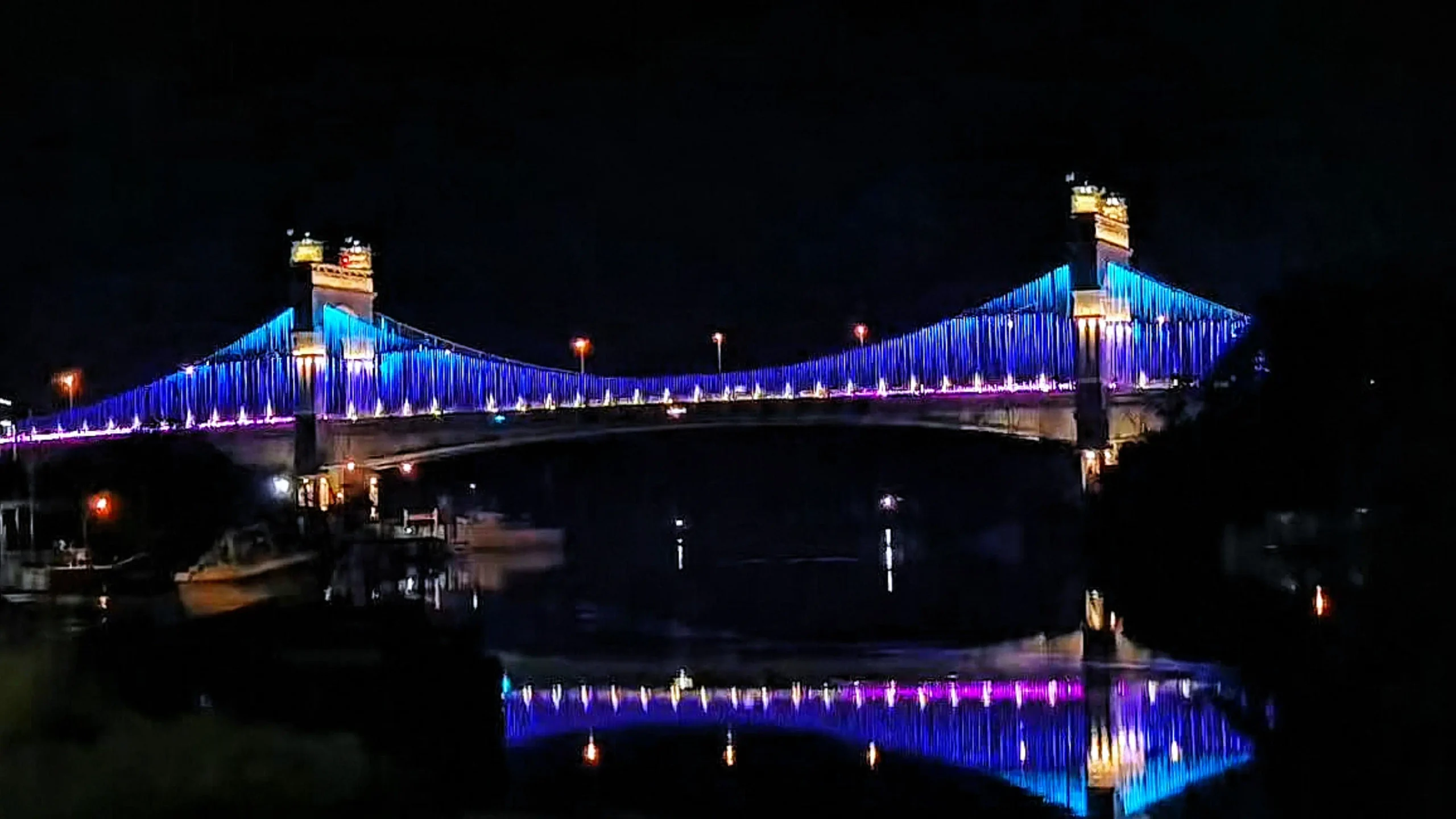
- 5,000+ outdoor lighting installations since 2004, sold through distributors, contractors and project buyers. Two are public: RGB point lights on a suspension bridge in Malaysia, and a 55 × 25 m P84 mesh screen in Cambodia.
- What we claim
- 100+ patents and a five-year OEM/ODM warranty on the point-light range. These are company figures, not audited ones. Treat them the way this article tells you to treat any supplier’s claims — ours included — and ask to see the certificate.
Entity name, plant size, project count and patent count are published by the company; the two named projects are documented on this site. Nothing here is audited, which is exactly why the ranking above does not use these numbers as a criterion.
Where we sit
Where MEKALEO sits — and the orders we hand to someone else
Having said who we are, the useful question is whether we are the right call for your project. That comes down to order size, paperwork and price pressure — three places where being small is a real limit.
We are the small end of the layer-3 category above: no public financials, no CNAS lab, 8,000 m² against the 360,000 m² of the largest name on this list. What that buys you is attention — 400 pieces is a good month for us and an interruption for entry 1.
- What we can carry
- Catalogue orders in the hundreds to low thousands, 7–15 days out of Guzhen. Custom colour, bracket or cable runs in the 400–3,000 piece range, scheduled per drawing. English drawings in, IES files and dimming curves out, samples before production.
- What we are not
- Not a listed company and not a tender-grade supplier: no CNAS reports, no bank guarantee, no ten-year balance sheet. A public bid screens us out on those three lines, and it should. We would also fail the scale criterion in our own scoring model — which is why we are absent from the list rather than ranked last on it.
- What we turn down
- Fixed 20,000-piece specs on a six-week clock, and RFQs with eight bidders where price is the only open variable. Both exist in volume, and both are better served by entries 1 to 3.
What that means in practice
If your project needs a factory that already cleared customs in your market, has a decade of named references, and can absorb a schedule slip, buy from the top of this list. We will not pretend to compete with that.
If you have drawings, a colour that has to match an existing façade, and an order measured in hundreds rather than tens of thousands, send them over — we will tell you plainly whether it is ours to take, including when the answer is that it is not. Product detail sits on the pixel light and point source page.
| If your order looks like this | Ask | Because |
|---|---|---|
| 20,000+ pieces, fixed spec, tender documents | EXC · YD · SANSI entries 1–3 | Capacity, certifications and named references that a public tender will ask for — a small plant cannot produce the paperwork, let alone the volume. |
| A landmark whose paperwork will be challenged | SANSI · StrongLED entries 3–4 | CNAS lab, photometric files and named projects that survive due diligence by a consultant or a bank. |
| One supplier covering outline, grazing and wall wash | DELOS · ROLEDS entries 5–6 | A full façade range, so one building does not end up with three warranty chains to chase. |
| 400–3,000 pieces, a colour and a bracket that do not exist yet | Us | Too small for the companies above to quote well, too custom for a trading desk to get right. |
This is the only section on the page that ranks us against the firms above. Nothing in the ranking was adjusted for it — the ten places were scored against the four published criteria and stayed there, which is also why we do not appear in them.
Upstream
Where the light actually comes from
Two point lights can look identical and perform 30% apart, because the difference sits in the LED bin and the potting — both decided one layer upstream. Here is who makes that layer, in public numbers.
| Company | 2025 revenue | Segment detail | What you are actually buying |
|---|---|---|---|
| MLS 木林森 SZSE 002745 | CNY 17.44bn | Packaging CNY 7.63bn, +12.8% | SMD light engines at the highest volume; the default source for 3535 and 5050 RGBW in this industry |
| MLSD 兆驰股份 SZSE 002429 | CNY 5.73bn LED chain only | CNY 871m profit on that chain | Chip-to-package integration; the cheapest route to a stable bin supply at scale |
| Nationstar 国星光电 SZSE 002449 | CNY 3.28bn | Packaging CNY 2.32bn, −7.6% | RGB packaging with strong colour-consistency reputation; used where colour shift matters |
| Refond 瑞丰光电 SZSE 300241 | CNY 1.84bn, +19.2% | Net CNY 66m, +109% | Automotive-grade reliability; relevant if your façade is in a coastal or high-UV climate |
Source: 2025 annual reports and the CSA Research review of listed LED companies. “Packaging” means the LED component, not the finished fixture — this is the layer a point-light factory buys from, and the layer that decides your colour consistency.
Anatomy
Seven components decide whether it survives year three
A point light has more in common with a sealed electronics enclosure than with a lamp. Almost every field failure traces back to one of these seven parts — and to the question nobody asks at RFQ.
At 20–60 m up a façade, replacement cost is 10–30× the fixture price: scaffolding, permits, night work. That ratio is the whole argument for paying for the potting and the bin code rather than for the aluminium.
Sourcing
Six ways buyers lose money on Chinese point lights
These are not factory tricks. They are process gaps on the buyer’s side, which is why they repeat across every project.
Quoting a contractor as a factory
A trading licence plus a showroom is not a plant. Ask for the business licence with 制造 in the scope, the plant address, and a photo of the SMT line — then compare the address on the PI.
Accepting IP67 without a report
IP is a per-model, per-lot claim. Ask for the test report number and the lab, and check that the model code on the report matches the model code on the quotation.
Comparing pixel pitch, ignoring protocol
DMX512 and SPI are not interchangeable, and refresh rate decides whether a camera sees flicker. Two suppliers quoting the same pitch may be quoting different universes per port.
Ignoring the bin code
When two quotations differ by 40%, the gap is almost never the aluminium — it is the LED bin and the potting. Ask which bin, from which supplier, and whether it is held for the whole order.
Leaving control hardware out of the BOM
Controllers, PSUs, signal amplifiers and cable are commonly 15–30% of installed cost, and are usually a different supplier. Price them before you compare fixture prices.
Skipping the 72-hour ageing test
Run samples at rated power for 72 hours, then measure flux and colour shift. Failures in the first three days are the ones that would have happened at 20 m in month two.
Questions buyers actually ask
LED point lights from China: FAQ
Who is the largest LED point light manufacturer in China?
What is the difference between an LED point light and an LED pixel light?
How much does an LED point light cost from a Chinese factory?
What IP rating should a façade point light have?
Can Chinese factories supply DMX512 and SPI, or only one protocol?
What is a realistic MOQ and lead time?
How do I verify a Chinese point light factory is real?
Which region of China makes point lights?
Shortlist two, sample three, then decide
If you send us your façade drawings we will tell you which of these companies fits your order size — including when the answer is “not us”. We build custom runs for hotels and towers, and we would rather hand you a correct referral than quote for work we cannot deliver on schedule.
Project enquiry
Send your drawings. Get a specification you can defend.
Elevation DWG, facade area, closest viewing distance and site country — we reply within 48 hours with a fixture matrix, power and DMX topology, and a quotation. No price-only quotes.
5,000+ projects delivered · 40+ countries · ISO 9001 · CE / UL / RoHS