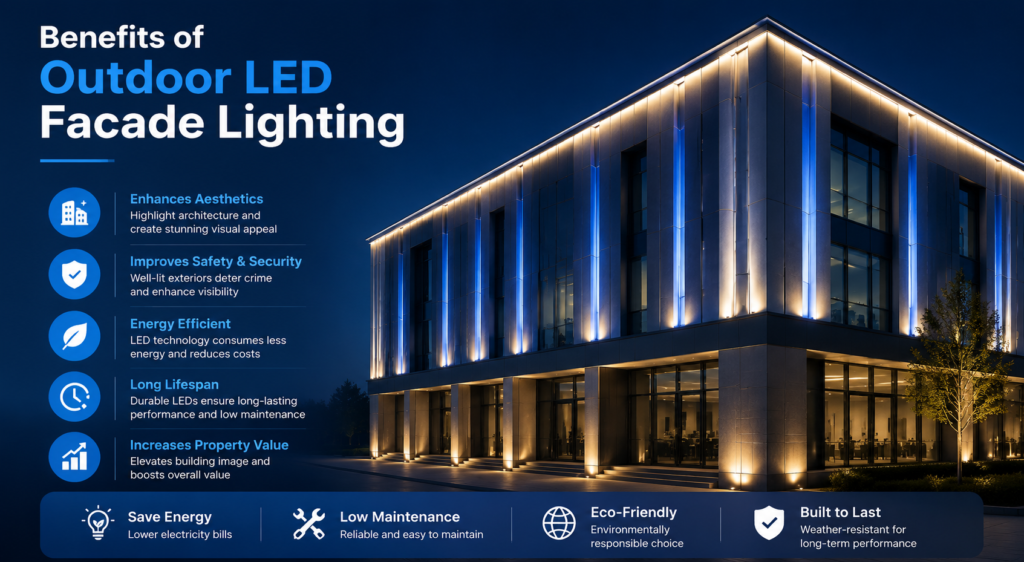
Why do building owners, architects, and city planners keep choosing LED for facade lighting — not occasionally, but almost universally for every new project? The answer isn’t fashion. It’s that LED technology changed the underlying economics and design possibilities of exterior lighting so thoroughly that the older alternatives stopped making sense.
This article lays out the six reasons that matter — energy, lifetime, customization, maintenance, return on investment, and environmental responsibility — and shows how each one compounds the others. If you’re weighing whether facade lighting is worth the investment at all, start here; when you’re ready to plan a project, explore our outdoor LED facade lighting solutions.
1. Energy Saving: The Same Light for a Fraction of the Power
The Efficiency Gap Is Structural, Not Incremental
LEDs convert electricity to light through electroluminescence rather than by heating a filament or exciting a gas. That physical difference means far less energy is lost as heat. Compared with the metal-halide and high-pressure sodium systems that dominated facade lighting until the 2010s, LED installations typically draw 50–70% less power for equivalent visual results — a figure supported by U.S. Department of Energy solid-state lighting research.
Dimming Multiplies the Savings
Legacy discharge lamps dimmed poorly or not at all — they ran at full power or off. LEDs dim smoothly to any level with proportional energy savings. A facade running at 100% during peak evening hours, 40% after midnight, and off before dawn consumes dramatically less than its nameplate wattage suggests. The savings come not just from efficiency, but from control.
Scheduling Turns Efficiency Into Policy
Astronomical clocks and automated schedules mean the facade lights only when it earns its keep. No staff member forgets to switch it off; no energy is spent lighting a building nobody is looking at. Over a decade, intelligent scheduling often saves as much energy as the LED conversion itself.
2. Long Lifetime: Measured in Decades, Not Seasons
50,000+ Hours Changes the Math
Quality LED systems are rated L70 at 50,000+ hours — meaning after 50,000 hours of operation they still deliver at least 70% of original output. At a typical facade duty cycle of six hours per night, that is over twenty years of service. Metal halide, by contrast, offered 10,000–20,000 hours and noticeably degraded color along the way.
Graceful Aging, Not Sudden Death
LEDs don’t fail the way bulbs burn out. They dim slowly and predictably, which means the facade’s appearance degrades gently rather than developing sudden black holes where lamps have died. For a surface meant to represent a brand every single night, predictable performance is itself a benefit — there is no bad night.
Longevity Where Replacement Is Expensive
Facade fixtures often sit in places that are genuinely hard to reach: high on towers, over water, recessed into stone. Every replacement may require lifts, scaffolding, or rope-access technicians. A light source that lasts twenty years instead of two transforms the lifetime cost of exactly the fixtures that are most expensive to touch.
3. Customization: Light as a Design Language
Any Color, Instantly, Without Touching the Fixture
Before LED, changing a facade’s color meant physically swapping gel filters on every fixture. RGB and RGBW LED systems mix virtually any color on command — national colors for a holiday, brand colors for a launch, warm white for every ordinary night — all from software, in seconds, at no marginal cost.
From Static Object to Living Surface
Addressable control lets a facade shift with time, season, and occasion: subtle breathing effects, sunset-triggered scenes, synchronized citywide celebrations. The building stops being a static lit object and becomes a communicative surface that can respond to context — something no previous lighting technology could offer at any price.
Precision Serves Architecture
Customization isn’t only about color shows. Fine dimming control and beam precision let designers reveal exactly what the architecture deserves — grazing a stone texture, accenting a colonnade, keeping shadow where shadow gives depth. The benefit is expressive range: from restrained heritage elegance to full media spectacle, the same underlying technology covers the entire spectrum of intent.
4. Maintenance: From Constant Chore to Rare Event
Fewer Interventions, Planned Not Emergency
The combination of long lifetime and gradual degradation converts maintenance from a reactive scramble into a planned, infrequent activity. Instead of replacing failed lamps every season, facility teams inspect on a schedule measured in years.
Remote Diagnostics Replace Physical Searching
Modern control systems report fixture status back to the operator — which unit is faulty, and often why — before anything is visible from the street. On a facade 100 meters up, the difference between searching for a fault and knowing its exact location is the difference between a day of rope access and a targeted one-hour repair.
Lower Risk, Not Just Lower Cost
Every trip up a facade carries safety risk and operational disruption. Fewer maintenance events mean fewer working-at-height exposures, fewer road or plaza closures, and fewer interruptions to the building’s normal life. Reduced maintenance is a safety benefit wearing a financial disguise.
5. ROI: The Investment That Pays Back Three Ways
Payback Channel 1 — Operating Cost Reduction
The energy and maintenance savings above are directly bankable. For buildings converting from legacy lighting, reduced electricity and near-eliminated relamping labor typically recover the investment within a few years — after which the savings simply accumulate.
Payback Channel 2 — Visibility and Brand Value
A distinctive nighttime identity works as a permanent, photogenic advertisement. Hotels, retail destinations, and mixed-use developments gain recognition, social-media presence, and footfall from a facade people remember and share — marketing value delivered every night at the cost of a few kilowatts. Unlike an ad campaign, it never stops running.
Payback Channel 3 — Asset Value and Competitiveness
Well-executed facade lighting signals a maintained, prestigious property. It supports higher perceived quality for tenants and guests, differentiates a building in a crowded skyline, and contributes to the sustainability credentials increasingly demanded in commercial leasing. The lighting becomes part of the asset, not an accessory to it.
The Honest Caveat
ROI is real but not automatic. It depends on appropriate design (spectacle where spectacle pays, restraint where it doesn’t), quality components that actually deliver the promised lifetime, and disciplined scheduling. The benefit case assumes the system is done well — which is precisely why the decision deserves serious planning.
6. Environment: Efficiency With Responsibility
A Smaller Carbon Footprint by Design
Cutting facade energy use by half or more directly reduces the carbon footprint of a building’s nighttime presence. Multiplied across a city skyline, LED conversion of exterior lighting represents one of the more visible and measurable urban energy wins of the past two decades.
No Mercury, Less Waste
Unlike the discharge lamps they replaced, LEDs contain no mercury, removing a hazardous-waste stream from every future maintenance cycle. Twenty-year lifetimes also mean dramatically fewer discarded lamps and packaging per decade of operation.
Controllability Enables Dark-Sky Responsibility
Perhaps the least appreciated environmental benefit: LEDs can be controlled precisely enough to be responsible. Warm color temperatures reduce sky glow; precise optics keep light on the building instead of scattered upward; curfew dimming protects wildlife and neighbors’ sleep. The DarkSky International and IES Five Principles for Responsible Outdoor Lighting — useful, targeted, low-level, controlled, warm-colored — are only practically achievable with a light source this controllable. Older technologies physically couldn’t comply; LED makes responsibility a settings choice rather than a hardware limitation.
Efficiency and Ecology Point the Same Direction
Notably, the environmentally responsible configuration — dimmed late at night, warm-toned, precisely aimed — is also the cheapest to run. There is no trade-off between the green choice and the economic one; the same schedule serves both.
How the Six Benefits Compound
These benefits are not six separate arguments — they reinforce one another:
- Long lifetime makes the maintenance savings real.
- Energy efficiency plus dimming control make the environmental case and the ROI case simultaneously.
- Customization creates the brand value that turns a cost center into a marketing asset.
- Controllability enables the dark-sky compliance that keeps the installation legally and socially sustainable for its whole twenty-year life.
The reason LED swept the facade lighting world is that no earlier technology could deliver even half of this list at once.
Comparison Table: Benefits at a Glance — LED vs. Legacy (HID) Facade Lighting
| Benefit Dimension | Legacy HID (Metal Halide / HPS) | Outdoor LED |
|---|---|---|
| Energy use | Baseline | 50–70% lower |
| Rated life | 10,000–20,000 hrs | 50,000+ hrs (L70) |
| Dimming | Poor or none | Smooth, 0–100% |
| Color change | Physical filter swap | Instant, via software |
| Failure mode | Sudden burnout | Gradual, predictable dimming |
| Maintenance pattern | Frequent, reactive relamping | Rare, planned, remotely diagnosed |
| Mercury content | Yes (hazardous disposal) | None |
| Dark-sky compliance | Physically difficult | Achievable via control settings |
| Marketing/brand flexibility | Static appearance | Dynamic, event-responsive identity |
FAQ
Q: How much energy does LED facade lighting actually save? Typically 50–70% versus equivalent metal-halide systems, before counting dimming and scheduling — which often add substantial further savings on top.
Q: How long until the investment pays back? It varies with usage hours, local energy prices, and how expensive the old system was to maintain. Conversions from legacy lighting commonly pay back within a few years through energy and maintenance savings alone; brand value arrives on top.
Q: Do LEDs really last 20 years outdoors? The LEDs themselves are rated 50,000+ hours (L70) — about two decades at typical facade duty cycles. Real-world lifespan depends on the quality of drivers, seals, and thermal design, which is why component quality matters more than headline specs.
Q: Is facade lighting compatible with dark-sky regulations? Yes — and LED is the reason. Warm color temperatures, precise aiming, and automated curfew dimming make compliance a configuration choice. Older technologies largely couldn’t comply at all.
Q: Is the environmental benefit significant or symbolic? Significant. Halving energy use, eliminating mercury, cutting waste through 20-year lifetimes, and enabling responsible-lighting practice are measurable impacts — and they align with, rather than against, the economic case.
Q: Does customization matter for a conservative corporate building? Yes, differently. Even a static-white scheme benefits from fine dimming, scheduling, and precise beam control — customization here means restraint executed perfectly, not color shows.
📚 References
- U.S. Department of Energy, Solid-State Lighting Program — LED efficacy, lifetime, and energy-savings research 🔗 https://www.energy.gov/eere/ssl/solid-state-lighting
- DarkSky International & IES — Five Principles for Responsible Outdoor Lighting 🔗 https://darksky.org/resources/guides-and-how-tos/lighting-principles/
- IES LM-79 / LM-80 — Photometric measurement and lumen maintenance test standards 🔗 https://store.ies.org/
- The Nobel Prize in Physics 2014 — invention of efficient blue LEDs, the foundation of white LED lighting 🔗 https://www.nobelprize.org/prizes/physics/2014/summary/